How public banks are quietly steering insurance business to private insurers
Public banks are increasingly directing insurance business toward private insurers over their own group companies, bancassurance data shows. The trend raises questions about channel conflicts and whether PSU banks are prioritising commissions over their affiliated insurers.
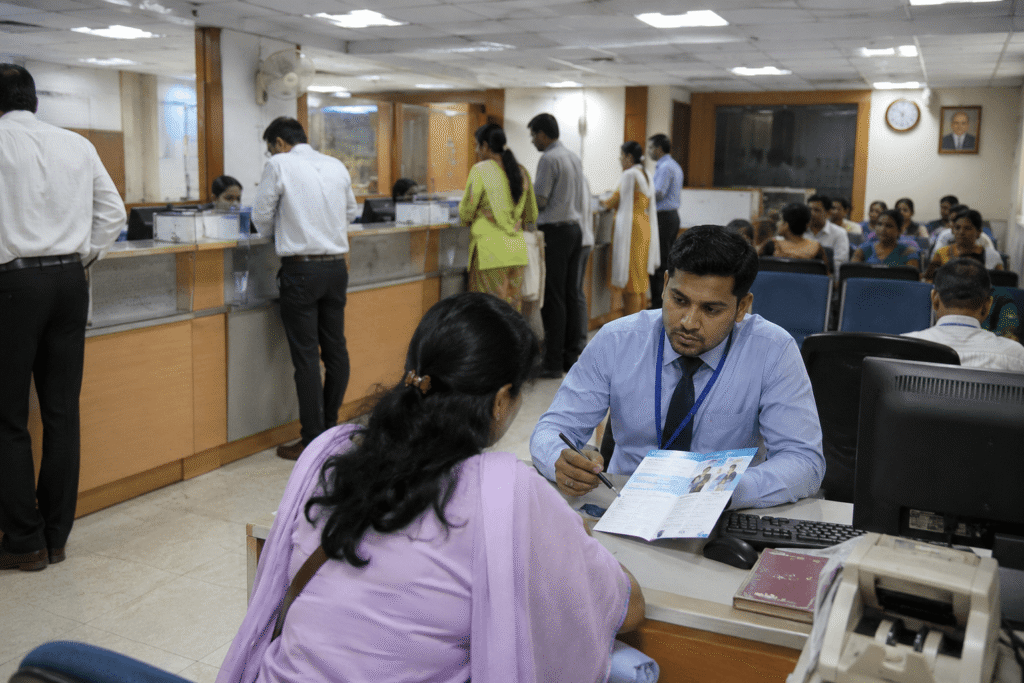
Public Banks: Public sector bank branches have become a key touchpoint for insurance sales across India. AI-generated image
New Delhi — Public banks: When a public sector bank sells a customer a government-mandated accident insurance policy, the business typically goes to a state-owned insurer. But when that same bank customer takes out a home loan or a car loan and needs insurance to go with it — the more lucrative business — it usually goes to a private insurer instead. That’s the picture painted by testimony before Parliament’s Committee on Public Undertakings, in a finding that raises uncomfortable questions about whether India’s own public banks are quietly disadvantaging India’s own public insurers.
Public banks: “Anti-selection”
The complaint came directly from The New India Assurance Company Limited (NIACL), the only one of India’s four public sector general insurers (PSGICs) currently maintaining a healthy solvency position, during the Committee’s examination of insurance-sector CPSUs.
NIACL’s representatives told the panel that public sector banks route the Pradhan Mantri Suraksha Bima Yojana (PMSBY) — the government’s ₹12-a-year accident cover scheme — to PSGICs almost by default, because private insurers show little appetite for it. But when it comes to insurance bundled with loans — the segment banks and insurers actually want — the flow reverses. In NIACL’s own words, submitted to the Committee: “Our bancassurance share is an abysmal one per cent.” The company’s ask was blunt too — it wants that figure closer to 20%.
The Committee’s report frames this pattern using NIACL’s own term for it: anti-selection. Public banks, in effect, hand PSGICs the low-margin, obligatory social-welfare business while steering the commercially attractive loan-linked policies toward private tie-ups.
The 1% figure comes from NIACL’s testimony specifically, not from a separately verified, company-by-company breakdown of all four PSGICs. The Committee’s own recommendations, however, extend the concern to PSGICs as a group — describing “the current engagement with private insurers for commercially optimal loan-linked products” as an opportunity PSGICs collectively are missing out on.
Public banks: LIC tells a similar story
The pattern isn’t confined to general insurance. Data furnished separately by Life Insurance Corporation of India (LIC) — India’s largest and only public sector life insurer — shows just how marginal the bancassurance channel has historically been for the public sector giant. LIC’s own channel-wise breakdown, submitted to the Committee, shows bancassurance contributing only 2.82% of its First Year Premium Income (FYPI) in FY 2019-20, dipping to 2.63% in FY 2021-22, and climbing gradually to 4.13% in FY 2024-25 — a level LIC itself has called inadequate.
The Corporation has now set a formal target of crossing 10% bancassurance share by FY2028, an implicit admission that public-sector banks have not been a meaningful growth channel for the country’s own life insurance behemoth. Over the same period, agents remained LIC’s overwhelming channel, still accounting for over 93% of FYPI as of FY24, even as the company’s overall market share slid from 50.46% to 37.46%.
Also Read: PB Fintech Shares Rise as Net Profit Jumps 92% to ₹163 Crore
Public banks: Where the money actually goes
A recent analysis of bank annual reports for FY26 found that India’s leading private and public sector banks together earned more than ₹20,000 crore in brokerage and commission from selling insurance policies in FY26 alone.
The breakdown shows exactly where that skew lives. HDFC Bank, India’s largest private lender, earned ₹5,688 crore in commission and fee income from life insurance distribution and a further ₹1,239 crore from health and general insurance — nearly ₹6,927 crore in total. ICICI Bank earned ₹2,882 crore from life insurance distribution and ₹1,186 crore from health and general insurance, a combined ₹4,068 crore. HDFC Life sourced 58% of its ₹14,635 crore individual annualised premium equivalent through the bancassurance channel in FY26 alone — a figure that dwarfs LIC’s 4.13%.
Among public sector banks, State Bank of India — the country’s largest lender — earned ₹2,795 crore in insurance commission in FY26, up 19.26% from the year before. But the composition of that number tells its own story: a full 85%, or ₹2,384.63 crore, came from distributing policies of SBI Life — SBI’s own, separately listed, majority-privately-owned insurance subsidiary. Other public banks trail far behind: Punjab National Bank earned ₹438.67 crore (down 8.61% year-on-year), Union Bank of India ₹475.45 crore (down 10.77%), Indian Bank ₹190.65 crore, and smaller lenders like UCO Bank and Punjab & Sind Bank in the range of ₹30-70 crore each.
The pattern that emerges: even the public sector banks that dominate India’s branch network are, for the most part, monetising insurance distribution through their own bank-promoted insurance arms or private tie-ups — arms and partners that are increasingly run on commercial, shareholder-driven logic rather than any obligation to prioritise sister public sector insurers like NICL, OICL, UIICL or GIC-backed products.
Public banks: What the Committee wants
The panel’s recommendation is aimed squarely at closing this gap. It has asked the Department of Financial Services (DFS) to work jointly with the Reserve Bank of India and IRDAI to issue clear guidelines ensuring public sector banks distribute mandatory social protection scheme business more equitably across all insurers — not just PSGICs — and, crucially, that PSGICs get fair access to the loan-linked insurance business that the report says currently flows primarily to private bancassurance tie-ups.Separately, the Committee also pushed DFS to explore performance-linked compensation structures for PSGIC leadership and specialist roles, on the reasoning that public insurers cannot compete for underwriting, actuarial and technology talent while being structurally locked out of their most profitable potential distribution channel.
Public banks: The bigger picture
Strip away the acronyms, and the story is a simple one: state-owned banks, sitting on India’s largest customer base, are commercially incentivised to sell insurance products that make them the most money — and increasingly, that means products from their own subsidiaries or private partners, not from India’s public general insurers or LIC. The Committee’s intervention amounts to an acknowledgment that market forces alone will not close this gap, and that it may take a regulatory push from RBI and IRDAI — not just goodwill between public sector entities — to get public money flowing back toward public insurers.