Investing via UPI in stocks, mutual funds? Here’s what Costs More Under the New MDR Rule
UPI investments in stocks and mutual funds could become costlier under the new MDR rule. Here’s what investors need to know about the charges.
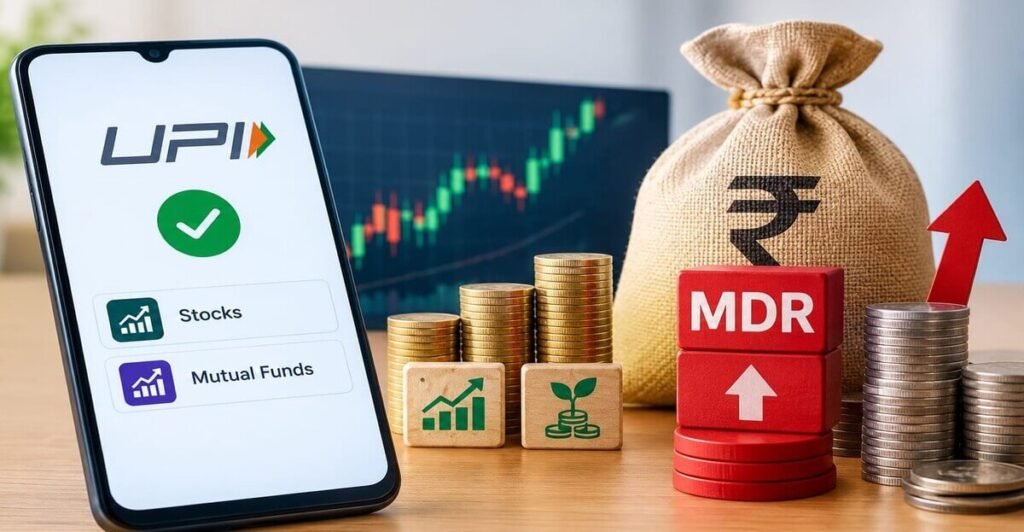
UPI investments in stocks and mutual funds could become costlier under the new MDR rule. Here’s what investors need to know about the charges.
New Delhi, UPI: India’s new Merchant Discount Rate (MDR) framework for UPI, set to take effect from 15 October 2026, includes a dedicated fee slab for capital market transactions. Payments made via UPI toward mutual funds, stockbroking accounts, securities dealers, and broker wallet top-ups will now attract an MDR of 0.02%, capped at ₹300 per transaction, whenever the payment amount exceeds ₹2,000. The rate and cap were confirmed in a Frequently Asked Questions (FAQ) document released by the National Payments Corporation of India (NPCI) alongside a broader Press Information Bureau (PIB) release on the UPI MDR overhaul.
UPI: What the Capital Market MDR Covers
The 0.02% rate applies specifically to a category NPCI has defined as Capital Market transactions. This includes fund transfers executed via UPI for equity buying, debt market investments, mutual fund purchases, and top-ups to broker wallets. The framework covers all regulated entities operating in this space, including Asset Management Companies (mutual fund houses), SEBI-registered stockbrokers, securities dealers, and investment platforms.
NPCI’s FAQ states that this tier was intentionally set lower than the standard 0.4% MDR applicable to general person-to-merchant (P2M) transactions, in order to support continued retail participation in formal financial markets. By comparison, the standard merchant rate on P2M payments above ₹2,000 is 0.4%, while capital market transactions are charged at roughly one-twentieth of that rate.
Also Read: NPCI Sets Flat ₹5 UPI Fee on Insurance Premiums as New MDR Regime Kicks In
UPI: How the Fee Is Calculated
The MDR on capital market payments is charged only above the ₹2,000 threshold, and is capped at ₹300 regardless of transaction size. This means the fee scales as follows:

For example, a ₹50,000 mutual fund lump-sum purchase via UPI would attract an MDR of ₹10, based on the 0.02% rate. Once the transaction value crosses roughly ₹15 lakh, the fee stops rising and stays fixed at the ₹300 ceiling, regardless of how much larger the payment is.
UPI: Who Actually Pays: Investor or Platform
Under the framework, MDR is structured as a cost borne by the receiving entity — the mutual fund house, brokerage, or dealer — rather than a charge deducted directly from the investor’s payment. The broader PIB release states that banks have been advised to ensure merchants do not pass MDR charges on to customers, and that UPI application providers are barred from levying platform fees or hidden charges of their own. NPCI’s FAQ document does not specify a separate pass-through rule for capital market entities distinct from this general provision.
The capital market MDR sits alongside other newly introduced fee categories in the same framework, including a flat ₹5 charge on transactions above ₹2,000 in sectors such as railways, telecom, insurance, and fuel, and the standard 0.4% rate on general P2M payments above ₹2,000, capped at ₹300 for transactions of ₹75,000 and above.
Implementation Timeline
The finalized MDR framework, including the capital market rate structure, takes effect from 15 October 2026. NPCI has stated this timeline is intended to give acquiring banks, payment aggregators, fintech applications, and corporate accounting platforms time to update their software and billing systems ahead of the rollout. The operational parameters and category-wise caps were determined by the UPI and Services Steering Committee, headed by NPCI, under the Payment and Settlement Systems Act, 2007.