3 of 4 public general insurers are technically insolvent, Parliament panel gives govt six months to fix that
General Insurers: Three of India’s four public sector general insurers are technically insolvent, a Parliamentary panel has found.
3 of 4 public general insurers are running below the required solvency margin — and Parliament wants it fixed in six months. AI Generated Image.
New Delhi — General Insurers: Three of India’s four government-owned general insurance companies have been operating below the regulatory solvency floor for the last three financial years, kept afloat largely by gains on their equity portfolios rather than by the business of insuring people, according to a Parliamentary panel report tabled in the Parliament on Thursday.
The 32nd Report of the Committee on Public Undertakings (2026-27), chaired by BJP MP Baijayant Panda, reviewed the performance of India’s seven insurance-sector Central Public Sector Undertakings (CPSUs) over a two-year examination that began in February 2025.Its findings on the four public sector general insurers — National Insurance Company Limited (NICL), Oriental Insurance Company Limited (OICL), United India Insurance Company Limited (UIICL) and The New India Assurance Company Limited (NIACL) — paint a picture of a segment that has returned to accounting profitability while its core underwriting business keeps bleeding money.
Also Read: PB Fintech Shares Rise as Net Profit Jumps 92% to ₹163 Crore
General Insurers: The numbers
Insurers are required by the IRDAI to maintain a solvency ratio — a measure of how much capital they hold against their liabilities — of at least 1.50. Committee data, furnished by the Department of Financial Services (DFS), shows that NICL, OICL and UIICL have all been in negative territory since FY 2022-23:
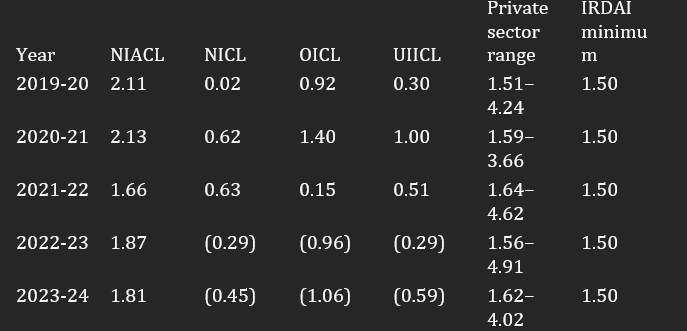
OICL’s solvency ratio has been negative since FY22, and by FY24 stood at -1.06 — the weakest of the three. NIACL is the outlier of the four, staying comfortably above the regulatory floor throughout. Private-sector general insurers, by contrast, have never dropped below 1.51 in the same period.
The Committee notes that between FY 2019-20 and FY 2023-24, the four PSGICs collectively racked up underwriting losses of approximately ₹96,861 crore. In FY24 alone, a combined underwriting shortfall of ₹18,862 crore was almost exactly offset by investment income of ₹18,035 crore — income drawn largely from the companies’ equity holdings rather than from premiums minus claims.
Government capital infusions of ₹17,450 crore were pumped into three of the four companies — NICL (₹9,275 crore), OICL (₹4,420 crore) and UIICL (₹3,755 crore) — between 2019-20 and 2021-22. NIACL received none. No further infusions have been made since 2022-23, and the report notes the government has not sought budgetary support for the companies in the current or forthcoming Budget either.
Also Read: ‘No Insurance, No Fuel’: Supreme Court Cracks Down as 56% of Vehicles Run Uninsured
General Insurers: “Not actually facing any financial stress”
The report captures a DFS official telling the Committee that despite the numbers, the department views the situation calmly. According to the testimony recorded in the report, the official said this is the first time in seven or eight years that all four companies have turned profitable, and that “even though our solvency is below the IRDA prescribed level,” the companies are “not actually facing any financial stress” — pointing to their investment corpus and healthy balance sheets as reasons the government has not sought fresh budgetary support.
IRDAI’s own submission to the Committee is more measured. The regulator confirmed it is “aware of the negative solvency situation in three of the four PSGICs,” and said it had granted forbearance specifically on the Fair Value Change Account — an accounting mechanism that lets insurers count unrealised gains on their large equity holdings toward solvency. But the regulator was explicit that this relief is temporary: it expects the companies to reach positive solvency “through sustained profitability improvements,” not through accounting relief alone.
General Insurers: Why the losses keep happening
The Committee’s report traces the underwriting losses to two lines of business PSGICs cannot walk away from: Motor Third Party (TP) insurance, which insurers are legally required to sell to any vehicle owner who seeks it, and health insurance, particularly group mediclaim.
DFS told the Committee that Motor TP premiums have long been inadequate to cover the volume and severity of claims, a problem compounded by rising litigation, broader definitions of liability, and increasingly large court-awarded compensation — a trend officials described as “social inflation.”
The Committee’s own data shows the scale of the gap: PSGICs’ combined Incurred Claims Ratio (ICR) stood at 97.23% in FY24, compared with 76.49% for private insurers — meaning public insurers pay out ₹97 for every ₹100 of premium collected, against ₹76 for private players. In Motor TP specifically, the PSGIC ratio was 99.57% versus 73.30% for private insurers; in health, it was 103.16% versus 83.49% — meaning PSGICs are paying out more in health claims than they collect in health premiums.
The report also flags one-off shocks that hit the sector’s finances: the “One More Pension Option” scheme introduced in FY 2019-20, and a spike in claims from settling COVID-19-related policies.
General Insurers: A regulator’s warning on the horizon
Perhaps the most pointed exchange in the report concerns whether the government’s patience — and IRDAI’s forbearance — will last. Asked directly about a level playing field between public and private insurers, IRDAI told the Committee that while there is officially no regulatory distinction between the two, the regulator has historically extended “a little bit of leniency to the public sector in terms of the forbearance.” That, the regulator added, is changing: “now we are coming down very heavily on all.”
IRDAI also linked the solvency question to a bigger structural shift already underway — a move from the current factor-based capital framework, which applies uniform capital charges regardless of an insurer’s actual risk profile, to a Risk-Based Capital (RBC) regime that has been in development since 2021.
The regulator told the Committee it expects to publish the final RBC framework for consultation in FY 2025-26, with phased implementation starting FY 2027-28. For PSGICs sitting on large, high-quality equity portfolios, RBC could offer some relief by recognising the true economic value of those assets — but for insurers with concentrated risk in volatile segments like Motor TP and health, it “may require higher capital buffers.”
General Insurers: What the Committee wants done
The panel has given DFS a six-month deadline to produce a solvency restoration status report for each of the three PSGICs currently in negative territory, spelling out specific business-mix changes, profitability targets and technology investments each company will make to return to the 1.50 minimum.
It wants Board-approved restoration plans with quarterly milestones and independent review, jointly overseen by DFS and IRDAI. Notably, the Committee also recommends that any further government capital infusion be treated strictly as a last resort — to be considered only after companies have exhausted internal routes to improving solvency, such as repricing loss-making segments.
On that front, the report singles out NICL’s decision to start exiting persistently loss-making group mediclaim business as a model other PSGICs should consider following, rather than continuing to underwrite unprofitable policies just to protect market share.
General Insurers: The bigger picture
The report’s broader argument is that the current recovery is fragile precisely because it depends on market performance rather than the core business of pricing and settling insurance claims well. As the Committee puts it, profitability driven predominantly by investment income, while encouraging in the short term, “cannot substitute for sustained improvement in core underwriting performance.” With India’s equity markets having delivered strong returns in recent years, that dependency has been masked. A prolonged market downturn — or the RBC transition exposing the true risk-adjusted picture — could bring the solvency question back to the surface in a way that is harder to explain away.
This article is based on the 32nd Report of the Parliamentary Committee on Public Undertakings (2026-27), “Review of Performance of Insurance Sector CPSUs,” presented to the Lok Sabha and laid in the Rajya Sabha on 6 August 2026.








1 thought on “3 of 4 public general insurers are technically insolvent, Parliament panel gives govt six months to fix that”