How much does health insurance cost in India? A complete 2026 breakdown
Health insurance costs in India vary sharply by age, city and cover type, with premiums up over 27% in early 2026. A breakdown of what drives your premium and what the September 2025 GST exemption really means for buyers.

Health insurance premiums in India range from ₹10,000 for young buyers to ₹80,000 for seniors. GST on individual policies is now zero — but rising medical costs mean premiums keep climbing anyway.
New Delhi: Health insurance premiums in India vary sharply by age, city, sum insured and family size, with young individuals paying as little as ₹10,000 a year for a ₹15 lakh cover while senior citizens can pay ₹60,000–₹80,000 annually for similar coverage, according to industry pricing data. The cost picture shifted for retail buyers after the 56th GST Council meeting, chaired by Finance Minister Nirmala Sitharaman, exempted individual health insurance premiums from GST entirely — bringing the rate down from 18% to 0% — effective September 22, 2025.
Health Insurance: The current price bands
For a young, healthy individual, an annual premium of ₹10,000 to ₹15,000 typically buys a ₹15 lakh sum insured, according to health insurance advisory platform Ditto. Family floater plans covering four members with similar coverage generally cost ₹30,000 to ₹45,000 a year. At the senior end of the market, premiums climb steeply — Star Health data puts annual costs for senior citizens between ₹25,000 and ₹40,000, while Ditto’s estimates for the same segment run as high as ₹60,000–₹80,000 depending on the insurer and add-ons selected. Given the spread across sources, these figures should be treated as indicative ranges, with exact quotes confirmed directly with insurers.
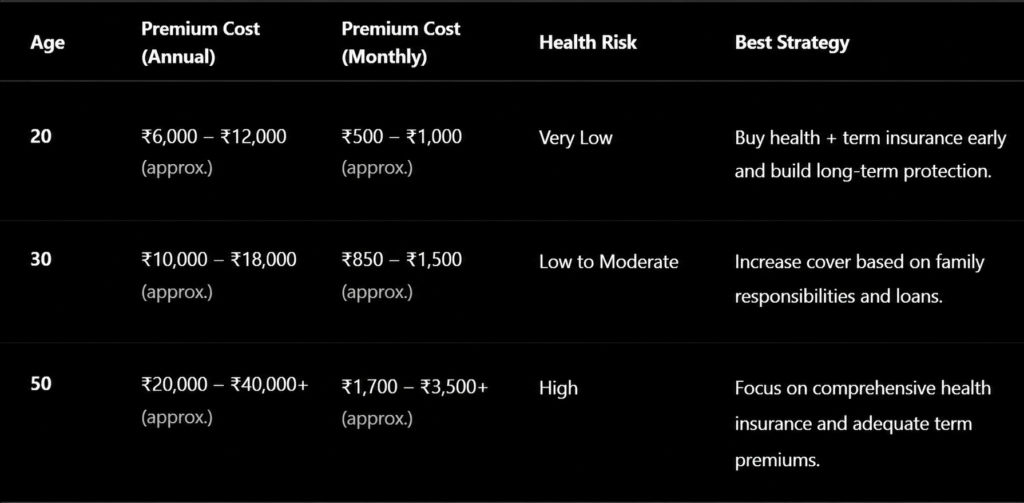
Age-wise data from comparison platform PolicyX illustrates the scale of the age-based gap: a 26-year-old can secure a ₹5 lakh sum insured plan for roughly ₹10,068 a year, while a 56-year-old buying the same coverage pays close to ₹26,970 — nearly two-and-a-half times more for identical protection.
Health Insurance: Why premiums are rising even as tax falls to zero
Health insurance premiums in India grew 27.17% year-on-year in January 2026 to ₹5,414.54 crore, according to data cited by Angel One and reported by Insurance Business. Standalone health insurers recorded the sharpest growth, with premiums up 32.3% to ₹3,226.56 crore, while general insurers’ health premiums rose 20.4% to ₹2,187.98 crore. Retail health premiums increased 27% year-on-year, outpacing group health plans, which grew 10% — indicating individual and family buying is currently outpacing employer-provided cover.
Government-backed health schemes also expanded, with gross written premium from these schemes reaching ₹2,480 crore in January 2026, up 37.78% from ₹1,800 crore a year earlier, reflecting continued rollout of programmes such as Ayushman Bharat aimed at lower-income and rural populations.
Underlying this growth is medical inflation, estimated at 10-12% for 2026 according to Star Health, driven by rising hospitalisation charges, costlier treatments and increased demand for quality care — a trend that continues to push base premiums up even as the tax component has been removed entirely for individual buyers.
Also Read: PB Fintech Shares Rise as Net Profit Jumps 92% to ₹163 Crore
Health Insurance: The GST exemption, correctly explained
Prior to September 2025, health insurance premiums attracted an 18% GST — 9% CGST plus 9% SGST or IGST — a rate long criticised by industry bodies and IRDAI as a barrier to insurance penetration. At its 56th meeting in September 2025, the GST Council announced a full exemption on individual health and life insurance premiums, effective September 22, 2025. The exemption covers individual, family floater and senior citizen health policies, along with related reinsurance services, and applies to both new purchases and renewals made on or after that date.
Group health insurance, including employer-provided corporate cover, continues to attract 18% GST and was not covered by the exemption. Policies purchased or renewed before September 22, 2025 remained subject to the earlier 18% rate until their next renewal cycle. Insurers are expected to pass the exemption’s benefit on to policyholders, with anti-profiteering provisions monitoring compliance, according to consumer-facing insurer communications reviewed by The Insurance Reporter.
Health Insurance: What actually determines your premium
Insurers price health cover based on a combination of factors rather than a flat rate:
- Age — the single biggest driver; premiums rise steeply after 45 and again after 60
- Sum insured — higher cover costs more, though premiums do not rise proportionately, making larger sums often better value per lakh of coverage
- Individual vs family floater — a combined family plan is typically cheaper than separate individual policies for the same members; PolicyX data shows a saving of roughly ₹5,659 on a joint plan versus two individual ones for a young couple
- City and lifestyle risk — metro-based buyers and those with lifestyle-linked health risks generally pay more due to higher local treatment costs
- Add-ons — maternity cover, critical illness riders and similar benefits increase the base premium
Bottom line for buyers
Industry advisories consistently note that buying early locks in lower premiums, since age is the primary determinant of cost and rates rise with each passing year. Comparing plans on deductibles, sub-limits, hospital network and portability — not premium alone — remains the standard recommendation across insurers, since a cheaper plan on paper can carry higher out-of-pocket costs at the time of a claim.