Supreme Court on ₹45,000 Crore Challan Backlog: Add Dues to Electricity Bills, Impound Vehicles
Supreme Court has also suggested vehicle impounding as authorities explore tougher ways to recover long-pending traffic challans and improve compliance.
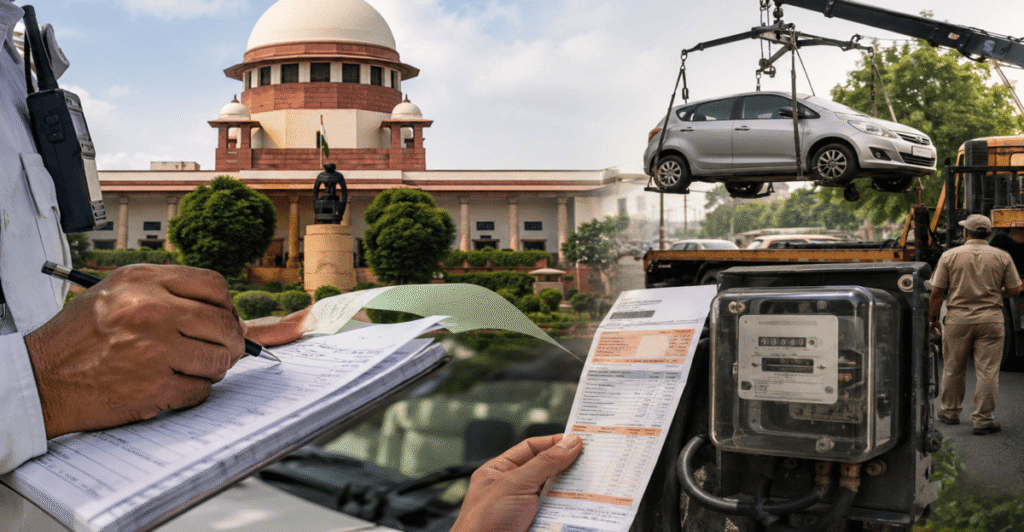
Supreme Court has sought stronger measures to recover the massive ₹45,000 crore challan backlog, including linking unpaid dues to electricity bills.
NEW DELHI, Supreme Court: By the figures placed before the Supreme Court this week, Indian authorities have issued traffic e-challans worth about ₹45,000 crore and collected about ₹25,000 crore of it. The remaining amount, roughly ₹20,000 crore, is still owed.
A bench led by Justice JB Pardiwala responded by suggesting that authorities find enforcement routes beyond issuing notices. Among them was adding unpaid challans to defaulters’ electricity bills, so that non-payment could put the power connection at risk. The remarks were made orally during a hearing.
“Work it out. In this country, you have to find a way out,” the court said, according to accounts of the hearing.
The court observed that authorities must take concrete steps on the ground to recover unpaid traffic challans, and that merely issuing e-challans is not enough. It also questioned how effective e-challans are on their own. Justice Pardiwala said that if people do not pay, authorities could explore recovering the amount by linking it to other government dues, including electricity bills. The observation was reported by Bar and Bench, which quoted the court as saying: “If people are not paying traffic challans, add it to their electricity dues bill. They’ll have to pay the electricity bill, otherwise the power line will be disconnected.”
Supreme Court: Not just sufficient to keep issuing e-challans
Justice Pardiwala said it was not enough for police to keep issuing e-challans, “thousands and lakhs” of them. The question, he said, was recovery of the fines the challans impose.
The court said it had been informed that States and Union Territories had to recover ₹45,000 crore in e-challan fines, of which ₹25,000 crore had been recovered so far. It said authorities needed to work at the ground level, keeping ground realities in mind.
Also Read: IRDAI’s insurance distribution paper is a solution in search of a problem
The bench described the current process. An e-challan is ordinarily sent to a particular court for recovery, the person appears, and the fine is paid. What is expected of authorities, it said, goes beyond that.
Supreme Court – The measures the bench listed
The court set out a series of steps that authorities could take against vehicles and owners with unpaid challans:
Registration and vehicle records: Bar renewal of the registration certificate, issue of duplicate certificates, and updating of owner details.
Fitness certificates: Do not issue them until all challans are cleared.
Parivahan portal: Blacklist the vehicles concerned on the portal and block ownership transfers.
Driving licences: Suspend renewals, and take measures to suspend licences already in force.
PUC certificates: No centre should be permitted to issue a Pollution Under Control certificate to such vehicles.
Roadside checks: Random checking of vehicles, with the vehicle impounded where an e-challan has not been honoured.
On the electricity proposal, the bench said unpaid traffic challans could be added to the defaulter’s electricity dues bill, and that consumers would then have to pay the bill or face disconnection of the power line.
Supreme Court: What is and is not on record
The remarks were oral suggestions made during a hearing. The reports available so far do not describe a formal order or binding directions. Any directions would depend on the written order, and on the States and Union Territories that would have to implement them. Electricity distribution and vehicle registration are administered by separate authorities, and the reports do not say how any such linkage would work.