PMFBY: A Rejected Tender and an Unpaid Bill — Why Gujarat and Telangana Never Came Back
PMFBY is a government-backed crop insurance scheme for farmers. It provides financial protection against crop losses caused by natural calamities and adverse weather.
PMFBY provides crop insurance protection to farmers against losses caused by weather and other risks. The scheme has faced implementation challenges in states such as Gujarat and Telangana.
NEW DELHI — PMFBY: Ten years after Prime Minister Narendra Modi launched the Pradhan Mantri Fasal Bima Yojana as India’s answer to crop-failure risk, the scheme is running in 25 of the country’s 36 states and union territories — leaving out two of its largest agricultural economies, Gujarat and Telangana, according to data placed before the Lok Sabha on August 11.
The government’s own numbers show the scale of what these two states sit outside of. Over the last five years, PMFBY and its companion scheme, the Restructured Weather Based Crop Insurance Scheme (RWBCIS), have collected Rs 18,352 crore in premium from farmers nationally and paid out Rs 86,732 crore in claims — nearly five times what farmers put in, with the difference made up by central and state government subsidy. State-run Agriculture Insurance Company of India alone processed close to 43 percent of all claims paid, Rs 38,560 crore of the national total, underlining how much of the scheme still runs through a single public insurer even though 16 companies, public and private, are empanelled to sell it.
The question that surfaced these numbers was one of several on PMFBY that came up during the Monsoon Session of Parliament, which ran from July 20 to August 13 and concluded last week. Separate questions in the same session pressed the ministry on claim-settlement delays for flood-hit farmers in Uttar Pradesh’s Shravasti and Balrampur districts, and on the government’s preparedness for a below-normal monsoon under El Niño conditions — an unusually high volume of scrutiny for a single scheme, and a sign of how central crop insurance remains to MPs’ concerns from farm belts across the country.
Also Read: PMFBY Claims Uttar Pradesh: Govt Says No CCE Discrepancy, 98.93% Settled
PMFBY: Six States, One Scheme, Six Exits
In its reply to an unstarred question from DMK MP R Sachithanantham, the Ministry of Agriculture and Farmers Welfare confirmed that Andhra Pradesh, Bihar, Gujarat, Jharkhand, Telangana and West Bengal have all opted out of PMFBY at various points since its 2016 launch. Andhra Pradesh, Jharkhand and West Bengal have since rejoined, and the ministry said Bihar has also decided to return. That leaves Gujarat and Telangana as the only two of the original six still outside the scheme as Kharif 2026 enrolment gets underway.
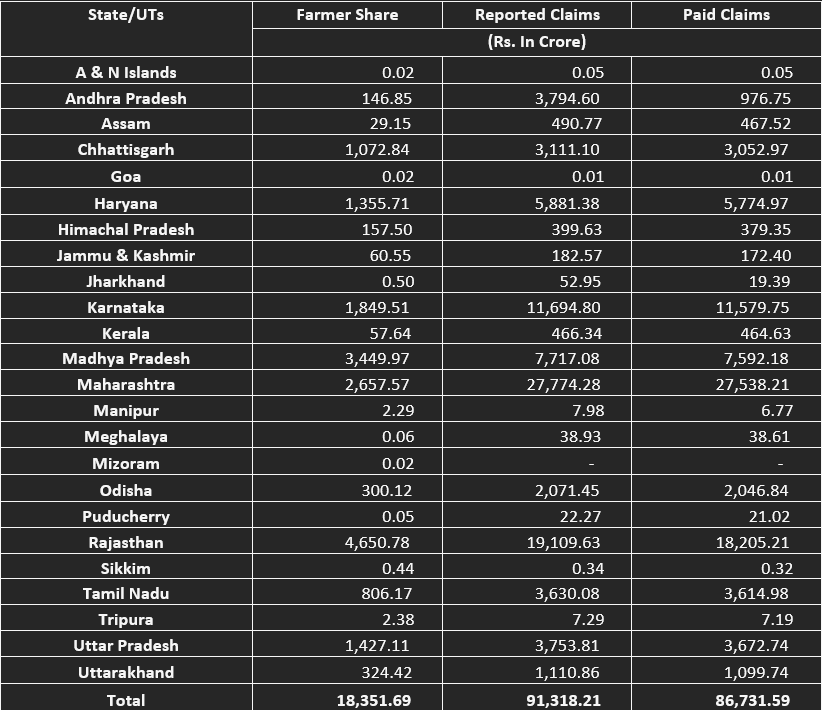
Source – Parliamentary Panel
The pattern isn’t new, but it has hardened. Bihar, West Bengal and Jharkhand left earliest, in the years immediately following launch. Andhra Pradesh, Telangana and Gujarat followed later, around 2019-2020, when the scheme was revamped and states were given the option to walk away instead of implementing it on the Centre’s terms.
PMFBY: Why Gujarat Left: The Price Insurers Wanted
Gujarat ran PMFBY for four seasons, insuring between roughly 8 lakh and 11 lakh farmers a year through 2019-20. When the state went out to tender for a fresh three-year insurance contract in 2020 under the scheme’s revised guidelines, insurance companies quoted premiums the state government judged too high to justify, and Gujarat chose not to award the contract. It has not implemented PMFBY since.
The episode has been read by some in the agriculture policy establishment as a warning sign for the scheme rather than an isolated local decision. A former senior Agriculture Ministry official was quoted in a 2024 report in BusinessLine as saying that Gujarat’s continued absence points to something wrong with PMFBY, given that the scheme was launched from the Prime Minister’s own home state. Unless the Centre addresses the concerns that pushed states like Gujarat out, the official said, the scheme risks becoming something states adopt only when they have no better alternative, rather than one they choose on its merits.
PMFBY: Why Telangana Left: Unpaid Bills
Telangana’s exit followed a different route. The state’s share of the premium subsidy went unpaid for the 2018-19 and 2019-20 crop seasons, and it was this backlog — not a rejection of the scheme’s design — that led Telangana to stop notifying PMFBY from 2020-21 onward, according to prior agriculture ministry disclosures. A change of government in the state in December 2023 briefly revived talk of a return: officials told BusinessLine in April 2024 that Telangana had conveyed its intention to rejoin in time for that year’s Kharif season. That return has not materialised — the state remains off the list of 25 implementing states in the Centre’s latest reply, more than two years later.
Also Read: PM Kisan Samman Nidhi Yojana: 2026 Guide to Eligibility, Installments & Registration
PMFBY: A Scheme Built on Fine Print
The Lok Sabha replies reviewed for this story point to a recurring set of frictions behind these exits and the broader dissatisfaction that trails the scheme even in states that have stayed in: delayed release of a state’s share of the premium subsidy, disputes between state governments and insurance companies over yield data, and gaps in farmers’ bank account details that hold up payouts long after claims are approved. The ministry has in the past told Parliament that these three issues — state payment delays, yield disputes, and banking data errors — are the primary reasons claims remain pending even in states actively running the scheme.
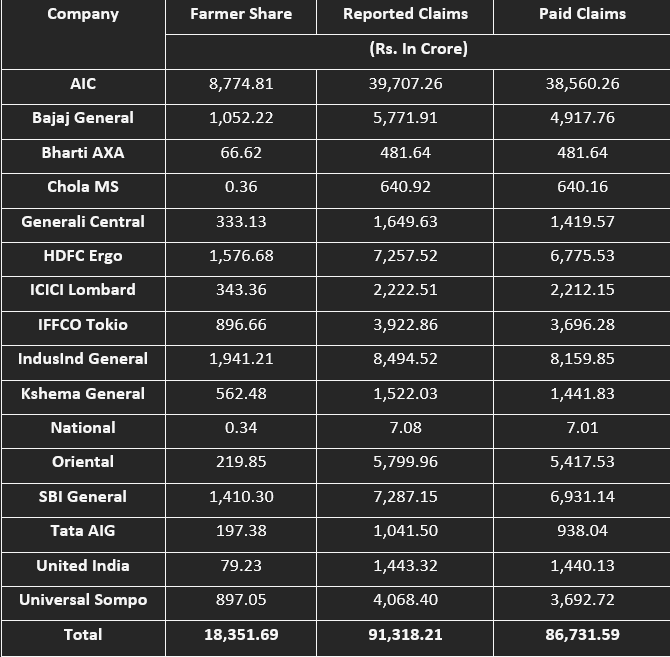
Source – Parliamentary Panel
The Centre has since introduced penalties meant to address at least the first of those frictions: from Kharif 2025, states that delay releasing their premium share face the same 12 percent penalty already imposed on insurance companies for late claim payments, and states must now deposit their share in an escrow account in advance. Whether that changes the calculus for Gujarat and Telangana specifically is not addressed in the government’s reply.
PMFBY: The National Picture
Punjab, notably, has never implemented PMFBY at all, citing near-total irrigation coverage that its government has argued makes the scheme’s core risk protection less relevant to its farmers. Between the states that never joined and the two still outside after leaving, PMFBY’s claim to being a pan-India scheme continues to run up against a handful of states where either the price insurers charge, or the price governments are willing to pay, hasn’t yet lined up.