PM Kisan Samman Nidhi Yojana: 2026 Guide to Eligibility, Installments & Registration
PM Kisan Samman Nidhi Yojana gives farmers ₹6,000 a year in three installments. Here’s a complete 2026 guide to eligibility, registration, e-KYC, and the latest installment updates.
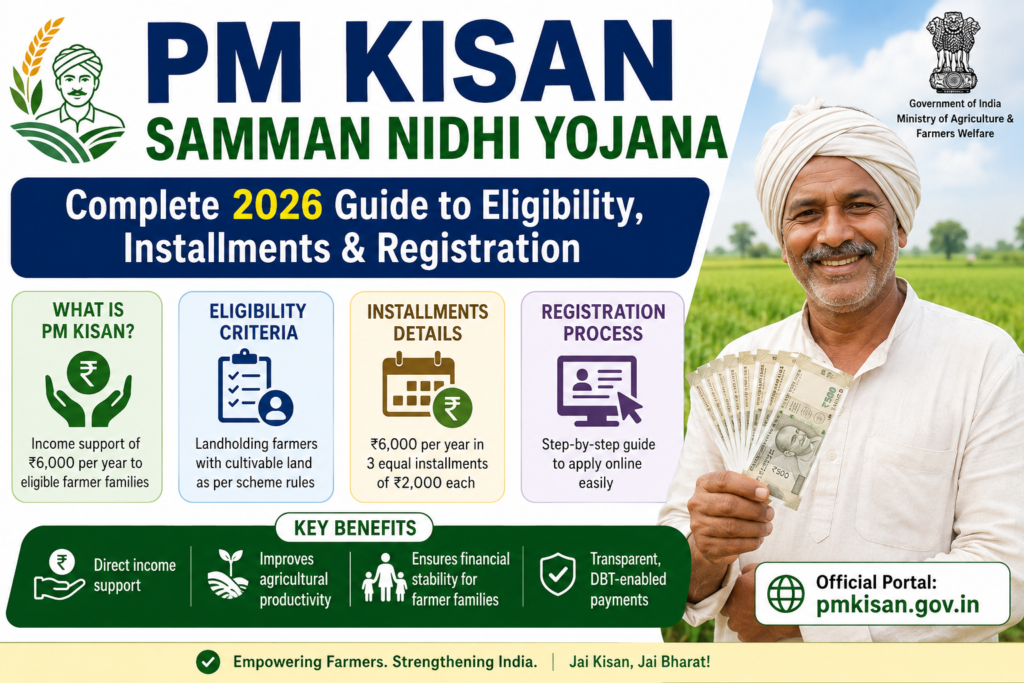
A farmer stands in a lush agricultural field, symbolizing the PM Kisan Samman Nidhi Yojana, India's flagship income support scheme that provides eligible farmer families with direct financial assistance through periodic installments.
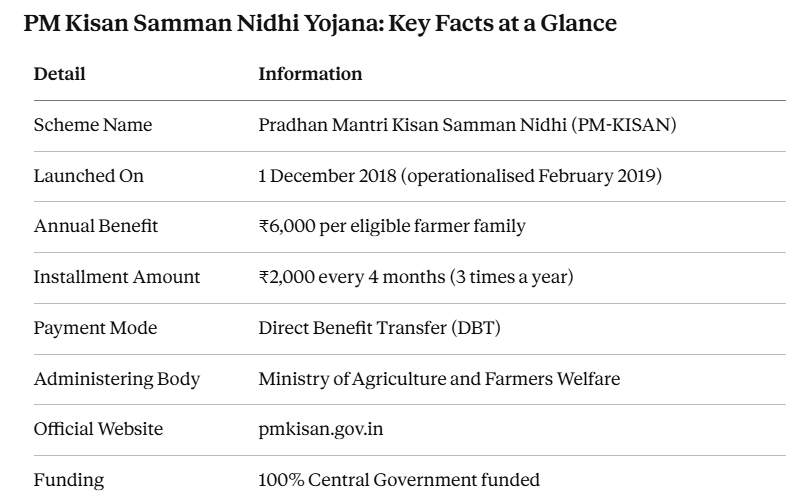
PM Kisan Samman Nidhi Yojana, commonly known as PM-KISAN, is one of the Indian government‘s largest direct income support schemes for farmers. Launched by Prime Minister Narendra Modi, the scheme provides ₹6,000 per year to eligible landholding farmer families, transferred directly into their bank accounts in three equal installments of ₹2,000 each, once every four months.
The scheme is fully funded by the Government of India and administered through the Ministry of Agriculture and Farmers Welfare, using a Direct Benefit Transfer (DBT) system that sends money straight to a farmer’s Aadhaar-linked bank account — cutting out middlemen and reducing delays or leakages.
If you’re a farmer trying to understand whether you qualify, how to register, or why your installment hasn’t arrived, this guide covers everything you need.
When Was PM-KISAN Launched and Why?
The scheme was formally launched on 24 February 2019 from Gorakhpur, Uttar Pradesh, though it was approved by the Union Cabinet on 1 December 2018. It was initially designed for small and marginal farmers — those owning up to 2 hectares of land — but was expanded in June 2019 to cover all landholding farmer families, regardless of the size of their landholding, subject to certain exclusion criteria.
The core objective is straightforward: supplement farmers’ income so they can meet the cost of agricultural inputs like seeds, fertilizers, and equipment, while reducing dependence on informal, high-interest moneylenders.
PM Kisan Eligibility Criteria: Who Can Apply?
To receive the ₹2,000 installment, a farmer family must meet the following eligibility requirements:
- The family (defined as husband, wife, and minor children) must collectively own cultivable agricultural land
- Land must be registered in the farmer’s name as per state or revenue land records
- The farmer must have a valid Aadhaar card linked to their bank account
- The bank account must be NPCI-seeded (a separate step from simple Aadhar-bank linking — more on this below)
- The farmer must have completed e-KYC verification on the PM-KISAN portal
Who Is Excluded from PM-KISAN Benefits?
Even if you own farmland, you are not eligible if you fall under any of these categories:
- Institutional landholders — companies, trusts, and registered societies owning agricultural land
- Constitutional post holders — serving or former Presidents, Vice Presidents, Prime Ministers, Governors, Chief Ministers, and judges
- Elected representatives — serving or former MPs, MLAs, mayors, and district panchayat chairpersons
- Government employees — serving or retired Central/State Government employees, PSU staff, and local body employees (excluding Multi-Tasking Staff, Class IV, and Group D employees)
- Pensioners receiving a monthly pension of ₹10,000 or more (with some exceptions)
- Income tax payers in the previous assessment year
- Professionals such as doctors, engineers, lawyers, and chartered accountants practicing professionally
How to Register for PM Kisan Samman Nidhi Yojana
You can register through three channels: the official website, the mobile app, or in-person at a Common Service Centre (CSC).
Online Registration via the PM-KISAN Portal
- Visit the official website: pmkisan.gov.in
- Go to the “Farmers Corner” section and click “New Farmer Registration”
- Choose either “Rural Farmer Registration” or “Urban Farmer Registration”
- Enter your Aadhaar number, select your state, and enter the captcha code
- Click “Search” — if you’re not already registered, you’ll be prompted to proceed
- Fill in your personal details, bank account information, IFSC code, and land records
- Submit the form — your state government will then verify and process the application
Registration via the PM-KISAN Mobile App
- Download the PM-KISAN app from the Google Play Store
- Select your preferred language and tap “New Farmer Registration”
- Enter your Aadhaar number and captcha, then continue
- Fill in the same details as the web registration and submit
Offline Registration
Visit your nearest Common Service Centre (CSC) or block-level agriculture office, where staff can help complete your registration using your Aadhaar and land documents.
Understanding e-KYC and NPCI Seeding (Common Reasons Payments Get Delayed)
Two of the most common reasons farmers don’t receive their installment on time are incomplete e-KYC and missing NPCI seeding — and these are often confused with each other.
e-KYC (Know Your Customer)
e-KYC is now mandatory for every PM-KISAN beneficiary. It can be completed in three ways:
- OTP-based e-KYC — via Aadhaar OTP directly on the PM-KISAN website
- Biometric e-KYC — done in person at a Common Service Centre
- Face Authentication e-KYC — available through the PM-KISAN mobile app
NPCI Seeding
This is a separate and often-missed step. Simply linking your Aadhaar to your bank account is not enough — your account also needs to be mapped in the NPCI (National Payments Corporation of India) mapper for DBT payments to go through. If your installment is delayed despite having Aadhaar-bank linkage, visit your bank branch and request the “DBT / NPCI Aadhaar Seeding form” to fix the mismatch.
PM-KISAN Installment Schedule and Payment Cycle
Installments are paid on a structured four-month cycle, corresponding to three periods across the financial year:
- April to July
- August to November
- December to March
Recent installments have followed this general pattern:
- The scheme’s installments are typically released by the Prime Minister from a different state each cycle, with amounts credited directly to beneficiaries’ Aadhaar-linked bank accounts shortly after.
- Each cycle has disbursed roughly ₹18,000–19,000 crore to over 9 crore farmers nationwide, reflecting the scale of the program.
Note for readers: Since installment dates shift slightly each cycle and are officially confirmed only closer to release, always check the PM-KISAN portal or official government announcements for the exact next installment date rather than relying on projected dates.
How to Check Your PM Kisan Beneficiary Status
- Visit pmkisan.gov.in
- Go to “Farmers Corner” and click “Beneficiary Status”
- Enter your Aadhaar number, mobile number, or registration number
- Click “Get Data” to view your installment history, last credited amount, and current e-KYC/land verification status
If you’ve forgotten your registration number, use the “Know Your Registration Number” option on the portal, verify via OTP on your registered mobile number, and it will be displayed instantly.
Common Reasons for PM-KISAN Payment Delays
If your installment hasn’t arrived, it’s usually due to one of the following:
- Incomplete or pending e-KYC
- Aadhaar not linked to your bank account
- Bank account not NPCI-seeded
- Land record mismatch with revenue department data
- Missing Farmer ID (now mandatory in several states)
- Falling under one of the exclusion categories
Additional Benefits Linked to PM-KISAN
Beyond the direct cash transfer, PM-KISAN beneficiaries can access several linked benefits:
- Kisan Credit Card (KCC): PM-KISAN beneficiaries can avail short-term agricultural loans up to ₹3 lakh without collateral, at subsidized interest rates
- PM Fasal Bima Yojana (PMFBY): Many PM-KISAN beneficiaries are now auto-enrolled in this crop insurance scheme, with premium subsidies adjusted directly
- PM Kisan Maan Dhan Yojana (PM-KMY): A voluntary pension scheme that PM-KISAN beneficiaries above 18 can opt into directly through the portal
- Soil Health Card Scheme: Data from PM-KISAN registrations helps target soil testing camps for farmers
Frequently Asked Questions About PM Kisan Samman Nidhi Yojana
How much money do farmers get under PM-KISAN? Eligible farmer families receive ₹6,000 per year, paid in three installments of ₹2,000 each, credited roughly every four months.
Is e-KYC compulsory for PM-KISAN? Yes. e-KYC is mandatory for every beneficiary. Without it, your installment will not be processed, regardless of your eligibility status.
Can government employees receive PM-KISAN benefits? No, with limited exceptions. Serving or retired government employees are excluded, except for Multi-Tasking Staff (MTS), Class IV, and Group D employees.
What is the difference between Aadhaar-bank linking and NPCI seeding? Aadhaar-bank linking simply connects your Aadhaar number to your bank account. NPCI seeding is a separate mapping process required specifically for DBT payments like PM-KISAN to be processed successfully — having one does not guarantee the other is done.
Can I apply for PM-KISAN if my land is under a legal dispute? Generally yes, as long as your name appears in current revenue records, unless there’s an active court stay — in which case, consult a lawyer before proceeding.
What should I do if I lost my registration number? Use the “Know Your Registration Number” option on the PM-KISAN portal, verify your mobile number via OTP, and your registration number will be displayed.
The Bottom Line
PM Kisan Samman Nidhi Yojana remains one of India’s most significant direct income support programs for farmers, with crores of beneficiaries relying on its ₹2,000 installments to manage agricultural costs. The scheme’s success increasingly depends on farmers staying proactive — completing e-KYC, ensuring NPCI seeding, and keeping land records updated — since most payment delays stem from these administrative gaps rather than eligibility issues. Farmers are advised to regularly check their beneficiary status on the official PM-KISAN portal to avoid missing future installments.
This article will be updated as new installment dates and scheme updates are officially announced.