Acko’s Second EoM Breach in a Row: IRDAI Warns Insurer, Halts Expansion for Six Months
Acko: IRDAI has warned Acko over its second consecutive Expenses of Management (EoM) breach and restricted the insurer’s expansion for six months.
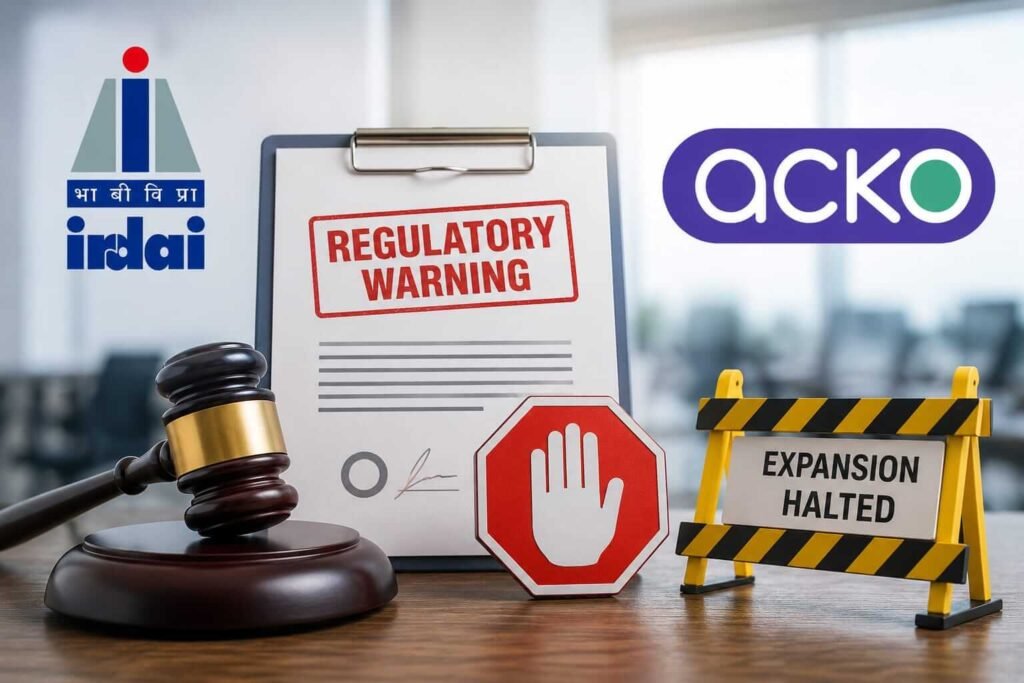
Acko:IRDAI has taken regulatory action against Acko following another EoM breach. The six-month expansion restriction puts the insurer’s compliance and financial discipline under renewed scrutiny.
New Delhi – Acko: Insurance regulator IRDAI has issued a formal warning to Acko General Insurance and barred it from opening new places of business for six months after the company breached its Expenses of Management (EoM) limits for the second consecutive year, according to an order issued on August 19, 2026.
For financial year 2024-25, Acko incurred operating expenses of Rs 985.15 crore against an allowable ceiling of Rs 650.37 crore—an overspend of Rs 334.78 crore, or 51% above the regulatory limit. This marks the second year running that Acko has exceeded prescribed expense thresholds, and IRDAI’s rejection of the company’s forbearance request signals a harder line on cost compliance.
Also Read: Who Pays When the AI Gets It Wrong? Inside the Race to Insure Artificial Intelligence
Acko: The Pattern: Repeated Non-Compliance Now Costly
The significance of IRDAI’s action lies not in the current-year breach alone, but in its escalation. Acko exceeded EoM limits in FY 2023-24 as well; when the company requested forbearance that year, IRDAI denied it. Faced with identical circumstances in FY 2024-25—lower-than-expected premiums and regulatory accounting changes—the insurer appealed for relief again. IRDAI declined a second time.
The cumulative effect matters. Acko had been granted five years of forbearance from FY 2018-19 to FY 2022-23, a grace period for its early operations. That window closed. By FY 2024-25, Acko was in its seventh year as an insurer—well beyond startup phase.
In January 2026, IRDAI sought explanation from Acko on its EoM limits. The company responded on January 27 and made further submissions during a personal hearing at IRDAI’s Hyderabad office on January 30. The regulator heard Acko’s arguments—slower industry growth (gross written premiums of Rs 2,067 crore vs. expected Rs 2,750 crore) and the impact of regulatory changes on 1/n premium recognition—and rejected them.
Acko: What Expenses of Management Covers
EoM includes all operating costs: salaries, technology, office infrastructure, and crucially, commissions paid to agents and distributors. When an insurer exceeds its EoM ceiling, the overspend cannot be passed to policyholders; it must be absorbed into the company’s Profit & Loss (Shareholders’) Account. IRDAI’s 2024 regulations set these limits based on percentages of gross written premium, with limits varying by business segment.
For general insurers like Acko, the framework is set out in Regulation 19 of the IRDAI (Expenses of Management, including Commission, of Insurers) Regulations, 2024. Acko’s actual expenses—Rs 985.15 crore—exceeded the allowable threshold by Rs 334.78 crore, which the company duly charged to shareholders’ funds.
Acko: Broader Enforcement Signal
Acko’s action comes as part of a wider regulatory tightening. On the same day, IRDAI barred Niva Bupa Health Insurance from opening new places of business for six months for identical non-compliance with EoM limits during FY 2024-25. The parallel enforcement suggests IRDAI is moving beyond warnings for expense breaches; restrictions on business expansion are now on the table.
Intensifying competition in India’s insurance sector has pushed up distribution costs, with commissions rising across the market. Both Acko and established players are caught in this squeeze. But IRDAI’s position is clear: rising costs are no excuse for breaching prescribed limits.
Acko: The Restrictions and Next Steps
Acko is barred from opening new branches until approximately February 19, 2027—six months from the order date. This freezes expansion plans at a critical time for the insurer, which has been scaling rapidly in recent years.
IRDAI has directed Acko to place the order before its Board of Directors at the next Board Meeting and submit minutes of that discussion within 15 days. The order notes that Acko may appeal before the Securities Appellate Tribunal under Section 110 of the Insurance Act, 1938, if it contests the regulator’s decision.
Acko: Why This Matters for Acko’s Growth Story
Acko was among the earliest digital-first general insurers in India, founded in 2016 and registered with IRDAI in September 2017. The company has positioned itself as a technology-driven challenger to legacy incumbents. Rapid growth and aggressive distribution expansion have been central to that narrative.
But the EoM framework forces a reckoning: growth cannot outpace cost management. In a competitive market where commissions rise to acquire customers, the regulatory ceiling becomes a hard constraint.