Car Insurance Policy Claim Ratios In India: A 5-Year Reality Check
Car insurance Policy claim ratios in India have shifted over the past five years. Here’s what the data shows about insurer performance and policyholder trends.
Car insurance Policy claim ratios in India have moved quite a bit over the last five years — some insurers are settling far more claims than others. We dug into the numbers.
Car Insurance Policy: Every new car insurance policy or renewal notice for a car insurance policy in India carries the same quiet promise: pay the premium, and when something goes wrong, the insurer picks up the bill. Five years of regulatory filings tell a messier story. Dig into the numbers insurers file with the Insurance Regulatory and Development Authority of India every year, and you find some of the country’s biggest names are, by one crucial measure, losing money on the very policies they sell — while others have quietly turned the same business into a much better bet than it was five years ago.
The number that tells this story rarely makes it into an advertisement. It is called the Incurred Claims Ratio, or ICR, and it is the closest thing India’s insurance regulator publishes to a truth serum for the motor insurance business.
Also Read: Travel Insurance Comparison: How to Pick the Right Policy for Your Next Trip
Car Insurance Policy: The number nobody puts on a billboard
Search for a car insurance policy in India and the marketing pitch is almost always the same: a claim settlement ratio in the high 90s, presented as the reason to buy. What that number usually doesn’t tell you is that it is blended across every kind of insurance the company sells — health, fire, travel, motor — lumped into one reassuring figure. IRDAI does not, in fact, publish a claim-count settlement ratio broken out specifically for motor insurance. What it does publish, insurer by insurer, going back a full decade, is ICR: net claims incurred divided by net premium earned, for the motor segment alone.
Read plainly, ICR answers “is this business making money for the company that’s insuring me.” A rising ICR means an insurer is paying out more in motor claims relative to what it is charging in motor premium. Push that number past 100%, and the insurer is losing money on every rupee of motor premium it collects.
Car Insurance Policy: Public insurers are underwater, and the water keeps rising
The four public sector giants — National Insurance, New India Assurance, Oriental Insurance and United India Insurance — have watched their combined motor ICR climb from 78.6% in FY2020-21 to 107.9% in FY2024-25. In practical terms, for every ₹100 these four insurers collected in motor premium last year, roughly ₹108 went straight back out the door in claims.
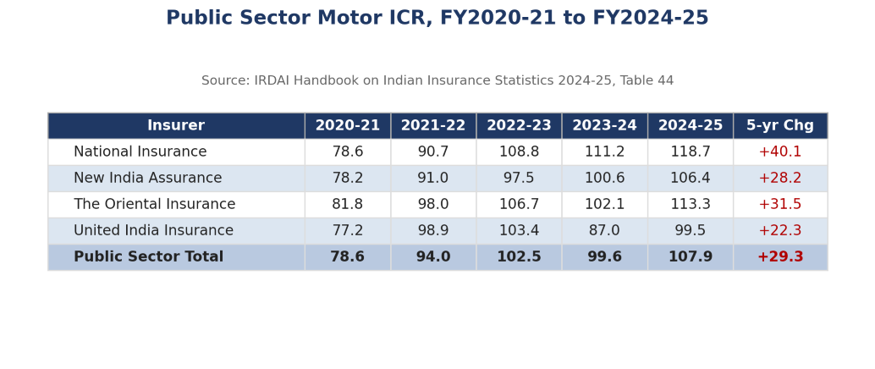
National Insurance’s numbers are the starkest in the whole dataset. Its motor ICR has risen every single year for five straight years — 78.6%, then 90.7%, then 108.8%, then 111.2%, then 118.7% — a 40-point climb with not one year of relief. Oriental Insurance and New India Assurance are walking the same path, just a step behind. United India is the lone exception worth noting: it actually improved in FY2023-24, dropping to 87%, before the trend caught up with it again and pushed it back to 99.5% the year after.
There’s a well-documented structural reason behind this, and it isn’t really a secret in the industry: Motor Third-Party premiums — the mandatory cover every vehicle owner must buy — are set by IRDAI through an annual tariff, not priced freely by the insurers themselves. Claims costs, on the other hand, move with court awards, medical inflation and rising repair bills, none of which wait for the tariff to catch up. Public insurers, sitting on decades of legacy third-party books, absorb more of that mismatch than younger private players whose portfolios lean more toward Own Damage cover.
Private insurers look calm from a distance — up close, it’s a different picture
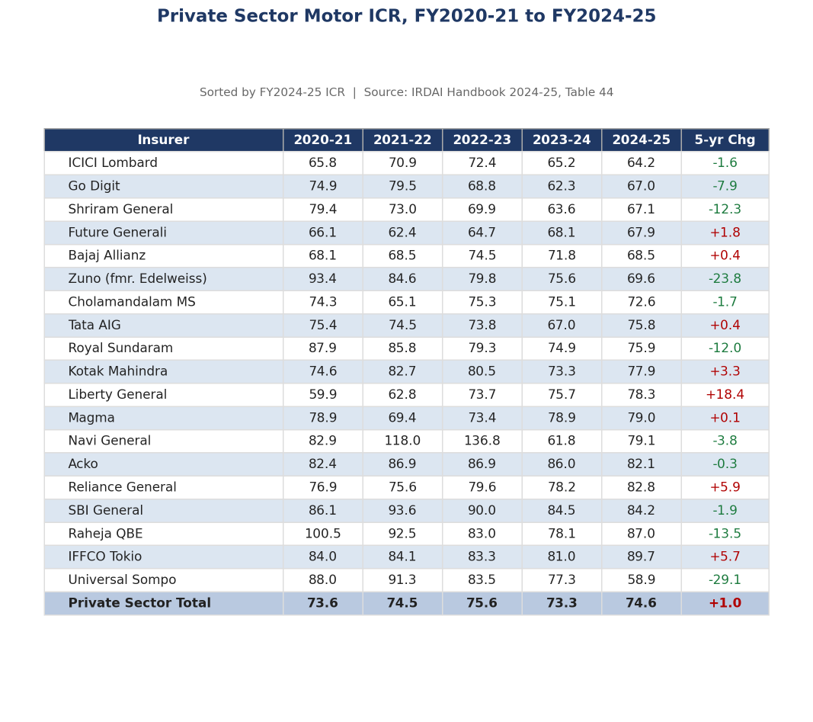
Car Insurance Policy: Zoom out to the private sector as a whole, and the story looks almost boring: the combined ICR has barely moved, sitting in a tight band between 73.3% and 75.6% across all five years. That stability, though, is an average masking real churn underneath — individual insurers have moved sharply in both directions while the sector total sat still.
Car Insurance Policy:The ones getting their house in order
Five private insurers cut their motor ICR more than anyone else over the period — worth reading as improving pricing discipline, not necessarily faster or friendlier claims handling:
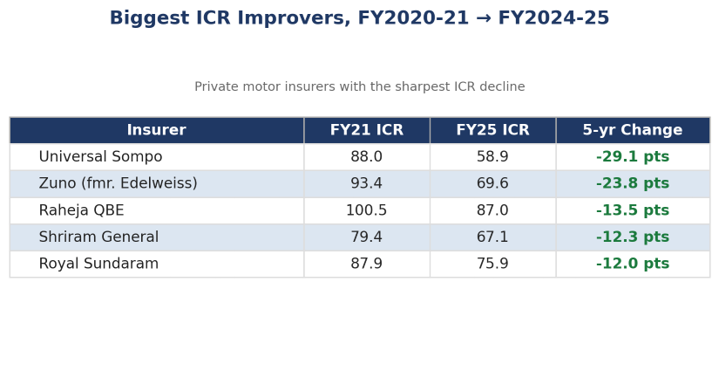
Universal Sompo’s move is the sharpest anywhere in the private sector: from 88.0% down to 58.9%, a 29-point drop, and almost all of it landed in the final year alone — 77.3% down to 58.9% between FY2023-24 and FY2024-25. That’s a steep enough one-year swing. The IRDAI Handbook doesn’t say anything about the swing.
Also Read: Why Your Car Insurance Claim Could Get Rejected — And How to Avoid It
Car Insurance Policy: The ones sliding the other way
On the flip side, these insurers saw claims costs grow fastest relative to what they were charging:
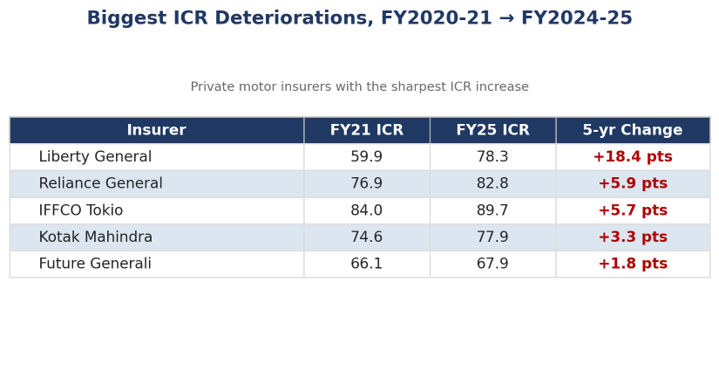
Liberty General began the period with the lowest — the healthiest — motor ICR of any private insurer, at 59.9%. Five years later it sits at 78.3%, a steady, uninterrupted climb every single year. It’s the private sector’s mirror image of National Insurance’s story: the same one-way trajectory, just starting from a far better place and ending in merely average territory rather than triple-digit trouble.
And then there’s Navi General, which doesn’t really fit a trend line at all. Its motor ICR goes 82.9% in FY21, then 118.0%, then a startling 136.8% in FY23 — meaning claims cost the company more than a third above what it collected in premium that year — before crashing to 61.8% the following year and settling at 79.1% most recently. Swings like that usually mean one thing: a small, thin book of motor business, where a handful of large claims can move the entire ratio on their own. For an insurer with numbers this jumpy, the five-year average tells you almost nothing useful — you have to look at each year on its own.
Is there a “fast payer” in this data? Not quite
Car Insurance Policy: It would be easy, at this point, to reach for a satisfying twist: name the insurer that’s both financially disciplined and quick to pay. The honest answer is that official IRDAI data we have doesn’t let us make that call. IRDAI simply does not publish a claim-count settlement speed metric broken out for motor insurance specifically. The one claim-count figure it does publish blends every line of business an insurer sells into a single number.
What we can do, with a caveat, is look at the all-lines claim settlement figure for the four public insurers — whose books lean heavily toward exactly the motor and health business this article is about:
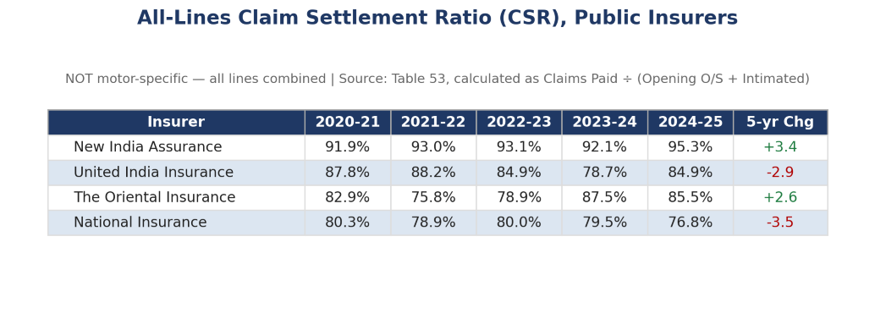
And here the story gets genuinely interesting. New India Assurance’s motor ICR rose 28.2 points over five years — a real, sustained deterioration in the profitability of its motor book. At the very same time, its all-lines claim settlement figure climbed to the best in its peer group, 95.3%, in FY2024-25.
Put simply: a company can be losing more and more money on every motor policy it sells while still paying out claims to customers promptly. ICR tells you about the insurer’s balance sheet. Claim settlement tells you about your experience filing a claim. They are answering two different questions, and nothing in this data licenses assuming that a company bleeding money on motor is therefore also slow to pay — or that a company under less financial strain therefore pays faster. The two just don’t move together here.
Car Insurance Policy: The Policyholder’s Cheat Sheet
For policyholders, here’s what actually carries over to someone renewing a car insurance policy this year:
- ICR is a signal about the insurer’s business, not a promise about your individual claim. It tells you whether the company is making or losing money on motor cover — nothing more, nothing less.
- A steadily climbing ICR — as seen at National Insurance, Oriental, New India and Liberty General — points to a business under sustained cost pressure. That often shows up later as premium hikes, not necessarily as claim denials today.
- A sharp single-year improvement (Universal Sompo, Zuno) is worth a second look before treating it as good news — it can reflect genuine underwriting discipline or simply a reserving adjustment.
- No official, motor-specific “how fast do they pay” number exists today. Any company-wise “motor claim settlement ratio” you see quoted online is either self-reported by the insurer or estimated by a third party — not something IRDAI itself publishes at that level of detail.
Car Insurance Policy: How this was reported
Every ICR figure in this piece comes directly from IRDAI’s Handbook on Indian Insurance Statistics 2024-25, Table 44 (“Net Premium Earned, Incurred Claims and Incurred Claims Ratio of General and Health Insurers”), motor insurance segment, FY2020-21 through FY2024-25. The all-lines claim settlement figures are calculated from Table 53 (“Status of Claims of General and Health Insurers”) as claims paid divided by the sum of claims outstanding at the start of the year and claims intimated during it, across every line of business combined. Standalone health insurers, specialised insurers such as Agriculture Insurance Co. and ECGC, and insurers with incomplete five-year records (Bharti AXA, pre-merger Kshema, Zuno’s pre-launch years) were left out of the trend comparisons to keep the numbers comparable.