Milky Mist IPO: DRHP Flags Insurance Gaps, Product Liability and Business Interruption Risks
Milky Mist IPO: Milky Mist’s DRHP flags insurance-related gaps that investors may need to watch closely. The filing points to product liability and business interruption risks amid the company’s IPO plans.
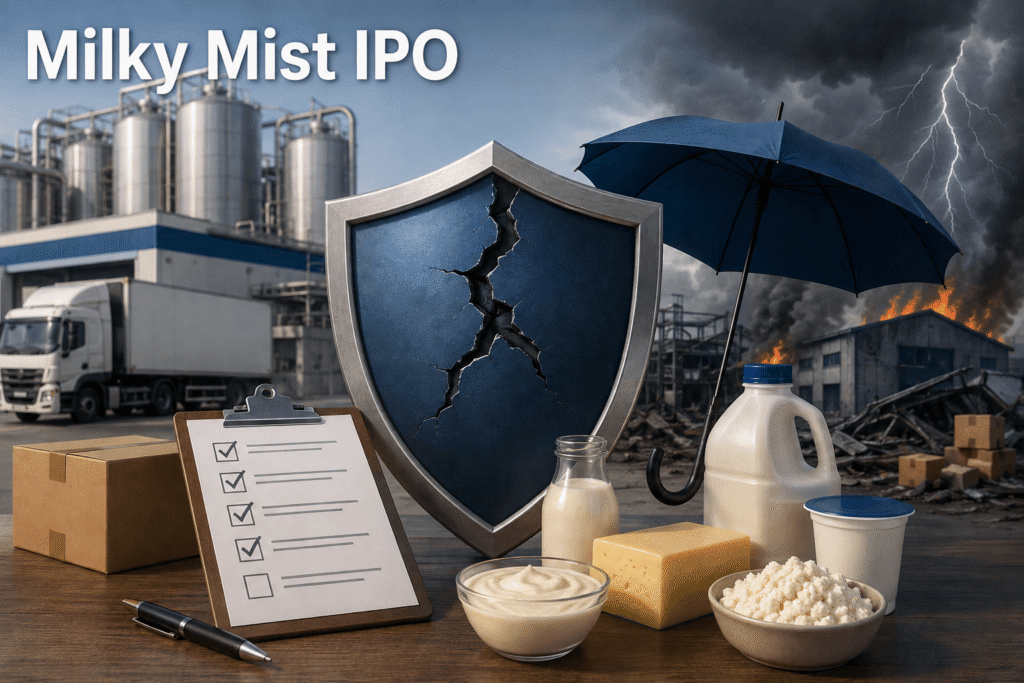
Milky Mist IPO filing highlights gaps in insurance coverage across key business risks. Product liability and business interruption exposures could pose challenges during unforeseen events.
Milky Mist IPO: Milky Mist Dairy Food’s IPO has generated strong investor interest, with the issue subscribed more than 56 times during the three-day bidding period. The company’s grey market premium (GMP) has also remained in focus ahead of its expected listing on August 18.
But beyond the GMP and subscription numbers, the company’s IPO documents highlight another risk that could matter to investors — the adequacy of its insurance protection.
Milky Mist has warned in its Draft Red Herring Prospectus (DRHP) that its insurance coverage may not be adequate and that uninsured losses or losses exceeding its insurance coverage could adversely affect its business, financial condition, cash flows and results of operations.
The disclosure is particularly relevant because Milky Mist operates a large food and dairy manufacturing business, exposing it to risks ranging from damage to factories and machinery to product liability, product recalls and operational disruptions.
Also Read: Delhi Man Accuses BLK-Max Hospital Of Billing Malpractice In Viral X Thread
Milky Mist IPO: Milky Mist’s insurance cover versus asset value
According to the DRHP, Milky Mist had a gross book value of relevant assets of ₹2,017.39 crore as of March 31, 2025.
Against this, its insurance coverage stood at ₹1,916.04 crore, equivalent to 94.98% of the gross book value of these assets.
The coverage ratio stood at 91.42% in FY24 and 97.49% in FY23.
The difference between the asset value and insurance coverage was therefore around ₹101 crore in FY25.
However, this should not automatically be treated as a ₹101-crore insurance shortfall.
The asset value used by the company includes the gross value of property, plant and equipment excluding land, investment property excluding land and closing inventories. Insurance valuations can be based on different parameters, including replacement value and policy-specific terms.
Deductibles, exclusions, policy limits and the basis on which claims are settled can also affect the amount ultimately recovered after an insured event.
Therefore, the more important takeaway is that the company’s own filing acknowledges that its insurance may not fully protect it against every potential loss.
Milky Mist IPO: What insurance does Milky Mist have?
Milky Mist says it maintains insurance for its properties, including buildings, furniture and fixtures, plant and machinery, stock, stock-in-process and raw-material stock.
It also maintains a public liability policy covering product liability risks and insurance policies covering directors’ and officers’ liability.
The policies are generally valid for one year and are renewed annually.
However, the company cautions that there is no assurance that its insurance policies will always be renewed on time, at an acceptable cost or at all.
It also warns that it may not be fully insured against certain risks and that claims may not necessarily be honoured fully, partly, on time or at all.
Milky Mist IPO: Why product liability insurance matters for Milky Mist
Product liability is particularly important for a company such as Milky Mist because of the nature of its business.
The company manufactures and sells a wide range of dairy and packaged food products, including paneer, cheese, curd, butter, ghee, fresh cream, milk powder, flavoured milk, lassi and other value-added products.
A problem involving a food product can create a financial exposure that goes well beyond the physical value of the product itself.
A product liability claim could involve legal expenses, compensation claims, regulatory action and reputational damage, depending on the circumstances and the terms of the insurance policy.
Milky Mist itself flags this risk in its DRHP.
The company says that if a product liability claim exceeds its policy limits, the excess could adversely affect its business and financial condition.
This is particularly relevant for food manufacturers because a product-related incident can potentially affect multiple markets and products at the same time.
Milky Mist IPO: Milky Mist also has product recall coverage
Another notable disclosure in the DRHP is that Milky Mist maintains product recall coverage.
The company says it has not recalled any products during the last three fiscals. However, it warns that a future recall could result in additional costs and affect its reputation, business, financial condition and cash flows.
Product recall insurance is different from conventional property insurance.
Property insurance generally protects physical assets against specified insured events, while product recall coverage is designed to address certain costs associated with withdrawing potentially defective or contaminated products from the market, subject to the policy’s terms and limits.
For a packaged-food manufacturer, this distinction can be significant.
Milky Mist IPO: Business interruption is another risk
The DRHP also highlights the possibility of operational disruptions.
Milky Mist says events such as manufacturing equipment failure, cooling equipment malfunction during transportation, natural disasters, fire, floods and accidents could affect its manufacturing operations.
For a manufacturing company, the financial impact of such an incident can extend well beyond the cost of repairing a damaged factory or machine.
If production is halted, a company could lose revenue while continuing to incur expenses such as employee costs, financing costs and other fixed overheads.
This is where business interruption insurance becomes relevant.
Business interruption insurance, where available and subject to policy terms, can provide protection against certain financial losses resulting from an interruption caused by an insured event. Depending on the policy, the cover can include loss of gross profit and continuing expenses during an agreed indemnity period.
However, the DRHP reviewed does not establish the exact extent of Milky Mist’s business interruption insurance cover.
Therefore, it would be incorrect to conclude that the company either has inadequate business interruption insurance or does not have such cover.
The important point is that operational disruption is itself identified as a business risk by the company.
Milky Mist IPO: Insurance claims versus amounts received
The DRHP also provides details of Milky Mist’s insurance claims over the past three fiscals.
In FY25, the company reported insurance claims of ₹2.141 crore, while the amount received stood at ₹1.539 crore.
In FY24, claims stood at ₹1.067 crore against ₹0.946 crore received.
In FY23, claims stood at ₹1.016 crore against ₹0.669 crore received.
The amounts received were therefore below the amounts claimed in each of the three years.
However, this should not be interpreted as the company’s insurance claim rejection rate.
The DRHP does not state that the difference represents rejected claims or uninsured losses. Differences can arise because of claim assessment, timing of settlements and other policy-related factors.
Milky Mist IPO: Why the insurance issue matters for Milky Mist IPO investors
The insurance disclosure becomes more relevant when viewed alongside Milky Mist’s expansion plans.
The company raised ₹1,553 crore through its IPO, comprising a fresh issue of ₹1,428 crore and an offer for sale of ₹125 crore. The IPO price band was fixed at ₹133-₹140 per share.
The fresh issue proceeds are intended for purposes including repayment or prepayment of borrowings, expansion and modernisation of the company’s manufacturing facility and strengthening its business infrastructure.
This means Milky Mist is raising capital while expanding its manufacturing footprint.
As the company’s assets, production capacity and distribution network increase, its insurance requirements could also evolve.
For investors, the question is therefore not simply whether Milky Mist has insurance.
The bigger question is whether its insurance programme is sufficiently aligned with the company’s expanding asset base and the range of risks associated with food manufacturing.
Milky Mist IPO GMP remains in focus
Milky Mist’s IPO received strong demand from investors.
The issue closed with subscription of more than 56 times, with particularly strong demand from qualified institutional buyers.
The grey market premium has also remained positive following the close of the issue. On August 14, market observers cited a GMP of around ₹29 per share, implying a potential premium of about 21% over the upper IPO price of ₹140.
GMP, however, is an unofficial and unregulated market indicator. It can change before listing and does not guarantee the actual listing price.
Milky Mist shares are expected to list on the NSE and BSE on August 18.
Milky Mist IPO: The insurance risk investors should not ignore
The Milky Mist IPO illustrates why investors may need to look beyond subscription numbers, valuation and GMP when assessing a company.
For a manufacturing business, insurance is not limited to protecting buildings and machinery.
The broader risk-transfer programme can involve property damage, plant and machinery, raw materials, inventory, product liability, product recalls, public liability, transportation-related risks and business interruption.
Milky Mist’s DRHP explicitly acknowledges that losses can occur beyond its insurance limits and that uninsured losses could adversely affect its business and financial position.
This does not, by itself, make the Milky Mist IPO unattractive.
Instead, it provides investors with another risk factor to consider alongside the company’s growth, financial performance, valuation, manufacturing expansion and competitive position.
For insurance-focused investors, the disclosure offers a useful takeaway: having insurance is not necessarily the same as being fully protected.
The real question is whether the limits, scope and structure of the insurance programme are sufficient to absorb the financial consequences of a major property loss, product liability event, product recall or prolonged operational disruption.
That is the insurance angle embedded in the Milky Mist IPO that investors may want to look beyond the GMP to understand.