40 Crore Indians Have No Health Insurance Safety Net: Parliamentary Panel Pushes ₹4,000-6,000 Fix
Health Insurance: Around 40 crore Indians remain without a health insurance safety net, leaving millions vulnerable to rising medical costs.
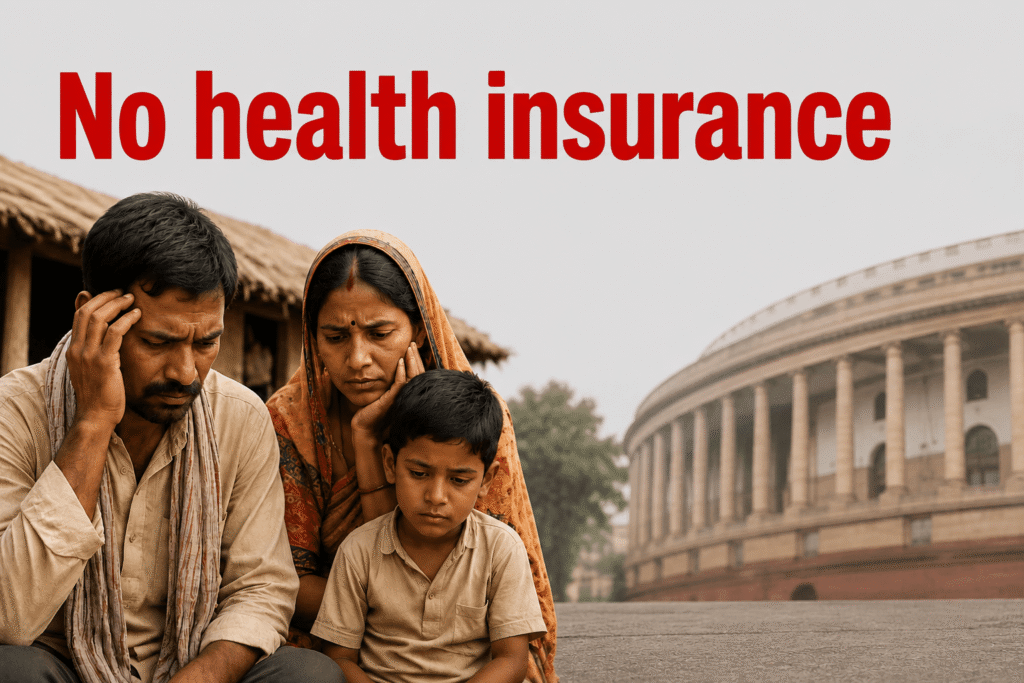
Health Insurance: 40 crore Indians have no health insurance safety net, highlighting a major gap in healthcare protection. A parliamentary panel has proposed an affordable ₹4,000–6,000 solution. AI-Generated-Image.
NEW DELHI — Health Insurance: Nearly 40 crore Indians — about 30% of the country’s population — remain without any meaningful health insurance cover, falling into a policy blind spot that is too well-off for government schemes and too poor for private insurers, a Parliamentary Standing Committee has found in a report tabled on August 7.
The Rajya Sabha panel’s report on healthcare affordability has zeroed in on what it terms the “missing middle” — informal-sector workers, self-employed individuals and households with unstable incomes who don’t qualify for Ayushman Bharat’s free coverage but also can’t afford existing private health policies. The finding adds hard numbers to a gap that has long been suspected in India’s health financing system but rarely quantified this precisely.
Also Read: Have Corporate Health Insurance? Here’s Why You May Still Need a Personal Policy
The scale of the problem is muddied by conflicting official data on coverage itself. The National Family Health Survey (NFHS-5) pegged insurance coverage at around 41% in 2021, while a NITI Aayog study on the missing middle put it closer to 70% once every government scheme, social insurance programme and private policy is counted. Even on the more generous estimate, that still leaves over 40 crore people with zero protection.
The committee’s central recommendation is unusually specific for a policy document: a standardised insurance product, built on the existing Aarogya Sanjeevani framework, priced between ₹4,000 and ₹6,000 per family per year, with minimal waiting periods and mandatory outpatient (OPD) coverage baked in rather than sold as an add-on. The panel noted that a large chunk of this population can actually afford modest premiums — the market has simply failed to design a product for them, with most private insurance currently pitched at higher-income buyers.
Health Insurance: The wider insurance picture is equally stark
The report pairs this recommendation with a set of numbers that paint a fuller picture of how skewed India’s health insurance market has become.
Private health insurance expenditure stood at ₹81,012 crore in 2022-23 — larger than Social Health Insurance (₹32,090 crore) and Government-Financed Insurance Schemes (₹26,266 crore) combined, according to National Health Accounts data cited in the report. At the other extreme, community-based health insurance — schemes designed for low-income and rural groups — totalled just ₹10 crore nationally, a figure the committee effectively treats as a rounding error in a market worth over ₹1.5 lakh crore.
Medical inflation is running at 10-13% annually, nearly double the general inflation rate, driven by unstandardised treatment protocols and practices such as room rent-linked pricing, the Insurance Regulatory and Development Authority of India (IRDAI) told the committee. Insurers settled 3.26 crore health insurance claims worth ₹94,248 crore in FY 2024-25, but the panel flagged that fraud, inflated billing and provider-induced demand continue to push up premiums for genuine policyholders.
On the government-scheme side, Ayushman Bharat PM-JAY has issued 44.23 crore cards and authorised 12.59 crore hospital admissions, generating an estimated ₹1.91 lakh crore in out-of-pocket savings as of mid-2026. A Lancet Regional Health–Southeast Asia study cited in the report found that 90% of PM-JAY beneficiaries began cancer treatment promptly, against just 33% of non-beneficiaries — one of the sharper illustrations in the report of what insurance coverage actually buys in health outcomes.
Also Read: Colombia Earthquake Death Toll Crosses 130, Insurers Brace for Property and Aviation Claims
Yet the committee was also told that government-scheme claims take far longer to settle than private ones. Testimony from Jawaharlal Nehru Medical College put private insurance claim settlement at 25-30 days, against 6-8 months for government scheme reimbursements — with government package rates running roughly 30% below what private insurers pay for the same procedures.
Health Insurance: Structural gaps flagged
The panel also flagged a tax anomaly it wants fixed: group health insurance, the format typically used to cover gig and platform workers, is taxed at 18% GST, while individual retail policies are exempt — effectively penalising insurers trying to cover precisely the workforce the “missing middle” product is meant to reach.
On implementation, the committee wants IRDAI and the Confederation of Indian Industry’s joint working groups to fast-track the standardised product, alongside wider hospital adoption of the National Health Claims Exchange (NHCX) and completion of the Public Insurance Registry (PIR) — digital infrastructure meant to bring transparency to claims and reduce disputes between insurers, hospitals and policyholders.
The recommendations now go to the government and IRDAI for action. If taken up, the ₹4,000-6,000 product would be one of the first insurance offerings designed explicitly for India’s economic middle — a segment its welfare architecture has largely left out until now.