‘No Insurance, No Fuel’: Supreme Court Cracks Down as 56% of Vehicles Run Uninsured
Supreme Court directs a pilot project linking fuel supply to valid vehicle insurance after finding 56% of Indian vehicles uninsured. The order also pushes ANPR-based enforcement and a citizen verification tool.
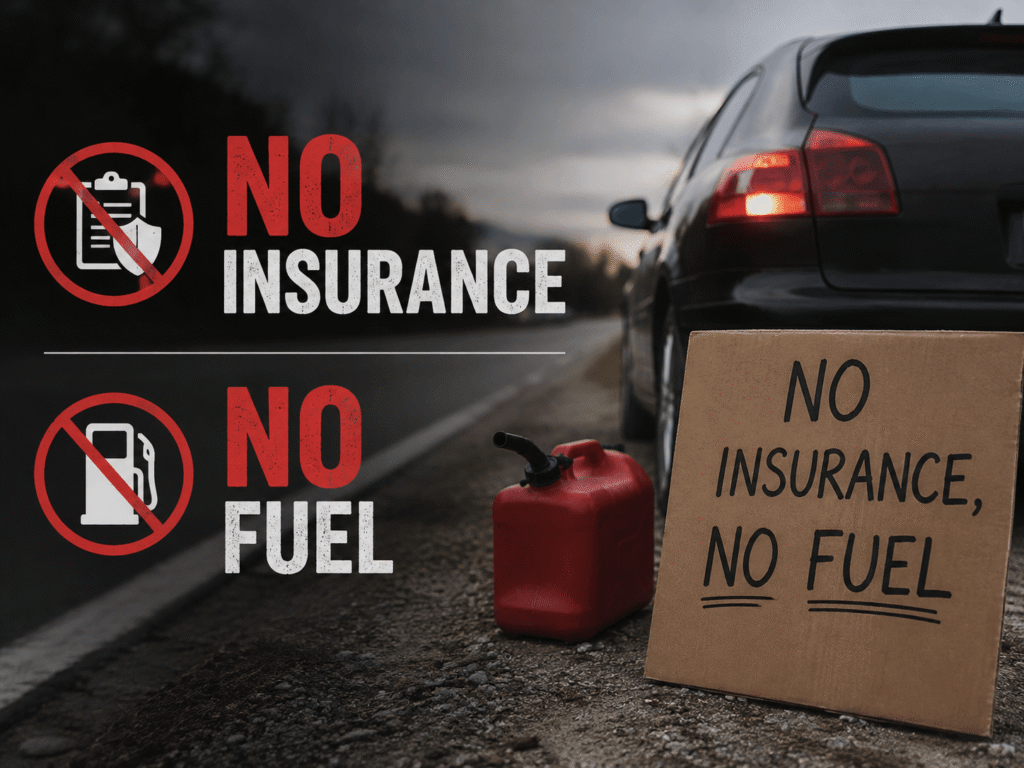
Supreme Court directs a pilot project linking fuel supply to valid vehicle insurance after finding 56% of Indian vehicles uninsured.
New Delhi: The Supreme Court on Tuesday directed the Centre, the Insurance Regulatory and Development Authority of India (IRDAI) and the Ministry of Road Transport and Highways (MoRTH) to develop a pilot project linking fuel supply to valid vehicle insurance, under which vehicles without valid cover could be refused fuel at petrol pumps. The direction was issued by a Bench of Justices Sanjay Karol and Prashant Kumar Mishra while disposing of an appeal filed by National Insurance Company Ltd against a Telangana High Court judgment, in the case National Insurance Company Ltd v. Smt Thungala Dhana Laxmi & Ors, after the Bench found that nearly 56 per cent of vehicles on Indian roads remain uninsured.
Also Read: Third-Party Insurance: SC Extends Mandatory Cover for New Vehicles, What It Means For You
Supreme Court: The Case Behind the Order
The underlying case traces back to a 1996 accident in which the husband of Thungala Dhana Laxmi died while travelling in his own insured car. The claim was rejected by the Motor Accident Claims Tribunal in 2009 on the ground that the comprehensive policy did not treat the owner as a “third party,” before the Telangana High Court reversed that finding in 2024 and held that a comprehensive policy covers all occupants of the vehicle.
Supreme Court: 56% of Vehicles Found Uninsured
While disposing of the appeal, the Bench cited the Report of the Standing Committee on Finance, which found that 16.54 crore of nearly 30.48 crore registered vehicles do not carry insurance. The Court stated that this level of non-compliance defeats the purpose of compulsory motor insurance and leaves accident victims and their families waiting years for compensation.
Supreme Court: The Legal Requirement — and Why It’s Not Working
Section 146 of the Motor Vehicles Act, 1988 requires every vehicle used in a public place to be covered by at least a third-party insurance policy, with violations punishable under Section 196 — a fine of up to ₹2,000, imprisonment of up to three months, or both, for a first offence, with enhanced penalties for repeat violations. Despite this statutory mandate, legal commentary on the matter has pointed to gaps in enforcement: registration authorities have no mechanism to suspend a vehicle’s registration when its insurance lapses, there is no ongoing check to catch non-renewal after the initial registration, and traffic police at checkpoints have historically lacked instant digital access to verify insurance status.
It was against this backdrop that the Bench, in an order dated October 30, 2025, in the same matter, reportedly expressed concern at the disclosure that over half of vehicles on Indian roads were plying without insurance, and asked the insurer, IRDAI and the General Insurance Council to propose remedial measures, including coercive mechanisms such as vehicle impounding. MoRTH was subsequently made a party to the proceedings to assist in framing workable directions.
Also Read: Buying Term Insurance? The One Metric You’re Probably Overlooking
Supreme Court: Enforcement Push: ANPR and E-Challans
To enforce this, the Court directed that Automatic Number Plate Recognition (ANPR) cameras be integrated with the Insurance Information Bureau and the VAHAN database to automatically detect uninsured vehicles and issue e-challans. It also proposed a separate pilot project allowing citizens — including passengers and employers — to verify a vehicle’s insurance status and report uninsured vehicles, and directed MoRTH to continue pilot projects for barrier-less tolling using ANPR technology, observing that shorter toll queues would also improve road safety.
Supreme Court: Building on Earlier Directions
The order continues a pattern of the same Bench pushing insurers and regulators toward more accountable, victim-first outcomes. In an earlier order in the same matter, dated October 30, 2025, the Court had asked IRDAI and the General Insurance Council to explore a more inclusive motor insurance framework so that owners, drivers and permitted users are not excluded from third-party protection. Separately, the Supreme Court has previously held that insurers cannot deny a claim by citing breach of a policy condition that was impossible for the policyholder to fulfil, ruling that contractual terms must be fair, transparent and practically enforceable.
Supreme Court: Next Steps
The Court has directed stakeholders in the present matter to file compliance affidavits by August 14, with the matter listed for further consideration on August 18.











1 thought on “‘No Insurance, No Fuel’: Supreme Court Cracks Down as 56% of Vehicles Run Uninsured”