PB Fintech Analyst Call: Insurance Licence on Table, No Mass Layoffs, Hiring To Slow
PB Fintech’s business is split roughly 50:50 between life and non-life insurance, and management’s assessment differed sharply between the two.
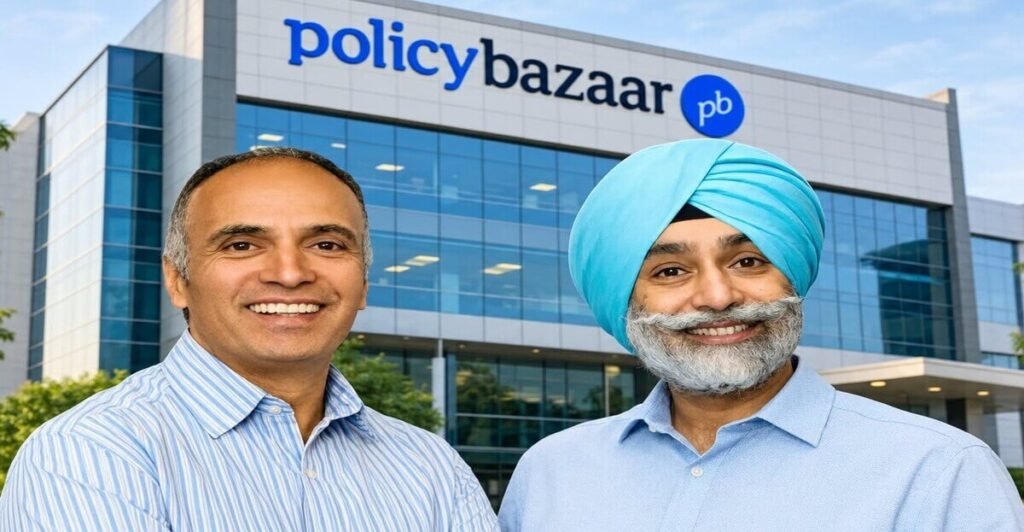
PB Fintech's Yashish Dahiya and Sarbvir Singh
PB Fintech: Minutes after PB Fintech’s shares fell 36% to close at ₹1,210, the company’s biggest single-day fall on record, its management sat down with analysts to explain what the regulator’s proposal could mean for a business built over 15 years on insurance distribution. The call, held after the sell-off triggered by the Insurance Regulatory and Development Authority of India’s (IRDAI) consultation paper on distribution economics, produced some of the strongest statements the company has made on the subject.
Management described the paper as “quite extreme” and said it could have a serious impact on revenue on the general insurance side. It also said that if the outcome does not reward the quality of business it has built, it would “seriously consider” getting an insurance licence, according to notes from the call.
PB Fintech – The numbers: what management says is at stake
PB Fintech’s business is split roughly 50:50 between life and non-life insurance, and management’s assessment differed sharply between the two.
On non-life, the company said one-third to one-quarter (roughly 25-33%) of the net present value (NPV) of the business could be hit. On life, it said NPV is stable and would not see a big impact.
The company also explained why it believes the NPV damage would be smaller than a headline commission cut suggests. If general insurance commissions were reduced by 60%, management said, PB Fintech should be able to win higher volumes, in the range of 15-20%, which would offset part of the loss.
Management said basic details of the proposal are not yet clear, including whether the changes would apply retrospectively or only to future business. It said there would be no impact this year.
Also Read: Commission Up 259%, Premiums Up 34%: India’s Insurance Middlemen Problem
On earnings, the company said it would endeavour to get its trajectory back on track by FY2029, while FY2028 is likely to be volatile. Management noted that PB Fintech took 15 years to turn profit-after-tax positive, at a margin of about 2% of premium, and said it has been deploying people and growing “passionately.” The focus, it said, would now move from passionate growth to rational growth.
PB Fintech: Distributors, agents and the pricing question
A large part of the call dealt with how the proposed commission levels would work for those who sell insurance. PB Fintech said larger agents may not find it lucrative to sell at the proposed rates. “If distribution was the engine, taking it out won’t make the car lighter and faster,” the company said.
Management gave an example from the agency channel: a health insurance agent selling two policies a month, previously earning about ₹15,000, would under the proposal earn ₹3,500-3,750, and could end up going “on rolls” as a salaried employee. The company also said it did not find it convincing that agents should be paid higher commissions than Point of Sales Persons (PoSPs), and said the PoSP model is now “under question.”
Management argued that if PB Fintech receives lower commissions than agency channels, the product sold on its platform should cost less than on other channels, and said IRDAI should ensure this. It said the company has worked for years to generate good-quality business, and that if the benefit of that quality reaches neither PB Fintech nor customers, “it’s best for PB to become a manufacturer.”
The company also pushed back on the idea that lower prices alone would lift demand. Management described insurance as a “push” business with price elasticity of at best 1, saying that customer confidence, service and quality matter more than cost reduction.
On costs, PB Fintech said it would not react with mass layoffs. Management said the company hired about 6,000 people to support growth, and that future hiring may slow. It described the business as running in two modes, growth and profitability, and said it would go slower on growth, focus on profitability and balance the two.
PB Fintech – The company outlined the following options:
Insurance and reinsurance manufacturing: management said it would explore the option, alongside seeking an insurance licence.
MGA route: the company said the IRDA Act provides for managing general agents (MGAs), and that it will try to pursue that route for cost-of-risk (CoR) sharing. It said quality of business should be given value by the regulator and that the company can make that argument.
Credit life: management said this market could open up for PB Fintech.
Non-insurance businesses: these are also being explored.
Paid services: PB Garage and wheels services, currently not charged for, could be charged.
International business: no change to plans.
PoSP business: will be re-planned.