When the ground moves 1,500 times a year: inside Japan’s system for insuring the un-insurable
Japan’s Earthquake: A magnitude 7.1 earthquake just killed 18 people in Kumamoto. Behind the headlines lies a six-decade-old public-private insurance system
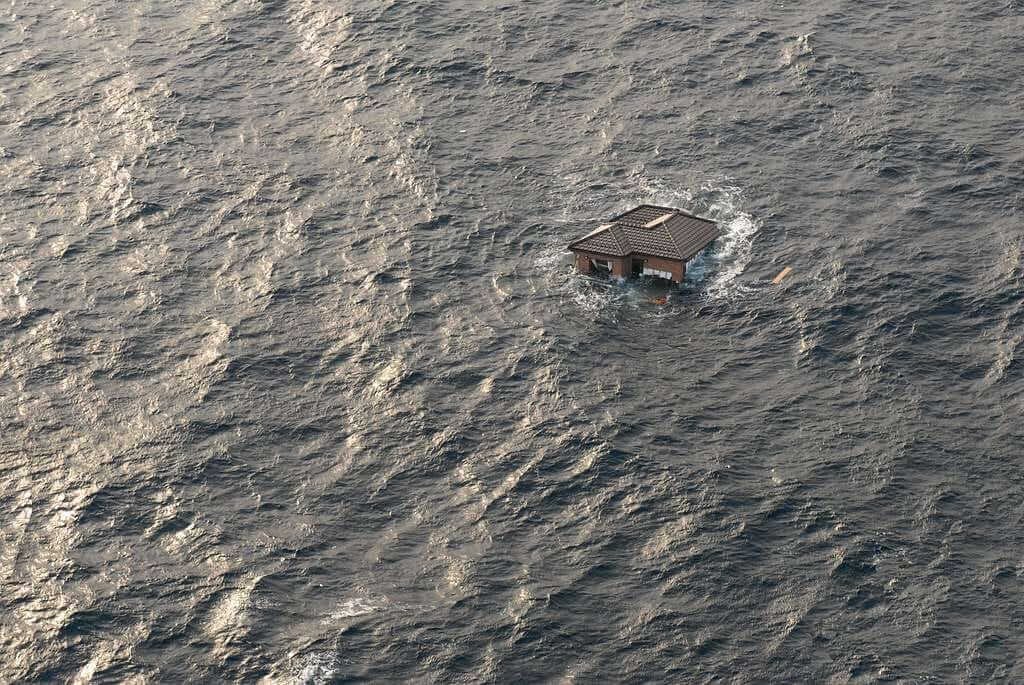
A photo from the March 2011 Tōhoku earthquake and tsunami in Japan. The image shows a Japanese home adrift in the Pacific Ocean, photographed by U.S. Navy personnel from the USS Ronald Reagan carrier strike group as it searched for survivors and debris in the coastal waters near Sendai in March 2011. Image Credit: US Navy.
Japan’s Earthquake: On the afternoon of July 28, 2026, a magnitude 7.1 earthquake tore through Kumamoto Prefecture on the southern island of Kyushu. Within hours, a shopping mall in Kashima had partially collapsed after what investigators believe was a gas explosion triggered by the shaking, bullet trains sat frozen, and by Wednesday morning the confirmed death toll had climbed past 18, with dozens more injured and rescue teams still combing through rubble.
Almost no other country in the world is rocked by earthquakes as frequently and destructively as Japan, an island nation sitting at the junction of four tectonic plates. It also sits on the Pacific “Ring of Fire,” the arc of volcanic and seismic activity that circles the ocean.
For most readers outside Japan, a headline like this arrives without context — another quake, another death toll, another set of collapsed buildings on the news ticker. What rarely makes the cut is the machinery running quietly underneath: an earthquake insurance system, built over sixty years, that has been specifically engineered to keep paying claims no matter how bad the year gets, without bankrupting the insurers who write the policies or the government that backstops them.
That machinery is worth understanding in detail, because Japan is not simply “prepared” for earthquakes in some vague civilizational sense — it has built a specific financial architecture for absorbing shocks that would cripple almost any other insurance market on earth.
Also Read: How to Lower Car Insurance Premium in India: 5 Proven Ways to Cut Costs
Japan’s Earthquake: A country built on a fault line
Japan’s earthquake problem is geological, not incidental. The country sits where the Pacific Plate, the Philippine Sea Plate, the Eurasian Plate and the North American Plate all meet and grind against one another, a genuinely unusual four-plate convergence zone found almost nowhere else. Along the country’s Pacific coast, the Philippine Sea Plate is slowly diving — subducting — beneath the Eurasian Plate at a rate of a few centimetres a year.
That slow-motion collision locks the two plates together at points, storing up enormous strain that is eventually released in a single violent rupture. Japan’s seismological agencies estimate that the country experiences roughly 1,500 “noticeable” earthquakes every year, though the vast majority cause no damage at all.
Two of those subduction zones matter more than any other for insurers and policymakers. The first is the Japan Trench off the Tohoku coast, which produced the magnitude 9.0–9.1 Great East Japan Earthquake and tsunami in March 2011 — the event that also triggered the Fukushima nuclear disaster.
The second, and the one that keeps Japanese actuaries up at night, is the Nankai Trough: an roughly 700-800 kilometre undersea fault running along Japan’s southern Pacific coast from Shizuoka to Kyushu, past Osaka and Nagoya.
Nankai Trough megaquakes have struck roughly every 90 to 150 years for over a millennium, most recently in 1946. Because it has now been close to 80 years since that last rupture, the government’s Earthquake Research Committee treats the fault as overdue, and its most recent revision — which caused considerable public confusion — put the 30-year probability of another Nankai Trough megaquake at somewhere between 60 and 90%, depending on which statistical model is used.
If a magnitude 9 event does strike, the government’s own worst-case projection is grim: up to roughly 298,000 dead and around ¥292 trillion (close to $2 trillion) in economic damage — a single disaster capable of erasing a meaningful share of Japan’s GDP.
Japan’s Earthquake: Living with it: the physical side of preparedness
Before getting to insurance, it’s worth understanding why Japan’s death tolls, while still tragic, tend to be a fraction of what similar-magnitude quakes cause elsewhere. Three things do most of the work.
The first is the Earthquake Early Warning (EEW) system, run by the Japan Meteorological Agency (JMA) since 2007 — the first nationwide public system of its kind anywhere. It exploits a simple physics quirk: an earthquake’s fast, harmless P-waves arrive at seismometers before the slower, destructive S-waves that actually shake buildings apart.
JMA detects the P-waves and broadcasts alerts to affected areas seconds to tens of seconds before the more damaging S-waves arrive, and that lead time — often just three to five seconds near the epicentre, but up to a minute farther away — is enough to automatically slow down Shinkansen trains, shut off gas valves, stop elevators at the nearest floor, and give schoolchildren time to duck under desks.
The second is building codes, revised repeatedly after major disasters — most decisively after the 1981 “New Seismic Design” standard and again following the 1995 Kobe earthquake, which killed more than 6,000 people. Newer buildings across Japan increasingly use base isolation (menshin) — literally decoupling the structure from the ground on flexible bearings so it sways rather than shakes — alongside seismic dampers and reinforced flexible frames. By 2023, Japan’s national housing earthquake-resistance rate had reportedly reached roughly 90%, according to the housing ministry.
The third is simply institutional memory and drilling — disaster response, evacuation planning, and public education repeated for decades. None of this makes Japan immune, as this week’s Kumamoto quake shows. But it dramatically changes the ratio of economic damage to loss of life, and that ratio matters enormously for how insurers think about risk.
Japan’s Earthquake: Why insurance had to be different in Japan
Standard fire insurance policies in Japan explicitly exclude earthquake, volcanic, and tsunami damage — deliberately, because insuring that risk the normal way simply doesn’t work. Ordinary property insurance is built on the law of large numbers: insurers pool premiums from thousands of policyholders whose individual risks of loss are largely uncorrelated, so that in any given year only a small, statistically predictable fraction of them will file claims. Earthquake risk breaks that model entirely.
When a major quake strikes, it doesn’t damage one home at random — it can simultaneously damage hundreds of thousands of homes across an entire region in a single afternoon. A private insurer holding that risk alone could be wiped out by a single event.
Japan’s answer, formalised in the 1966 Law Concerning Earthquake Insurance (passed after the damaging 1964 Niigata earthquake), was to stop treating earthquake cover as a normal insurance product and instead build a three-layer public-private reinsurance chain specifically designed so that no single participant — private insurer, reinsurer, or government — ever bears catastrophic risk alone.
Japan’s Earthquake: How a single earthquake insurance premium actually flows, layer by layer:
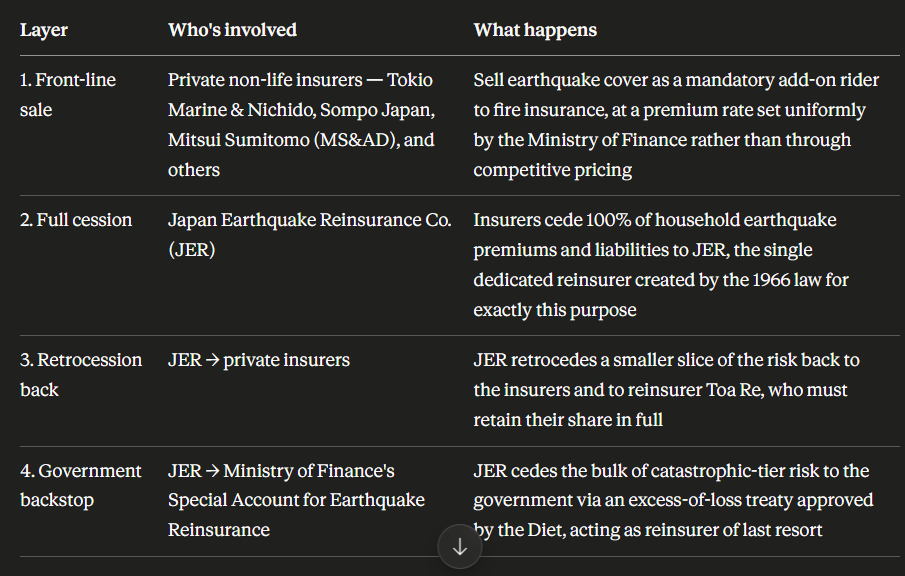
The system currently caps total industry-wide payouts for a single earthquake at ¥12 trillion — a ceiling deliberately calibrated to a repeat of the 1923 Great Kanto earthquake, and one that has been revised upward repeatedly since the 1970s, when the cap sat at just ¥800 billion.
The exact split between the three risk-bearers shifts with every revision — in the aftermath of the 2011 Tohoku disaster, the government’s own account was reportedly absorbing around 87% of maximum liability, with JER and the direct insurers splitting the rest. The point of the structure isn’t to eliminate loss; it’s to make sure that even a genuinely catastrophic event distributes financial pain across layers thick enough to absorb it, with the state explicitly stepping in as the reinsurer no private balance sheet could ever be.
Also Read: Pet Insurance: A Complete Guide to Choosing the Right Cover for Your Dog or Cat
Japan’s Earthquake: The gap nobody talks about: coverage that isn’t there
Here’s the part of the story of Japan’s earthquake that rarely gets told alongside the disaster footage: despite six decades of this infrastructure, a large share of Japanese households still aren’t covered. Industry data published in Toa Re’s Japan’s Insurance Market 2025 report puts the earthquake insurance attachment rate — the share of fire insurance policies that include the earthquake rider — at 69.7%, but the household penetration rate against all dwellings nationwide sits at just 35.1%. In plain terms: fewer than four in ten Japanese homes actually carry earthquake cover, even in the world’s most seismically sophisticated insurance market.
That gap didn’t move in a straight line. Uptake jumped sharply after the 1995 Kobe earthquake, and again after the 2011 Tohoku disaster — both moments when the public’s subjective sense of earthquake risk was violently updated by direct experience.
Momentum has since slowed, and JER itself has acknowledged there’s room for penetration to grow further. Coverage limits compound the gap: even insured households can only insure 30–50% of their fire insurance sum, capped at ¥50 million for a building and ¥10 million for contents — so even a fully “insured” household is really only partially protected by design, with the rest expected to come from savings, government disaster relief, or the Disaster Victims Livelihood Recovery Support System.
Japan’s Earthquake: Recent claims that show the pattern in numbers:
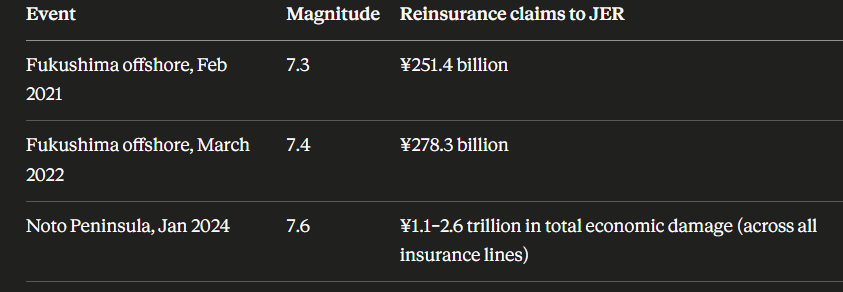
Insurance industry analysts have noted that even a moderate magnitude-7-class event in an active zone can consume 75% or more of the layer just below the government backstop — meaning a true magnitude-8-class Nankai Trough or Sanriku event would very likely blow through the ¥12 trillion system cap entirely, shifting the bulk of the household claims burden onto the government’s general finances rather than the pre-funded reinsurance structure.
Japan’s Earthquake: How the insurers themselves avoid going bankrupt
This is really the crux of “how they survive and thrive” — and the honest answer is that no single Japanese non-life insurer is actually carrying Nankai Trough-scale risk on its own balance sheet by choice. Beyond the JER/government backstop for household risk, Japan’s large carriers — Tokio Marine & Nichido Fire foremost among them — have spent nearly three decades quietly offloading tail risk to global capital markets through catastrophe bonds. Tokio Marine issued the world’s first securitised Japanese earthquake risk instrument back in 1997, and has returned to that market repeatedly since through its “Kizuna Re” series.
Its most recent transaction, priced in early 2026, raised $100 million in multi-year collateralised earthquake reinsurance, with investors accepting a roughly 2.4% chance of the bond triggering over a three-year period in exchange for a yield spread. In effect, hedge funds, pension funds, and specialist catastrophe investors around the world are quietly co-insuring a slice of Japan’s earthquake risk, absorbing losses that would otherwise sit on an insurer’s own books, in exchange for a running premium in years when nothing happens.
Also Read: CKYC 2.0 From August 1: OTP-Based KYC to Replace Repeated Paperwork for Bank, Insurance Policies
That combination — retention limits set by regulation, mandatory retrocession structures, a government backstop of last resort, and a supplementary layer of capital-markets risk transfer — is precisely why Japan’s big three non-life groups (Tokio Marine, Sompo, and MS&AD) have never come close to insolvency despite underwriting a country that shakes constantly. They simply aren’t allowed to hold catastrophic concentration risk unhedged; the entire regulatory architecture is designed to prevent it.
Where the system is visibly still catching up is the corporate side. Household earthquake insurance has the JER/government scaffolding described above; commercial and industrial earthquake cover does not — there is no equivalent government backstop or payout cap for corporate risk.
Worse, standard commercial policies typically pay out only against demonstrated physical damage, leaving a manufacturer or logistics firm whose operations are disrupted by a quake — without their building actually being destroyed — largely uncovered. That gap is now drawing new entrants: parametric earthquake insurance products, which pay out automatically based on a quake’s measured magnitude or shaking intensity rather than assessed physical damage, have seen at least two new providers enter Japan’s corporate market over the past year, aiming squarely at that business-interruption blind spot.
The bigger picture
Swiss Re’s Institute has estimated that a repeat of the 1995 Kobe earthquake today could cause around $200 billion in economic losses against roughly $35 billion insured — and a repeat of 2011’s Tohoku disaster could run to $300 billion in economic losses, with a similarly wide insurance shortfall.
Zoom out further, and the imbalance is regional as much as national: Asia accounted for roughly 30% of the world’s economic catastrophe losses through 2025, according to Swiss Re sigma research, while representing only around 5% of insured losses globally — a protection gap playing out across the region, of which Japan, ironically, remains one of the better-prepared examples rather than the worst.
That is really the paradox this week’s Kumamoto earthquake exposes. Japan has built arguably the most sophisticated earthquake-resilience infrastructure on the planet — from three-to-five-second early warning alerts to base-isolated skyscrapers to a purpose-built three-tier reinsurance chain running all the way to the national treasury. And yet even here, structurally, financially, and psychologically, a majority of households still walk into every earthquake season without a safety net that matches the size of the risk.
The lesson for any insurance market still building its own catastrophe framework — including one watching this story unfold from several thousand kilometres away — isn’t that Japan has solved the earthquake problem. It’s that even six decades of deliberate, state-backed design only gets you most of the way there.