BRICS Summit: Why Trump May Be Taking a Close Look at Iran’s Insurance Pitch in India
BRICS Summit: In New Delhi, Iran asked the world’s biggest emerging economies for something no bloc has ever built: a reinsurer of their own. Washington has reasons to care who says yes, and there are reasons it may not.
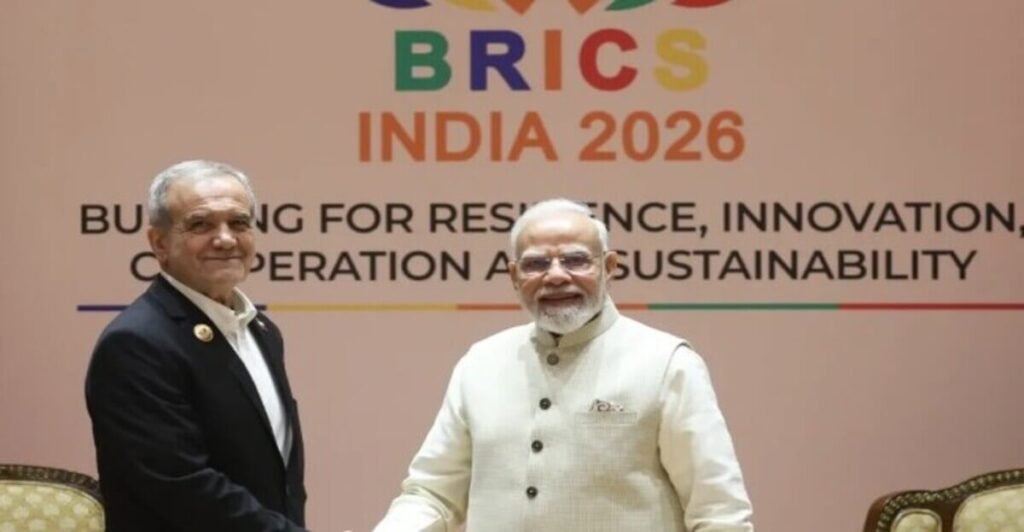
BRICS Summit brings Iran’s insurance ambitions in India into focus, with the country exploring greater cooperation in reinsurance and risk management.
BRICS Summit: Of all the things a head of state might carry to a summit in New Delhi, Masoud Pezeshkian carried insurance.
He did not tuck it into the fine print of a communiqué. On September 11, the eve of the BRICS summit, he proposed a reinsurance company for the group with an initial capital of $10bn, to cover the risks of major infrastructure and energy projects and increase private-sector confidence. The next two days brought the family photograph, the closed plenary and the declaration. At the end, the leaders planted banyan saplings to mark the summit.
The proposal landed in a charged setting, because insurance is already at the centre of the dispute over the Strait of Hormuz. The conflict began on February 28, when the US and Israel launched attacks on Iran, and Tehran has since closed the strait. In April the US Navy began blocking Iranian ports. Iran then created its own Persian Gulf Strait Authority, which requires vessels to carry approved cover.
The two sides describe that arrangement very differently. Mohsen Rezaei, a senior Iranian adviser, has said an insurance framework would guarantee security and environmental protection, with the costs borne by oil transporters. The authority’s terms say the cover applies to losses from capture, seizure and mines, and that Iran is currently bearing the premium. Washington takes a different view.
The US State Department has said international waterways must remain open and no country should impose unilateral tolls. On July 29 the Treasury sanctioned two Iranian insurers involved, and described the arrangement as extortion, noting that the risks covered are overwhelmingly created by Iran itself. One report says a 112-nation UN resolution rejected the authority’s framework as illegal under customary maritime law, and notes that Iran is not a signatory to the UN Convention on the Law of the Sea. Iran, for its part, has declared that authority over the strait rests with its armed forces.
Behind the dispute is something both sides agree on. A ship does not sail because its captain is brave. It sails because someone has agreed to pay if it sinks, is seized or is hit by a missile. Take that promise away and the ship stays in port.
BRICS Summit: The oldest lever in trade
The West’s use of that lever against Russia is the best-known case. The G7, the European Union and the UK prohibited Western companies from insuring any ship carrying Russian crude unless the oil was bought at or below a price cap. The stated aim was to preserve global energy supply while constraining Russian revenues. Moscow calls the measures crippling sanctions. Vladimir Putin, speaking at the summit’s concluding session on Sunday, tied his call for a BRICS insurance mechanism directly to Western restrictions on maritime insurance for Russian crude. “We can operate regardless of outside pressure,” he said.
The Gulf war has shown the same dynamic. War-risk premiums surged as much as 1,000% in some cases, and several major reinsurers, including India’s state-backed GIC Re, either withdrew cover or sharply raised premiums. Iran’s Strait Authority has, in turn, used the same lever. It has expanded a blacklist to 77 vessels and warned marine insurers, P&I clubs and classification societies to refrain from dealing with them.
Insurance, in other words, is an instrument that every side in this dispute has picked up. Iran’s BRICS pitch would place that instrument in a multilateral setting. Whether that reads as diversification or as a sanctions workaround depends on who is reading.
Also Read: Basketball Rim Injury at Mall Leaves Teacher Without a Finger, Insurer Ordered to Pay Rs 8.22 Lakh
BRICS Summit: Two speeches, one theme
The proposals arrived in stereo. Pezeshkian’s came first and was the more specific. His speech also urged wider use of national currencies in trade and wanted the New Development Bank to become the principal engine for financing infrastructure and energy projects. It was an Iranian initiative, not an announced policy of the grouping.
Putin’s was broader. He urged members to adopt an insurance mechanism and a joint grain market, framing both as answers to sanctions. Shipping publication Splash 247 noted that the Russian proposal was not specifically aimed at shipping, but comes as BRICS states increasingly seek insurance capacity insulated from sanctions and Western financial restrictions, with maritime trade one of the most obvious places to deploy it.
Sonjai Kumar, a risk management consultant who follows the space, says the significance lies in what the proposals reflect. In his reading, insurance and reinsurance capacity has stopped being purely a financial-services question and become a matter of economic and strategic resilience. Large infrastructure, energy, shipping and trade projects need enormous capacity. That capacity has ultimately rested on reinsurers and capital markets based mostly in Europe, the UK and the US, and sanctions, wars and political-violence risks are eroding it. His question for the room in New Delhi, as he frames it: if global capacity becomes unavailable, can emerging economies build a pool of their own?
BRICS Summit: India has already answered that question, once
The Indian government has, at home. The Bharat Maritime Insurance Pool was created this year, backed by a sovereign guarantee of INR129.8bn, about $1.4bn, covering hull and machinery, cargo, P&I and war risks. New Delhi explicitly cited excessive dependence on International Group P&I cover and the risk that insurance could be withdrawn because of sanctions or geopolitical tensions. The pool pays claims up to $100m from its own capacity before the sovereign backstop can be called.
Balasundaram R, an insurance industry veteran, argued on LinkedIn that the Indian precedent makes the BRICS idea less fanciful than it sounds. The pool, he wrote, pools the capacity of all Indian insurers and adds a sovereign guarantee on top. He says that although it currently underwrites only war risks, with sanctions clauses built in, one of its stated objectives is “sanctions resilience”. And in his account the effect was immediate: Western reinsurers that had been charging very high rates for transits through high-risk areas were forced to cut them once business started moving to the pool at moderately lower prices.
He extended the logic to the bloc. BRICS, he wrote, is powerful in natural resources, industrialisation and trade, and is growing faster than the rest of the world. Talk of an alternative to the dollar, or at least of trade in local currencies, sends a message that the bloc “cannot be scoffed at”. If one nation can build a pool, he asks, why not a bloc, with far greater capacity and less dependence on Western reinsurers? Globalisation stays, he adds, but local and regional insurance is “also on the cards over time”.
BRICS Summit: The five problems
Kumar does not disagree with the ambition. He disagrees with the timetable. His verdict on a BRICS reinsurer is that it is technically feasible but institutionally and geopolitically difficult. Capital alone does not make a reinsurer. It also takes underwriting expertise, risk models, actuarial capability, claims infrastructure, regulatory recognition, and confidence that claims will be paid across borders and currencies. He lists five specific problems.
The first is sanctions. If Iran, Russia or other sanctioned entities sit in the ownership or underwriting network, banks, brokers, reinsurers and investors may refuse to deal with the company for fear of primary or secondary sanctions.
The second is regulation. BRICS now contains very different insurance markets, with different solvency rules, accounting standards and foreign-exchange controls. Which regulator would supervise a joint reinsurer? What capital standard would apply? Where would disputes be settled?
The third is governance, which he thinks may be harder still. Who controls the company? Would votes follow capital or be equal? Who appoints the chief executive? A reinsurer, he says, cannot operate effectively if underwriting decisions become instruments of foreign policy. The successful model would need commercial independence with strong multilateral oversight.
The fourth is accumulation. A company covering oil facilities, shipping, infrastructure and political-violence risks across several countries could build up enormous, correlated exposures.
The fifth is the question he keeps returning to: who reinsures the reinsurer? A BRICS company cannot hold every risk on its own balance sheet. If it wants to avoid Western markets entirely, it would need a much deeper BRICS capital market and alternative risk-transfer ecosystem. That is possible over time, he says, but not immediately.
Nor does he expect Munich Re, Swiss Re, Hannover Re, SCOR or Lloyd’s to be displaced. The likelier result is a parallel, complementary pool of capacity and a reinsurance market that becomes gradually more multipolar.
BRICS Summit: Why Washington may be looking
The case for attention runs through four points. The first is the proposer. Washington has treated Iranian-linked insurance as a sanctions matter: the Persian Gulf Strait Authority was designated by the Treasury’s Office of Foreign Assets Control in May, and the two insurers followed in July. A proposal that carries Iran’s name will be read through that lens, even though Iran presents it as a resilience measure for all members.
The second is the pairing. Putin and Pezeshkian, whose countries face Western sanctions, asked for versions of the same thing within days. For Moscow and Tehran, sanctions are the reason to build alternatives. For Washington and its allies, sanctions are a policy tool with stated goals. The reinsurance ask is a point where those two views meet.
The third is history. Trump has threatened BRICS members with 100% tariffs if they build a rival currency, a threat first made in late 2024 and repeated since. Reinsurance is not a currency, but it sits in the same conversation about how much of global finance can run outside Western channels. BRICS members have distinct, often contradictory reasons for wanting more options, including sanctions insurance, transaction costs and national pride.
The fourth is that Washington has its own stake in the answer. When private capacity fled the Gulf, the US International Development Finance Corporation announced in March a maritime reinsurance facility that could cover losses of up to about $20bn. India built a sovereign-backed pool. Iran proposes a bloc-backed one. Each answer to the same capacity gap draws on state balance sheets, and the argument is over whose. The question of who may charge for security in the strait has also surfaced in Washington itself: Trump proposed a 20% US Navy charge for safe passage this summer, then withdrew the proposal a day later.
The case against alarm is just as real. The company is a proposal, not an institution. Kumar’s own list of hurdles suggests it is years from operating, and he does not expect it to displace Western reinsurers. The summit declaration criticised unilateral tariffs and sanctions, and for many members that criticism is the point: they see diversifying insurance capacity as prudent risk management, which is how Kumar and Balasundaram both frame it. And India, as host, has been careful.
BRICS Summit: Delhi’s tightrope
India has sought to steer BRICS away from a broader de-dollarisation push, and the declaration made no mention of de-dollarisation, though it did back trade in national currencies. New Delhi has explicitly rejected both a common BRICS currency and an anti-dollar agenda. There are reasons for that caution. India was hit with a 50 percent US tariff last year, which was later reduced.
India has a large domestic market, an established reinsurance institution, a sophisticated financial ecosystem and GIFT City. The New Delhi Declaration welcomed work on a BRICS Insurance Resilience Centre and India’s proposed BRICS Risk Lab there. That would put an Indian financial centre at the heart of a BRICS risk-intelligence ecosystem. The risk is that an Indian ambition and an Iranian proposal get read together in Washington, whatever the intentions in Delhi.
Which is why the banyan saplings are a better metaphor than they were meant to be. A banyan takes decades to spread. A reinsurer takes about as long to earn the one thing it actually sells. The harder thing to raise, as every underwriter knows, is belief.