Parliament Panel Bats for GST Waiver on Health Insurance for Gig Workers
Health Insurance: Gig workers often lack employer-provided health benefits, leaving them exposed to rising healthcare costs. A health insurance safety net can offer essential protection and greater financial security.
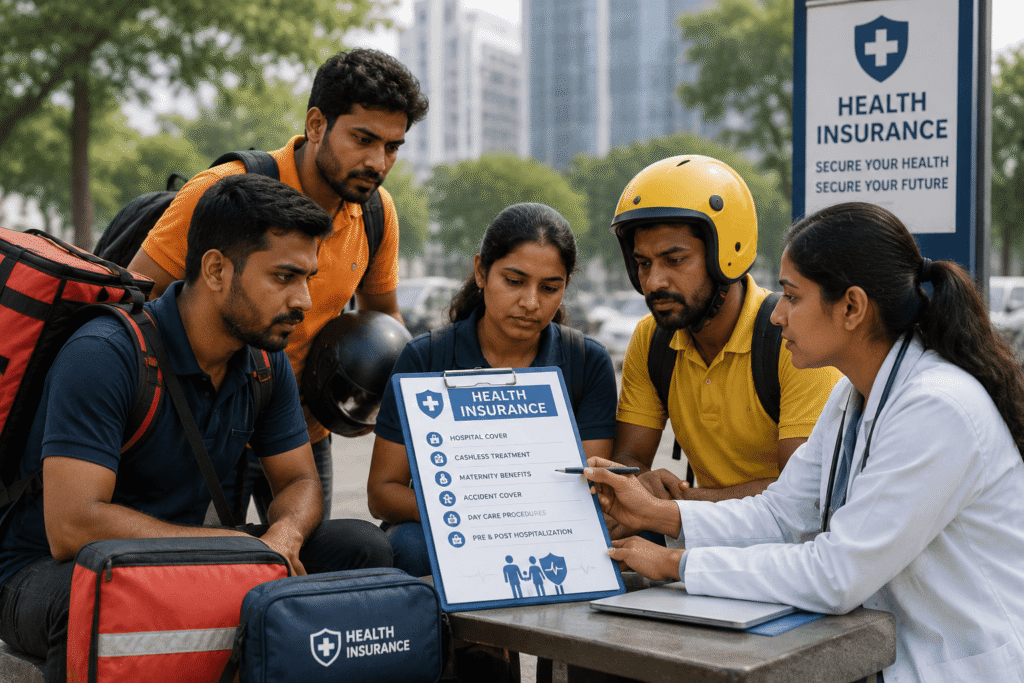
Health insurance: Gig workers seek health insurance protection against unexpected medical expenses. Affordable coverage can help provide financial security when illness or accidents strike.
NEW DELHI — Health Insurance: A Parliamentary Standing Committee has recommended a full GST waiver on health insurance premiums for gig and platform workers, flagging a tax anomaly it says actively discourages companies from insuring India’s fastest-growing category of workers.
The Rajya Sabha panel’s report on healthcare affordability, tabled on August 7, points out that group health insurance — the format typically used to cover gig and platform workers — is taxed at 18% GST, while individual retail policies bought by consumers are exempt. The committee said this fiscal logic “creates an unintended penalty for vulnerable workforces, such as gig workers and informal collectives,” and has recommended “a full GST waiver on low-cost group health insurance premiums up to a specific designated cap per life covered” to encourage platforms and cooperatives to extend coverage.
Also Read: Colombia Earthquake Death Toll Crosses 130, Insurers Brace for Property and Aviation Claims
Health Insurance: The bigger gap: 85% of the workforce has no job-linked cover
The GST recommendation sits within a larger finding: the committee observes that over 85% of India’s workforce operates within the informal sector, “entirely lacking institutional social security or structured healthcare coverage.” That figure refers specifically to the absence of employer-linked or scheme-based protection tied to their work — not that every worker in this group has zero insurance of any kind, since some may separately hold a government scheme card or a private policy bought on their own.
The committee noted that while the government spends approximately 1.5% of GDP on public healthcare, “public financing alone cannot fully absorb the catastrophic out-of-pocket health expenditures faced by millions of families,” and that formally bringing gig and informal workers under standard corporate health covers remains an “administrative bottleneck” in the near term.
Health Insurance: Zero-balance health accounts, on the RBI’s Jan Dhan model
To bridge this gap, the committee has proposed that every temporary, gig and informal-sector worker be mandatorily signed up for a zero-balance Health Savings Account (HSA), with onboarding responsibility resting on the employer or contracting platform rather than the worker.
The panel noted that the Reserve Bank of India has already cleared a regulatory pathway for such zero-balance HSAs, “analogous to the Jan Dhan architecture,” and that Bank of Baroda launched India’s first dedicated HSA product on December 18, 2025. Contributions would start out voluntary to avoid provoking employer resistance, with platforms “systemically nudged” to contribute ₹100 to ₹200 per worker per month.
The committee wants these HSA funds legally ring-fenced for health expenses and linked directly to insurers, cutting out intermediaries who it says currently “skim 30% to 40% off premium distributions” — a cost it argues is quietly inflating insurance prices for low-income workers.
The HSA model draws on global precedent cited in the report: Singapore pioneered the approach through its Medisave system in 1984, China’s version now covers over 300 million workers, and the US has over $50 billion managed in consumer HSAs.
Also Read: Have Corporate Health Insurance? Here’s Why You May Still Need a Personal Policy
Health Insurance: Folding gig workers into ESIC
The report also flags the Employees’ State Insurance Corporation (ESIC) — India’s main social security scheme for organised-sector workers — for failing to keep pace with the rise of gig employment. It recommends the “phased inclusion of unorganized and platform workers via national databases like e-Shram, supported by flexible contribution structures,” along with end-to-end digital claims processing, AI-driven fraud detection, and market-aligned treatment package rates to bring more private hospitals into ESIC’s network.
Health Insurance: Part of a wider coverage gap
These gig-worker measures sit within the committee’s broader finding that nearly 40 crore Indians — about 30% of the population — form a “missing middle,” too well-off for government schemes like Ayushman Bharat but unable to afford private insurance. Gig and platform workers, along with the urban poor and women in vulnerable occupations, were explicitly named by stakeholders during the committee’s consultations as groups needing expanded coverage.
Taken together, the GST waiver, mandatory zero-balance HSAs, and ESIC’s digital overhaul mark one of the more detailed policy attempts yet to formalise healthcare protection for India’s gig economy — a workforce that has expanded rapidly with the growth of ride-hailing, delivery and platform-based services but has so far been left to navigate healthcare costs largely on its own.
The recommendations now go to the Ministry of Finance, IRDAI and ESIC for consideration and implementation.