Why Your Car Insurance Claim Could Get Rejected — And How to Avoid It
Car insurance claim rejection often stems from lapsed policies, late reporting, or undisclosed modifications — a detailed look at what triggers a denial, how to escalate one, and how to prevent it.
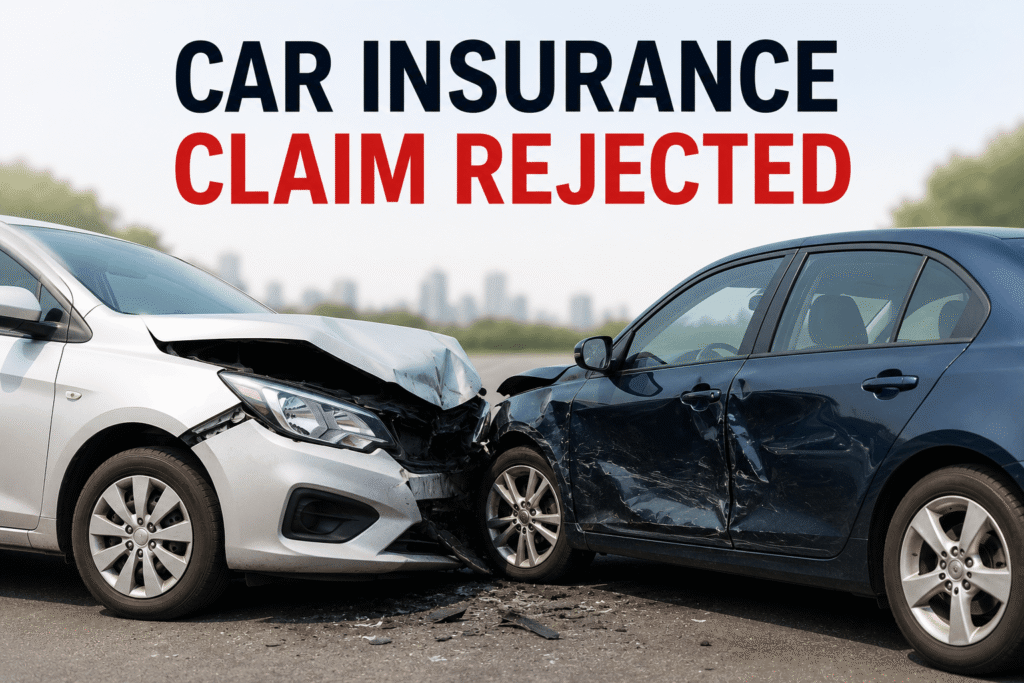
car insurance claim can get rejected even when your accident is genuine — a lapsed policy, late reporting, or an undeclared modification can be enough.
Car Insurance: Filing a car insurance claim after an accident, theft, or natural calamity is stressful enough without discovering, weeks later, that the insurer has declined to pay. Yet claim rejections remain a persistent complaint across India’s motor insurance segment. Industry observers and consumer forums consistently note that most denials do not stem from genuinely disputed damage — they trace back to a handful of recurring, largely preventable causes rooted in policy terms that policyholders rarely read closely at the time of purchase.
This piece breaks down the most common rejection triggers in detail, explains why insurers treat each one as grounds for denial, and outlines what a policyholder can do both before filing a claim and after receiving a rejection.
Also Read: Blackstone, Ex-HDFC ERGO CEO Anuj Tyagi Join Hands for New General Insurer — First 90% FDI Play
Car Insurance: How the Claims Process Typically Works
Before getting into rejection triggers, it helps to understand the sequence insurers follow. After an incident is reported, the insurer typically registers the claim, may depute a surveyor to assess damage (for larger claims), reviews submitted documents against policy terms, and either approves, partially approves, or rejects the claim. Rejections are usually communicated in writing with a stated reason, and insurers are generally required to provide this reasoning rather than deny a claim silently. Understanding this sequence matters because several rejection triggers occur very early — often before a surveyor is even involved — simply because of a technical mismatch between the policy and the incident.
Policy Lapse at the Time of the Incident
The single most common reason for rejection is also the simplest: the policy had already lapsed when the accident occurred. Motor insurance in India requires continuous, uninterrupted renewal, and even a gap of a single day between an old policy’s expiry and a new one being issued can void coverage for any incident falling within that window.
This is distinct from a policy being merely “due” for renewal — once expired, third-party liability cover is also void, which can expose the owner to legal liability beyond just the repair cost. Insurers generally recommend renewing at least a few weeks ahead of expiry, both to avoid a coverage gap and because a lapsed policy (particularly one lapsed for more than 90 days) may require a fresh vehicle inspection before it can be reinstated, delaying protection further.
Car Insurance: Delayed Intimation to the Insurer
Most insurers specify a narrow window — commonly within 24 to 48 hours — within which an accident, theft, or damage must be reported, either to the insurer directly or through their app or helpline. A meaningful share of rejected claims reportedly involve policyholders who delayed reporting because they assumed repairs could be arranged first, or because they were simply unaware such a deadline existed.
Insurers often treat late reporting as grounds to question a claim’s legitimacy — not necessarily because they suspect fraud, but because delay can compromise evidence (skid marks, vehicle position, witness recall) that would otherwise corroborate the account. Policyholders are generally advised to intimate the insurer immediately, even before arranging a tow or repair, and to follow up with an FIR where the incident involves theft, a hit-and-run, or significant third-party damage.
Also Read: Vikram-1 Launch: Who Insures Skyroot’s Rocket When It Flies — and When It Doesn’t?
Car Insurance: Driving Without a Valid or Appropriate Licence
A claim can be denied outright if the person driving did not hold a valid licence for the specific class of vehicle involved. This covers several distinct scenarios: a licence that had expired and not been renewed, a learner’s licence used without a qualified accompanying driver, or a licence that does not cover the vehicle category (for instance, a licence for manual transmission vehicles being used for an automatic, in jurisdictions where this distinction is enforced).
It also extends to cases where someone other than the insured or a permitted driver was behind the wheel, depending on the policy’s named-driver terms. Insurers typically verify this against the driving licence submitted with the claim, and a mismatch is one of the more clear-cut, non-negotiable grounds for rejection.
Car Insurance: Driving Under the Influence
Claims arising from accidents where the driver was found to be under the influence of alcohol or drugs are almost universally rejected, regardless of who was at fault in the collision itself. Insurers typically rely on police reports, breathalyser results, or medical test records from the treating hospital to establish this. Because this determination usually comes from an external authority (police or hospital) rather than the insurer’s own assessment, there is generally very little room to contest the rejection once such evidence is on record.
Unauthorised or Undeclared Vehicle Modifications
Aftermarket modifications that were not declared to the insurer — engine remaps, altered exhaust systems, unauthorised CNG or LPG kits, structural changes, or non-standard body kits — can void coverage related specifically to that modification, and in more serious cases, the entire claim. The logic insurers apply is that undeclared modifications change the risk profile of the vehicle from what was originally underwritten.
For CNG/LPG kits specifically, insurers usually require a separate add-on cover; without it, damage arising from or involving the fuel system may be excluded even if the modification itself didn’t cause the accident. Policyholders who modify their vehicle after purchasing a policy are generally advised to inform the insurer and add the relevant cover rather than assume it’s included by default.
Car Insurance: Using the Vehicle Outside Its Declared Purpose
A private car policy is underwritten on the assumption of personal use. If a vehicle insured this way is found to have been used for ride-hailing, food or parcel delivery, or other commercial purposes at the time of the incident, insurers commonly cite this mismatch between declared use and actual use as grounds for rejection. This has become a more frequently cited issue as ride-hailing and gig-delivery work have grown, with some policyholders reportedly unaware that their personal-use policy doesn’t extend to occasional commercial trips.
Car Insurance: Fraudulent, Inflated, or Misrepresented Claims
Claims involving suspected fraud — inflated repair estimates, staged accidents, pre-existing damage claimed as new, or misrepresentation of how an incident occurred — are rejected and can also trigger closer scrutiny of a policyholder’s subsequent claims or renewals. Insurers increasingly cross-verify garage estimates, parts invoices, and surveyor assessments against each other before settlement, and inconsistencies between the claim narrative and physical evidence are a common trigger for a fraud-related denial.
Car Insurance: Missing, Incomplete, or Inconsistent Documentation
Beyond the substantive reasons above, a large share of rejections and delays are purely procedural. This includes a missing FIR where one is required (typically for theft, major third-party damage, or hit-and-run cases), absent or incomplete repair estimates, an expired or missing driving licence copy, or inconsistencies between the claim form narrative and the police report. Policyholders are generally advised to keep the RC book, driving licence, policy document, and FIR (where applicable) organised and ready before initiating a claim, since insurers frequently return claims for resubmission over documentation gaps that have nothing to do with the incident itself.
Damage Not Covered Under the Policy Type
Not all damage is covered by every policy. A third-party-only policy, for instance, does not cover damage to the policyholder’s own vehicle at all — only damage or injury caused to a third party.
Even under comprehensive policies, certain exclusions typically apply: consequential damage (for example, engine damage from continuing to drive after a warning light), wear and tear, mechanical or electrical breakdown unrelated to an accident, and depreciation on parts unless a zero-depreciation add-on was purchased. Claims filed for this category of damage are often not “rejected” so much as they were never covered in the first place — underscoring the value of understanding what a policy actually includes before an incident occurs.
Car Insurance: What to Do If a Claim Is Rejected
A rejection is not always final. Insurers are generally required to state the specific reason for denial in writing, and policyholders who believe the rejection is unjustified can first raise the matter with the insurer’s internal grievance redressal officer. If unresolved, the matter can typically be escalated to the Insurance Ombudsman, a free, IRDAI-backed grievance mechanism for individual policyholders, provided the claim falls within the monetary threshold the Ombudsman handles and the complaint is filed within the specified time limit after the insurer’s final response. Keeping a written record of all correspondence with the insurer — claim intimation timestamps, emails, and the rejection letter itself — is generally advisable groundwork for any such escalation.
What Policyholders Can Do Proactively
Industry commentary consistently converges on a few preventive habits: renewing policies well ahead of expiry rather than at the last moment, intimating the insurer within the specified window regardless of whether repairs feel urgent, declaring any vehicle modifications and purchasing the relevant add-on cover, confirming that declared vehicle use matches actual use, and reading the exclusions section of the policy wording at the time of purchase rather than relying on assumptions. Where the situation is ambiguous — a borderline modification, an unusual use case, a lapsed-then-renewed policy — consulting the insurer or a licensed advisor before filing can meaningfully reduce the risk of an avoidable rejection.