Tarapur Nuclear Site: Why Global Reinsurers Stay Away Even as Indian Insurers Wage a Bruising Battle
Tarapur Nuclear Site: NPCIL budgeted Rs 30 crore to insure Tarapur’s reactors against physical damage. Oriental Insurance and United India Insurance, both running negative solvency ratios, bid it down to a third of that — for a risk global reinsurers barely touch.
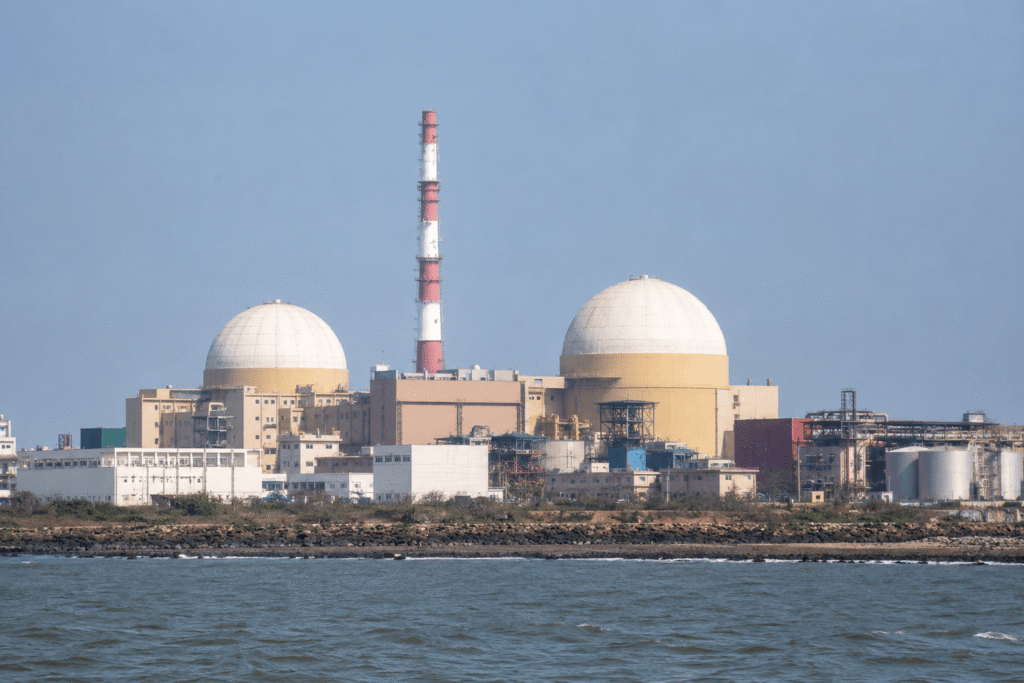
Tarapur Nuclear Site AI, Genrated image: Oriental Insurance and United India Insurance quoted Rs 10 crore and Rs 10.98 crore respectively for a nuclear property programme NPCIL had budgeted at over Rs 30 crore.
New Delhi-Tarapur Nuclear Site: Two of India’s state-run general insurers have gone in for a bruising price war to land a contract insuring physical assets at the Tarapur nuclear power station — and the numbers, first reported by ET, are stark enough to have revived questions about underwriting discipline at India’s public sector general insurers.
Nuclear Power Corporation of India (NPCIL) had budgeted Rs 30.13 crore, inclusive of taxes, for a one-year property damage cover on Tarapur units 3 and 4. When the contract went out for a reverse auction, Oriental Insurance came in at Rs 10 crore, United India Insurance at Rs 10.98 crore, and New India Assurance — the only bidder anywhere close to the budgeted figure — at Rs 28.9 crore. The same risk had been placed for roughly Rs 30–40 crore in previous years. Oriental and United India, the two lowest bidders, both carry solvency ratios well below what the regulator requires.
To someone outside insurance, that gap between Rs 30 crore and Rs 10 crore might just look like a good deal for NPCIL. It isn’t, and understanding why means unpacking a few things about how this kind of insurance actually works.
Tarapur Nuclear Site: What’s being insured here, and why it’s different from the “nuclear liability” you usually hear about.
Most nuclear insurance conversations in India revolve around the Civil Liability for Nuclear Damage (CLND) Act and the India Nuclear Insurance Pool — the mechanism that pays compensation to the public if an accident causes harm outside the plant. This contract is a different animal. It’s property damage insurance: cover for the physical plant itself — reactors, turbines, buildings, equipment — against fire, explosion, and other physical loss. The programme in question covers assets worth about Rs 7,500 crore, with a loss limit of roughly Rs 3,000 crore. So the premium being fought over, at Rs 10–29 crore, is meant to back a promise to pay out up to Rs 3,000 crore if something goes wrong.
Tarapur Nuclear Site: Why “non-safeguarded” matters.
Tarapur units 3 and 4 are indigenous pressurised heavy water reactors that don’t fall under the facilities India has placed under International Atomic Energy Agency (IAEA) safeguards — the inspection regime that applies to India’s civilian nuclear fleet under its 2008 safeguards agreement. Reactors under IAEA safeguards can usually draw on the international nuclear insurance and reinsurance system, because global reinsurers can verify, through IAEA oversight, that the facility is being run to civilian, not military-linked, standards.
A non-safeguarded facility offers no such verification. Large global reinsurers — the ET report names Munich Re, Swiss Re and SCOR — typically won’t put capacity behind this kind of risk at all. So Indian insurers can’t spread it through the routine “treaty” reinsurance arrangements that cover most of their book automatically.
They either carry the exposure themselves or go hunting for one-off “facultative” reinsurance overseas, deal by deal, which tends to be expensive precisely because so few reinsurers are willing to write it. That combination — large sum insured, thin reinsurance market, no automatic treaty support — is exactly the kind of risk where cutting the premium to a third of the going rate should raise eyebrows, not win applause.
Tarapur Nuclear Site: Solvency ratio, in plain terms.
An insurer’s solvency ratio measures how much capital it holds against the risks it has taken on; regulators set a floor — 1.50 in India — as the minimum buffer needed to be confident the insurer can pay claims even in a bad year. A ratio below 1 means the insurer’s own assessment shows its liabilities outweigh its solvency capital. As of March 31, 2025, National Insurance stood at -0.67, Oriental Insurance at -1.03, and United India Insurance at -0.65 — all deep in negative territory, and all still government-owned.
Oriental and United India are the same two insurers now willing to write a single policy at a third of its recent going rate, against a payout ceiling a hundred times the premium they’re charging.
Tarapur Nuclear Site: The reverse auction angle.
State-run insurers, like most public sector buyers of goods and services in India, are increasingly required to procure large policies through reverse auctions — bidders progressively undercut each other, and the lowest quote typically wins. It’s a sound way to buy stationery or fleet insurance. Applied to a risk this specialised, with this little reinsurance backup, a reverse auction can just as easily produce a race to the bottom as it can produce genuine efficiency, especially when the bidders are public insurers under pressure to show top-line business rather than underwriting profit.
Tarapur Nuclear Site: Timing.
The bidding surfaced only days after the Insurance Regulatory and Development Authority of India (Irdai) had urged general insurers to stick to prudent underwriting and sustainable pricing amid what the regulator flagged as intense, margin-eroding competition in the property insurance market. Whether this contract becomes an example Irdai points to, or simply passes as one more line in a loss-making segment’s ledger, is something worth watching in the months ahead.