Health Insurance Claims Now Account for 55% of All General Insurance Payouts, RBI Data Shows
Health insurance claims accounted for 55 per cent of all general insurance payouts in India in 2025-26, according to the RBI’s Financial Stability Report

Health Insurance Claims: Underwriting losses at general insurers widened in FY26, with investment income quietly masking the shortfall — RBI flags this as a systemic vulnerability.
New Delhi: Health insurance claims has overtaken every other line of general insurance business to become the single largest driver of claims payouts in India, according to the Reserve Bank of India’s Financial Stability Report (FSR).
Health insurance claims accounted for 55 per cent of total net incurred claims in the general insurance segment in 2025-26, the RBI report said, citing data from the Insurance Regulatory and Development Authority of India (IRDAI). Motor insurance was the second-largest contributor at 40.3 per cent. Together, health and motor now make up 95.3 per cent of all net incurred claims in the general insurance industry, leaving fire, marine and other traditional lines a shrinking share of the claims pool.
The RBI attributed the rise in health claims to medical inflation, rising hospitalisation rates and expanding coverage — a combination that has steadily pushed up the cost of servicing health policies even as more Indians come under insurance cover.
Also Read: Why Your Bike Insurance Claim Gets Rejected: 5 Common Reasons
Health Insurance Claims outpaced premium growth
The shift comes against a backdrop of overall claims growth outpacing the general insurance sector’s expansion. Net incurred claims in the general insurance segment rose from approximately ₹1.4 lakh crore in 2021-22 to ₹2.1 lakh crore in 2025-26, an increase of nearly 50 per cent over five years, the report said. Total general insurance premiums, by comparison, reached ₹3.4 lakh crore in the same period.
The RBI flagged that the concentration of claims in health and motor “creates correlated and structurally growing loss exposure that may strain reserving adequacy and underwriting margins, if not continuously recalibrated” — a warning aimed at insurers’ ability to price and reserve for these lines without regular recalibration.
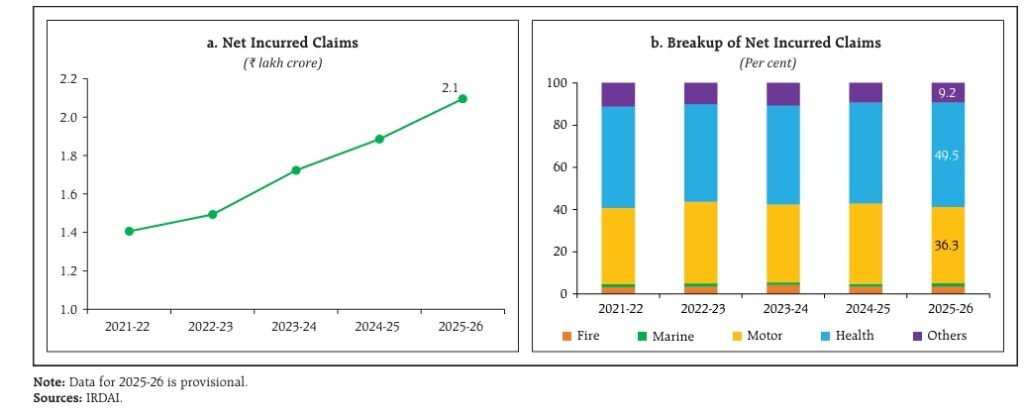
Health Insurance Claims: Underwriting losses widen, investment income plugs the gap
The report also noted that public sector general insurers’ underwriting losses widened further in 2025-26, with standalone health insurers (SAHIs) and private general insurers also recording significant underwriting losses during the year. Investment income has continued to subsidise these technical losses across the segment, the RBI said, warning that this “structural dependence on non-underwriting income as the primary profit stabiliser is a systemic vulnerability” — meaning any compression in investment yields or a market correction could directly expose weak underwriting performance that is currently being masked by investment gains.
The report’s scenario analysis adds weight to that warning. Under a severe stress test, only 4 of the top 10 general insurers would retain solvency ratios above the regulatory benchmark of 1.5 times the Required Solvency Margin, down from 7 under a mild stress scenario.
Three insurers, the RBI said, have remained below the regulatory minimum solvency ratio of 150 per cent for five consecutive quarters, from Q4 2024-25 through Q4 2025-26 — a persistence the report described as “a direct financial stability concern.” The RBI further noted that capital buffers across the top 10 general insurers are unevenly distributed, with a cluster of insurers operating on comparatively thin cushions above the regulatory floor, even as investment income keeps their underwriting shortfalls from showing up in headline losses.
Also Read: Pradhan Mantri Suraksha Bima Yojana: Complete Guide 2026
Health Insurance Claims: A regulatory response already underway
Separately, IRDAI has already begun responding to strain in the health insurance ecosystem. The regulator, in collaboration with the Confederation of Indian Industry (CII), has set up a structured engagement between health insurers and healthcare providers, organised into 10 thematic working groups tasked with examining claims management, hospital fraud, standardisation and policyholder experience. The first phase of this initiative runs from March to December 2026, with progress reviewed monthly through a joint coordination committee.
IRDAI has also constituted a dedicated Sub-Committee on Health Insurance in April 2026 to review the private health insurance landscape, including claims experience, product design, grievance redressal and financial protection outcomes.
For policyholders, the data underscores a trend that many will already feel anecdotally: health cover is becoming costlier to insure against, and insurers’ ability to keep pricing sustainable while claims keep climbing will likely shape premium trends in the years ahead.
You can read the full report here: RBI Report