Heavenly Spices Garlic Powder Recall: Here’s How US Companies Protect Themselves
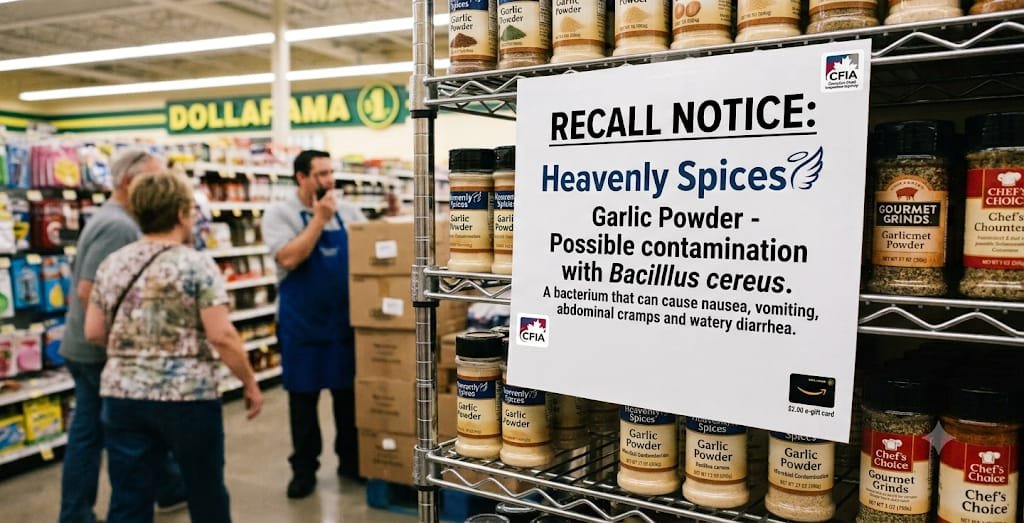
Heavenly Spices garlic powder has been recalled across Dollarama stores after tests flagged possible Bacillus cereus contamination, prompting a Class 2 warning from Canadian food safety regulators.
Heavenly Spices Garlic Powder Recall: Here's How US Companies Protect Themselves
Garlic Powder Recall: The Canadian Food Inspection Agency (CFIA) recalled Heavenly Spices brand garlic powder this week, after routine testing flagged possible contamination with Bacillus cereus, a bacterium that can cause nausea, vomiting, abdominal cramps and watery diarrhea. The recalled product, sold in 70-gram containers through Dollarama stores nationwide and online, was pulled following a CFIA notice issued on July 15, 2026, and classified as a Class 2 recall, meaning there is a moderate risk of short-term, non-life-threatening illness.
The agency has advised retailers and consumers not to use, sell, serve or distribute the affected batches, and Dollarama has reportedly offered a small gift card to affected customers. The recall surfaced in the same week as reports that General Mills pulled more than 735,000 packages of Pillsbury bread products over possible glass contamination, adding to a run of recent US food safety incidents.
For an audience that tracks risk and insurance, the who, what and when of a recall notice is only the opening chapter. The more consequential story is what happens next inside the company that made the product, and how prepared, or unprepared, its insurance program is for the fallout.
Garlic Powder Recall: What Happened
The recalled garlic powder was sold in 70-gram containers, both in stores and online, and Dollarama has reportedly offered affected customers a small gift card as compensation. Symptoms of Bacillus cereus infection typically resolve within 24 to 48 hours, and the bacterium is commonly associated with foods like meat, stews, and rice that have been improperly stored. What makes spice recalls particularly tricky, though, is shelf life and traceability.
Garlic powder can sit in a kitchen cabinet for months, gets used in small pinches across dozens of meals, and is frequently decanted into unlabeled containers — all of which make it harder for consumers to know they even have the recalled product, and harder for a company to fully contain the fallout once a recall notice goes out.
Also Read: Cyclospora Alert: The ‘Explosive Diarrhea’ Parasite Making Headlines Worldwide
That containment problem is exactly why product recall insurance exists as a distinct, specialized line of coverage in the US market.
Garlic Powder Recall: Why General Liability Isn’t Enough for a Recall Like This
A lot of food and consumer goods companies assume their general liability policy has them covered if a batch goes bad. It doesn’t, at least not for the recall itself. General liability responds when someone gets hurt and sues — it pays for bodily injury and property damage claims. It does not pay for the actual cost of pulling a product off shelves, destroying it, notifying distributors, or rebuilding a damaged brand. That is where a standalone product recall policy, sometimes called contaminated product insurance, steps in.
Also Read: As Monsoon Floods Hit Indian Cities, Home Insurance Remains an Afterthought
In the US, product recall coverage is typically built to reimburse a business for the tangible and intangible costs of a withdrawal: the logistics of retrieving stock from retail and distribution, disposal costs, replacement product, extortion or malicious tampering threats, lost profits during the disruption, and brand rehabilitation expenses like PR and crisis communications. Some carriers also bundle in risk management services — audits, crisis simulations, and rapid-response consulting — aimed at preventing a recall from happening in the first place or shrinking its scope if it does.
Garlic Powder Recall: The Cost Numbers Behind US Recall Insurance Demand
Recalls are not rare, and they are not cheap. Industry estimates commonly cited by US brokers put the average direct cost of a food recall at around 10 million dollars, a figure that captures logistics, disposal and replacement costs but understates the reputational damage that can follow.
Broader data on product recalls across categories shows the scale of the problem: nearly a billion total product units were recalled in the United States in a single recent year, and recall volume for consumer products jumped sharply in early 2022 compared with the prior year. Tightening regulatory oversight from agencies like the FDA and USDA, paired with growing consumer awareness of foodborne illness, is widely expected to keep pushing recall frequency upward rather than down.
Garlic Powder Recall: What a Product Recall Policy Typically Covers, and What It Doesn’t
Coverage under a US product recall or contaminated product policy generally responds to both voluntary recalls, where a company pulls a product proactively, and involuntary recalls, where a regulator like the CFIA or FDA orders it. Typical inclusions are recall response costs, business interruption tied to the disruption, third-party claims arising from contract manufacturing errors, and reputation or crisis management support.
Exclusions are just as important to understand. Most policies won’t pay out for recalls involving known contaminants that were disclosed before the policy was purchased, for banned substances or carcinogens, or for costs incurred outside the policy period. Brokers who specialize in this line generally advise food and beverage companies to work with carriers that have dedicated recall units and a track record of handling contamination claims, rather than treating recall coverage as a generic add-on.
The Bigger Takeaway for Risk Managers: Garlic Powder Recall
A single garlic powder recall may sound minor next to headline-grabbing auto or pharmaceutical recalls, but it illustrates the exact scenario US product recall insurance is built for: a shelf-stable, widely distributed item, sold through a mass retail channel, where contamination surfaces only after the product has already reached millions of households. As regulatory scrutiny on food safety tightens and recall frequency continues to trend upward, US food and consumer goods manufacturers are increasingly treating recall insurance not as an optional extra, but as a core part of balance sheet protection.