$355 Million Secret Behind England vs Argentina: Who Really Pays If Messi or Kane Get Hurt?
While fans focus on the scoreboard during the England vs. Argentina World Cup semifinal, a massive financial safety net is already in play. From a record $355 million FIFA compensation pool to multi-million-euro injury policies.
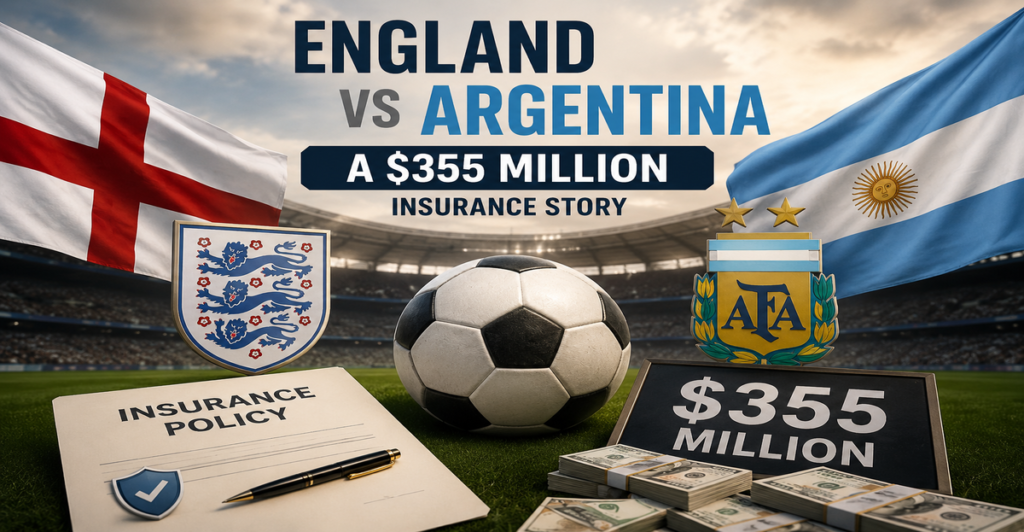
When football meets finance: the England–Argentina rivalry has a $355 million insurance story behind it.
Before Harry Kane and Lionel Messi take the pitch in Atlanta on Wednesday, FIFA’s insurers have already priced in the risk of them getting hurt. This year’s World Cup carries the largest club-compensation payout in the tournament’s history, and it exists entirely because of the injury insurance built into international football.
England vs Argentina:A Record Payout Tied to Every Minute Played
FIFA’s Club Benefits Programme, the fund that pays clubs for releasing players to their national teams, has been raised to a record $355 million for the 2026 edition, a nearly 70 percent increase over the $209 million distributed after the 2022 World Cup.
The mechanism is straightforward: the pool is divided by the total number of player-days across the tournament to arrive at a standardised daily rate, and clubs are paid for every day their player spends on national duty, win or lose. Manchester United, Manchester City and the rest of the clubs with players in tonight’s semifinal will all collect a share of that fund regardless of what happens on the scoreboard.
That programme is separate from, and sits alongside, a second and more consequential layer of cover: insurance against the players actually getting hurt.
England vs Argentina:The Injury Clause Every Club Is Watching
The FIFA Club Protection Programme is the policy that activates the moment a Messi, a Kane or a Jude Bellingham goes down injured on international duty.
It compensates clubs for wages paid to players sidelined for 28 days or more due to accidental injury sustained while on official national team duty, though it explicitly excludes illness, permanent injury, death or medical treatment costs. Payment is capped, and clubs can claim up to €7.5 million per accident, paid daily for up to 365 days after the first 28 days of absence, calculated only on the player’s fixed salary.
This is not a theoretical clause. Uruguay’s Manuel Ugarte suffered a serious knee injury during the tournament, and Manchester United is set to recoup close to £6 million in wage compensation for his expected nine-month absence, with the payout capped in line with the programme’s weekly salary ceiling.
Also Read: Haaland vs Kane: The Hidden $7.5 Million Insurance Policy Protecting Norway vs England Stars
Canada’s Ishmael Kone suffered severe lower leg fractures (breaking both his tibia and fibula) during a group-stage match against Qatar, triggering a claim that is expected to net his club, Sassuolo, roughly €650,000 once the qualifying absence period is worked out.
Every club with a player in an England or Argentina shirt tonight is carrying that same exposure, and industry commentary has already flagged that the FIFA scheme, while useful, is often inadequate to fully protect clubs against the financial fallout of losing a genuinely key player, which is why many clubs layer on their own commercial insurance against loss of income and asset devaluation.
Demand Risk: What a 34 Percent Ticket Spike Signals
The insurance story extends beyond the players. Secondary-market ticket prices for this semifinal have moved sharply in the days leading up to kickoff, with rates for the Argentina-England fixture rising 34 percent over the past three days, making it more expensive than the other semifinal between France and Spain.
That kind of demand spike is exactly the pattern that drives uptake of event-ticket insurance and travel-protection products, both of which have become a routine add-on for fans booking cross-border trips to marquee sporting fixtures. For India’s growing base of international sports travellers, a match like this is a useful real-world case for why ticket and travel cover matter for high-demand events, not just for cancellation risk but for price volatility itself.
Also Read: What Vinod Khosla’s $9.6 Bn Seahawks Purchase Reveals About Sports Franchise Insurance
Why This Matters Beyond Football
Put together, the numbers around tonight’s match sketch out a fuller picture of how much financial risk sits underneath a 90-minute game: a $355 million club-compensation pool, individual injury claims running into the millions of dollars, and a ticket market moving by double digits in a matter of days. None of this shows up on the scoreboard, but it is the layer of insurance infrastructure that makes modern international football financially viable for the clubs that supply the players. As India’s insurance and InsurTech sector looks for relatable, high-visibility examples of sports risk management, England vs Argentina is as good a case study as any.