The Fastest Ebola Outbreak on Record Is Spreading Without the Safety Net Built to Stop It
Ebola Outbreak: The world built a $500M pandemic bond after the 2014 Ebola crisis to fund fast outbreak response. It expired in 2020. Now DRC faces the fastest-growing Ebola outbreak on record — with no financial safety net in place.
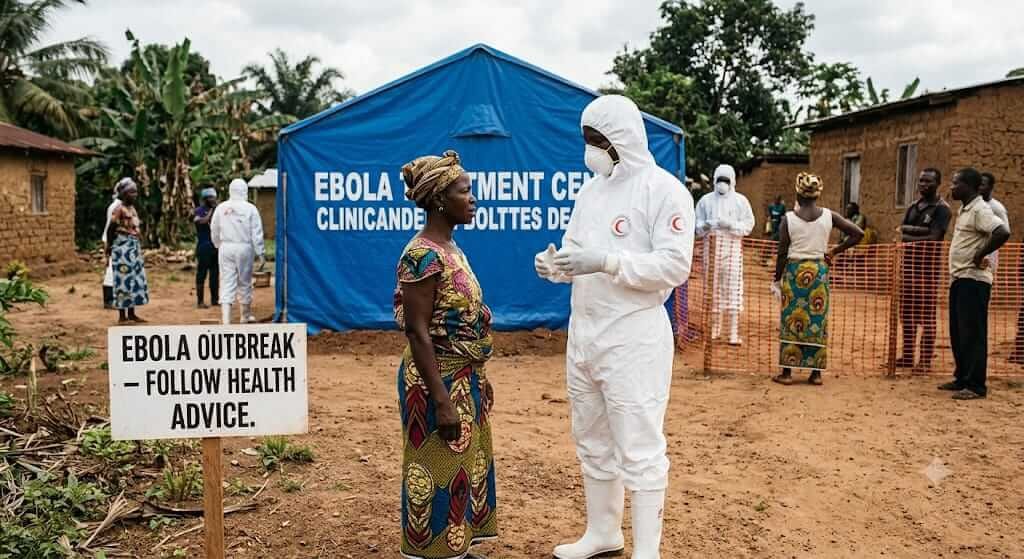
Ebola Outbreak: The current outbreak was declared a Public Health Emergency of International Concern by the World Health Organization on May 16, 2026
Ebola Outbreak: Nearly a decade ago, after Ebola killed more than 11,000 people in West Africa, the world built a financial insurance policy meant to make sure a slow-funded response never happened again. That policy has since expired — and was never replaced.
Now, the Democratic Republic of the Congo is facing what health officials are calling the fastest-growing Ebola outbreak on record. And the safety net designed specifically for this scenario doesn’t exist anymore.
Ebola Outbreak: A fast-moving outbreak with a new, harder-to-treat strain
The current outbreak was declared a Public Health Emergency of International Concern by the World Health Organization on May 16, 2026, centered in Ituri Province in northeastern DRC and spreading into Uganda. As of late July, DRC has reported more than 2,470 confirmed cases and nearly 1,000 deaths — figures that have made this the third-largest Ebola outbreak on record just over two months after it began.
Also Read | Cyclospora Alert: The ‘Explosive Diarrhea’ Parasite Making Headlines Worldwide
Unlike past outbreaks driven by the more familiar Zaire ebolavirus, this one is caused by the Bundibugyo virus — a rarer strain for which there is no approved vaccine or specific treatment. That has left responders leaning almost entirely on containment: rapid case detection, isolation, and contact tracing, in a region already strained by conflict, airport closures, and disrupted supply chains. More than 1,400 Doctors Without Borders staff are currently on the ground, alongside teams from the International Organization for Migration running border health screenings across 11 countries.
Uganda’s outbreak appears to be winding down, with no new cases reported since June 21. DRC’s is not.
Ebola Outbreak: The insurance policy built after the last catastrophe
The scale of the 2014–16 West Africa Ebola outbreak — over 11,000 deaths and an estimated $53 billion in economic damage — pushed the World Bank to try something unprecedented. In 2017, it launched the Pandemic Emergency Financing Facility, backed by $500 million in bonds and derivatives, with reinsurance giants Munich Re and Swiss Re among the backers. It was the first time pandemic risk in low-income countries had ever been transferred to financial markets.
The idea was simple: instead of waiting for slow-moving disaster aid, the PEF would trigger automatic payouts the moment an outbreak hit certain benchmarks — case counts, death tolls, and cross-border spread — verified by the WHO. In theory, money would move at outbreak speed, not bureaucracy speed.
Ebola Outbreak: It failed the first time it was tested
The PEF got its first real-world test during the 2018–19 Ebola outbreak in DRC, the second-worst on record at the time. It failed to pay out. The trigger required 20 deaths in a neighboring country before releasing funds — Uganda recorded a handful of deaths, but not enough to cross the threshold. The bonds’ investors kept their money. The DRC response went ahead without it.
Also Read | Cyclospora Alert: The ‘Explosive Diarrhea’ Parasite Making Headlines Worldwide
Critics pointed to a deeper design flaw beyond the threshold itself: the earliest a payout could even be evaluated was 12 weeks into an outbreak, with realistic disbursement closer to 14 weeks. During the 2014 outbreak, the monthly cost of an effective response rose from roughly $5 million to $490 million in that same window — a hundredfold increase in exactly the time it took the bond’s own mechanism to act.
Ebola Outbreak: And then it quietly disappeared
The original PEF bonds matured in July 2020, in the middle of the COVID-19 pandemic, and were not renewed in their original form. The World Bank has since discussed a redesigned “PEF 2.0,” but no equivalent pandemic bond covering Ebola has replaced the one that expired. For all practical purposes, the flagship financial instrument built specifically to fund a fast response to an outbreak like this one no longer exists.
That gap is not abstract right now. It’s the backdrop to the response currently underway in Ituri Province.
Ebola Outbreak: Why this matters beyond DRC
Slow funding doesn’t just cost money — it costs containment time, and containment time is what keeps an outbreak local instead of global. This outbreak has already produced imported cases evacuated for treatment in Germany and France, both linked to humanitarian workers who had been in affected areas. Every week that response funding lags is a week the virus has to keep moving.
For readers with more immediate, personal stakes — travelers, aid workers, expats, and anyone with family in the region — the practical fallout includes real coverage gaps too: standard travel insurance policies typically exclude claims tied to “known events” once a country is under a formal outbreak declaration, and many independent contractors and freelance workers in the region lack the specialized medical evacuation coverage that NGOs provide to their staff.
Ebola Outbreak: The open question
Nearly ten years after the world said it had learned its lesson from Ebola, the instrument built to prove it is gone, and nothing has fully replaced it. Reinsurers, global health financing experts, and World Bank officials have spent years publicly debating what a better version should look like. This outbreak is likely to reopen that debate — the question is whether it produces anything more durable than the last one did.