Insurance Claim Disputes Tripled in 4 Years, Govt Tells Parliament
Insurance claim disputes have surged threefold over the past four years, according to data shared by the government in Parliament. The rise highlights increasing concerns around claim rejections, settlements and policyholder grievances.
Insurance claim disputes have tripled in just four years, raising fresh concerns for policyholders.
NEW DELHI — Insurance Claim: The number of policyholders formally contesting rejected insurance claims with the Insurance Ombudsman has surged by nearly 195% over the past four years, according to official data presented by the Ministry of Finance in the Lok Sabha on Monday.
However, this dramatic increase in formal grievances must be viewed alongside a massive, simultaneous expansion in total insurance claims paid nationwide. In sectors like health insurance, claim payouts have more than quadrupled over the same period, leading to an overall decline in the percentage of claims being rejected.
Despite better settlement percentages, the sheer growth of the insurance market has pushed the absolute number of repudiation complaints before the Ombudsman from 11,942 in 2021–22 to 35,186 in 2025–26.
Also Read: Health Insurance Premium: 6 Legal Ways to Cut Cost
Insurance Claim: A Parallel Surge Across Judicial Forums
The explosion in consumer grievances is not restricted to the Ombudsman system. Data from the Insurance Regulatory and Development Authority of India (IRDAI) reveals a similar trend in the judiciary.
Cases decided by courts and consumer forums skyrocketed from 19,025 in 2021–22 to 46,122 in 2025–26, representing a 142.4% increase.
Many policyholders assume that taking an insurer to court yields better results than approaching an Ombudsman. However, official statistics demonstrate that win rates across both channels are virtually identical.
Insurance Claim: Consumer Win Rates: Ombudsman vs. Courts
The table below tracks case disposals and policyholder success rates across both redressal mechanisms over the last five financial years:
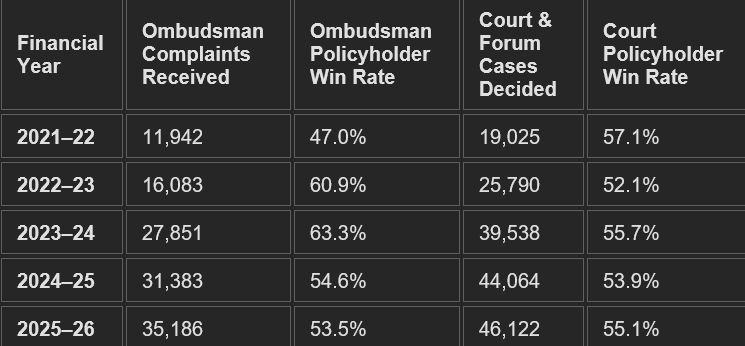
In 2025–26, the Ombudsman ruled in favor of complainants in 18,809 out of 35,186 cases (53.5%). During the same period, courts decided 25,418 out of 46,122 cases in favor of policyholders (55.1%).
Because the Ombudsman system is entirely free and charges insurers a penalty of ₹5,000 per day for delaying award payments, it remains a faster and more cost-effective option for aggrieved policyholders.
Insurance Claim: The Scale Paradox: Payouts Boom as Rejection Rates Drop
While rising dispute numbers suggest growing consumer frustration, category-level data reveals that insurers are actually settling a higher proportion of claims than they did four years ago.
The table below breaks down claims paid versus claims repudiated across major insurance sectors:
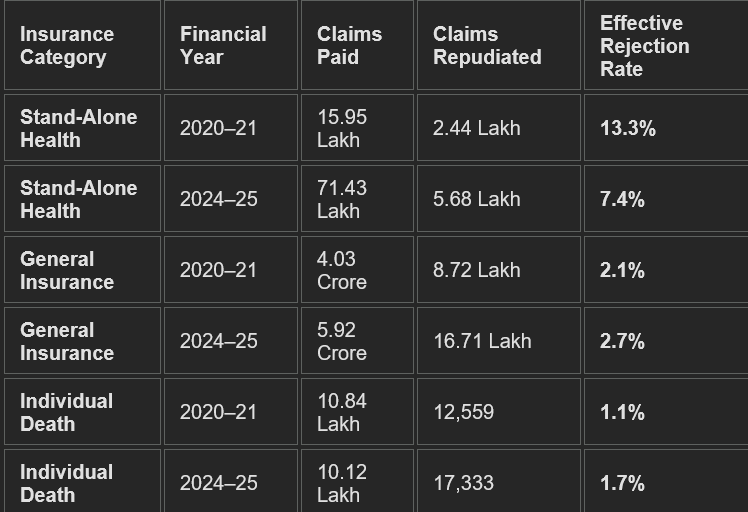
In stand-alone health insurance, claims paid surged by 347.6% over five years. As a result, the actual rejection rate for health policies dropped almost in half, falling from 13.3% in 2020–21 down to 7.4% in 2024–25.
However, because total coverage has expanded so rapidly, even a low rejection rate translates to over 1.6 million rejected general insurance claims every year. This sheer volume continues to drive thousands of policyholders into formal dispute channels.
Also Read: Cashless Health Claim Refused? A Step-by-Step Guide For Escalation
Insurance Claim: Regional Disparities Across Indian States
Government data from the Council of Insurance Ombudsman highlights major geographic variations in dispute volume and consumer outcomes.
The table below illustrates the performance of key states in Ombudsman claim repudiation cases for 2025–26:
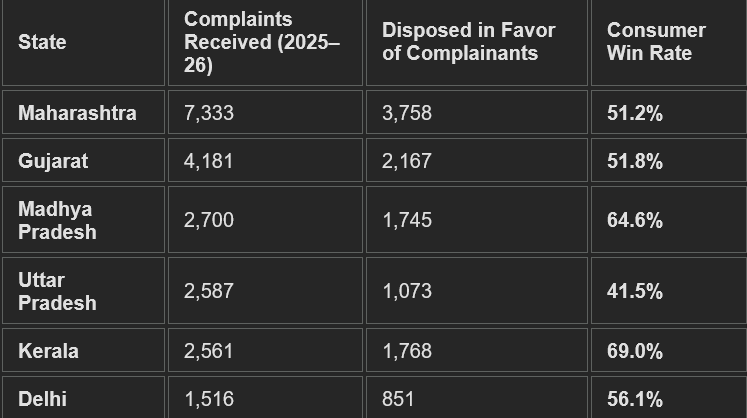
Kerala led consumer win rates, while Maharashtra recorded the most complaints.
Western states dominate the dispute landscape. Maharashtra and Gujarat together recorded 11,514 complaints in 2025–26, representing nearly 33% of all claim repudiation disputes in the country.
On the other hand, Kerala stands out as the most favorable state for policyholders contesting rejections, with the Ombudsman ruling in favor of consumers in 69% of cases.
Insurance Claim: Regulatory Reforms vs. Operational Reality
To curb arbitrary claim rejections, the IRDAI introduced updated protection regulations in 2024. Under these guidelines, health insurance claims cannot be repudiated without prior approval from an internal Claims Review Committee (CRC) or Product Management Committee (PMC).
Insurers are also required to issue policy terms in simple language, offer regional language documentation, and provide a mandatory 30-day free-look period for consumers to review policy conditions.
Despite these regulations, common triggers for claim repudiation persist. Insurers continue to cite non-disclosure of material facts, documentation delays by hospitals or garages, pre-existing condition waiting periods, and fraud investigations as primary grounds for rejection.