Govt’s Bima Bharosa portal received over 800 insurance complaints every day in FY26
Bima Bharosa: From claim disputes to service issues, the portal helps consumers register grievances and track their resolution.
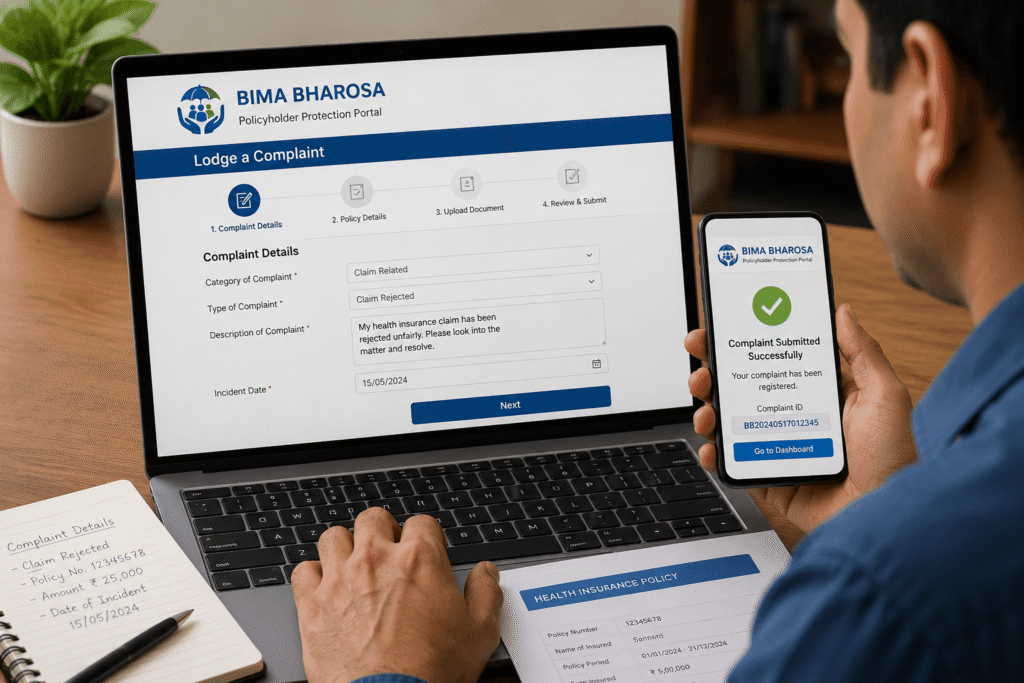
Bima Bharosa: Bima Bharosa gives policyholders a dedicated platform to raise insurance-related complaints and seek redressal. Ai-Generated-Image.
New Delhi — Bima Bharosa: Nearly 10,000 grievances remain unresolved, with health insurance accounting for the largest share of pending cases
The government’s Bima Bharosa portal — the centralised grievance redressal platform for the insurance sector — received 2,97,468 complaints during FY 2025-26, translating to roughly 815 complaints every single day, according to data placed before the Lok Sabha.
The figures were shared by Minister of State for Finance Pankaj Chaudhary in a written reply to an unstarred question from Congress MP Shashi Tharoor on July 27, 2026. The data, sourced from the Insurance Regulatory and Development Authority of India (IRDAI), gives a segment-wise breakup of complaints across life, health and general (non-life) insurance.
Also Read: Health Insurance Premium: 6 Legal Ways to Cut Costs
Bima Bharosa: The numbers

While the overall disposal rate across the portal stood at about 96.6%, the pendency was not evenly spread. Life insurance complaints were cleared at a rate of 99.5%, but health insurance — which received almost as many complaints as life insurance — saw only 95.2% disposed, leaving 5,664 cases pending. General insurance fared even worse proportionally, with a disposal rate of 93.9%.
In effect, health and general insurance complaints are pending at nearly 6–8 times the rate seen in life insurance, despite IRDAI’s mandate that insurers acknowledge complaints immediately and resolve them within 14 days.
Bima Bharosa: Why health claims get stuck
The government’s response also detailed why health insurance claims are commonly repudiated or only partially settled. According to IRDAI’s findings, the leading reasons include:
- Non-compliance with policy terms and conditions
- Exhaustion of the sum insured
- Misrepresentation, non-disclosure, or fraud
- Hospitalisation deemed not medically warranted or falling short of minimum duration requirements
- Claims exceeding sum insured or sub-limits
- Co-payment or deductible clauses
- Room rent or proportionate charging limits being breached
- Non-medical expenses not covered under the policy
Bima Bharosa: Mis-selling complaints
Separately, the reply disclosed that 26,667 grievances related to Unfair Business Practices (UFBP), including mis-selling, were reported on the Bima Bharosa portal in FY 2024-25 — a year prior to the headline complaint figures cited above, since that specific dataset was not updated for FY 2025-26 in the government’s response.
To address mis-selling, IRDAI said it has directed insurers to assess product suitability, conduct financial underwriting, provide Customer Information Sheets (CIS), offer free-look cancellation, and implement channel-specific controls, along with periodic root-cause analysis of grievances.
Also Read: Cashless Health Claim Refused? A Step-by-Step Guide For Escalation
Bima Bharosa: What the government says it’s doing
IRDAI listed several measures aimed at strengthening the grievance redressal mechanism:
- Insurers are required to maintain technology-based grievance infrastructure and integrate it with the Bima Bharosa portal for real-time tracking by policyholders
- A 14-day resolution timeline has been mandated for complaints
- A 12-language call centre is operational for registering complaints, alongside physical letters and emails
- IRDAI monitors grievances through MIS reports, periodic reviews, and on-site inspections, with supervisory action taken for non-compliance
Bima Bharosa: The bigger picture
While the government’s answer frames these steps as improving “monitoring and accountability,” the reply stops short of naming individual insurers with high complaint volumes or listing specific penalties imposed for mis-selling or unfair practices — details that would allow for more direct accountability of repeat offenders.
The disparity in pendency rates also raises questions about whether health insurance, given its complexity — sub-limits, room-rent caps, documentation disputes — needs a differentiated grievance-handling timeline or dedicated redressal track, rather than a uniform 14-day target applied across all segments.
(Source: Lok Sabha Unstarred Question No. 1203, answered on July 27, 2026, Ministry of Finance, Department of Financial Services)