Cashless Health Claim Refused? A Step-by-Step Guide For Escalation
Cashless health claims refused over tariff or documentation disputes still have a defined escalation path — from grievance officer to Insurance Ombudsman — and the right to reimbursement stays intact.
Cashless Health Claim: A cashless refusal isn't the end of the road — it's the start of a defined escalation process. Here's why it happens, and the full ladder from written denial to the Insurance Ombudsman.
New Delhi — Cashless Health Claim: A refused cashless request at the hospital counter is one of the most common breakdowns in India’s health insurance system. It almost always surfaces at the worst possible time — during admission or right before discharge — when patients and families have the least room to negotiate with a TPA desk. In most instances, the refusal traces back to a dispute between the hospital and the insurer, not to the patient’s claim being invalid.
That distinction is the starting point for everything that follows. A cashless refusal is not a claim rejection. It is an authorisation failure at the point of service — and the underlying claim can still be pursued through reimbursement in nearly every case.
Also Read: Your Kisan Credit Card Has Upto ₹10.5 Lakh of Hidden Insurance. Do You Know About It?
Cashless Health Claim: Why Cashless Requests Get Refused? The Reasons Explained
Tariff or Package-Rate Disputes
This is the single largest cause of cashless refusals. Every network hospital has a negotiated tariff agreement with each insurer, specifying the pre-agreed rate for procedures, room categories, and standard treatment packages. When the hospital’s billing desk quotes a rate for a specific surgery or procedure that doesn’t match what the insurer has on file — often because the hospital has revised its rates, or the procedure involves additional components not covered under the standard package — the TPA holds back authorisation until the rate is reconciled.
This dispute is entirely between the hospital and the insurer; the patient’s eligibility for the claim itself is not in question, but they get caught in the middle until the two sides agree on a number.
Network Status and Empanelment Issues
Hospitals can lose or gain network status with specific insurers over time, and this isn’t always visible to the patient at the point of admission. A hospital may display “cashless facility available” broadly, but that empanelment may apply to some insurers and not others, or may have lapsed for a particular insurer due to contract renewal delays. This creates situations where a patient assumes cashless will work simply because the hospital treats other cashless cases regularly, only to discover their specific insurer isn’t currently empanelled there.
Incomplete or Ambiguous Pre-Authorisation Forms
TPAs assess cashless requests based on the clinical information the hospital submits in the pre-authorisation form — diagnosis, proposed treatment, estimated cost, and supporting test reports. When this documentation is incomplete, vague, or doesn’t clearly justify the line of treatment (for instance, missing investigation reports that support a diagnosis), the TPA raises a query rather than approving outright. Each such query effectively pauses the clock on the insurer’s response timeline until the hospital resubmits complete information, which is why documentation gaps are a frequent and avoidable source of delay.
Suspected Policy Exclusion or Waiting Period
If the condition being treated appears, on the face of the pre-authorisation request, to fall under a specific exclusion in the policy — such as a pre-existing disease still within its waiting period, or a treatment listed as non-payable — the TPA may deny cashless pending further review. This is a preliminary flag based on limited information at the point of admission, not a final adjudication; a more complete clinical picture submitted later, at the reimbursement stage, can sometimes establish that the exclusion doesn’t in fact apply.
Room Rent and Sub-Limit Breaches
Many policies cap eligible room rent as a percentage of the sum insured, or specify a maximum room category (such as “single private room”). When a patient is admitted to a room category above this entitlement, the TPA may refuse cashless for the portion exceeding the limit, or ask the hospital to shift the patient to an eligible room category before proceeding. This is one of the more mechanical refusal reasons, tied directly to policy terms rather than any dispute over the treatment itself.
Each of these five reasons affects cashless facilitation — a service convenience — and not the insurer’s underlying contractual obligation to pay a valid claim.
Cashless Health Claim: The IRDAI Timelines Insurers Are Bound By
Under IRDAI’s Master Circular on Health Insurance Products (IRDAI/HLT/CIR/PRO/84/5/2024, dated May 29, 2024), insurers must operate within fixed windows:
- 1 hour — maximum time to decide on a cashless pre-authorisation request once received from the hospital
- 3 hours — maximum time to issue final discharge authorisation after the hospital raises the request
- If the insurer breaches the 3-hour discharge window, it must absorb any additional hospital charges arising from the delay — the patient cannot be billed for it
- On a policyholder’s death during treatment, insurers must facilitate immediate release of remains, independent of claim settlement status
For claims filed as reimbursement after treatment, insurers must settle or reject within 30 days of receiving the last required document. Missing this deadline triggers interest at 2% above the applicable bank rate, which insurers are required to credit automatically.
The Escalation Ladder: Step by Step Cashless Health Claim
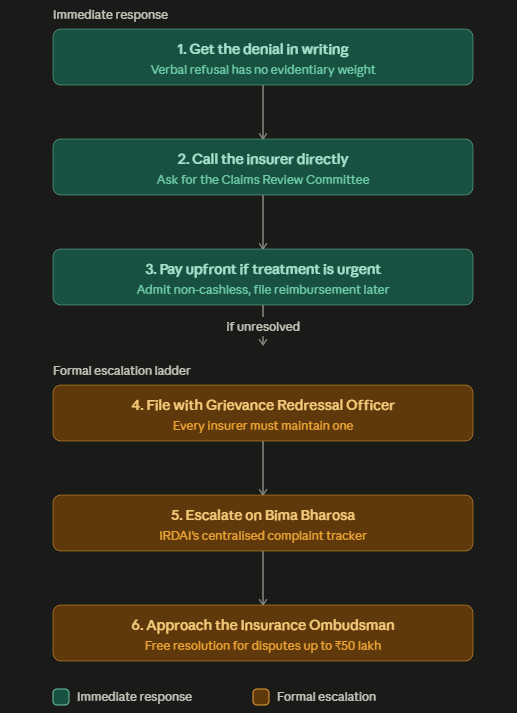
Step 1: Demand the denial in writing
A verbal refusal at the TPA desk carries no weight later. Insist on written communication citing the exact policy clause — this is the foundation for every step that follows.
Step 2: Bypass the hospital desk and call the insurer directly
The hospital’s TPA counter is not always the fastest route. Calling the insurer’s own helpline and requesting escalation to its internal Claims Review Committee often resolves tariff and documentation disputes faster.
Step 3: Pay upfront and admit on a non-cashless basis if treatment is urgent
Delaying urgent care to resolve an authorisation dispute is not necessary. Paying out of pocket does not forfeit the right to reimbursement — the claim can still be filed afterward with complete documentation.
Step 4: Escalate internally to the Grievance Redressal Officer
If the insurer’s frontline response is inadequate or the case stalls, every insurer is required to maintain a Grievance Redressal Officer who can be approached formally, in writing.
Step 5: Move to IRDAI’s Bima Bharosa portal
If internal grievance redressal doesn’t resolve the matter, the complaint can be filed on IRDAI’s centralised Bima Bharosa system, which tracks resolution timelines.
Step 6: Approach the Insurance Ombudsman
As the final escalation step, the Insurance Ombudsman adjudicates individual disputes up to ₹50 lakh, entirely free of cost to the complainant, and is designed specifically for cases where the insurer has failed to resolve a grievance satisfactorily.
Cashless Health Claim: Documents Required at the Reimbursement Stage
- Duly completed claim form
- Original discharge summary
- All original hospital bills and payment receipts
- Diagnostic and investigation reports
- Doctor’s prescriptions and treatment notes
- Policy document, along with the written cashless denial as supporting evidence
Cashless Health Claim: Cashless Refusal and Claim Eligibility Are Not the Same Process
Cashless facilitation and the underlying claim assessment are evaluated independently. A tariff dispute between hospital and TPA, or a documentation gap raised at admission, does not by itself determine whether the claim is valid. When a reimbursement claim is filed later with complete documentation, it is assessed on its own merits — it cannot be denied solely because cashless was refused for the same hospitalisation.