Vikram-1 Launch: Who Insures Skyroot’s Rocket When It Flies — and When It Doesn’t?
Vikram-1 Launch: Space insurance in India is having a moment following Skyroot Aerospace’s Vikram-1 launch, as the country’s nascent private space sector confronts an uncomfortable truth — most missions fly uninsured, and the mechanisms for third-party liability, launch failure and in-orbit loss remain thin.
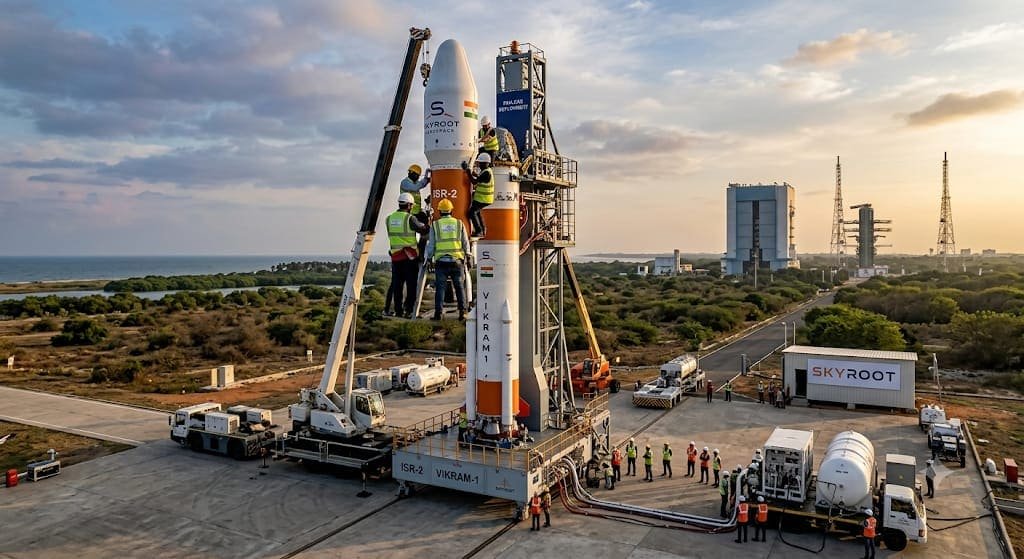
Vikram-1 soared clean on its maiden flight — but most Indian space missions still fly without insurance. Here's who pays when the rocket doesn't make it.
Vikram-1 Launch: Hyderabad-based Skyroot Aerospace made history on July 18 when its Vikram-1 rocket lifted off from Sriharikota, becoming the first privately developed Indian rocket to reach orbit, six years after reforms opened orbital launch to private builders alongside ISRO. Called Mission Aagaman, the flight was also widely reported as making India the third nation with private orbital launch capability.
The rocket itself was a technical showcase. Vikram-1 is built with an all-carbon composite structure and is powered by in-house developed propulsion systems, including 3D-printed engines and high-thrust solid-fuel rocket boosters, carrying Grahaa Space’s SOLARAS S3 satellite, Cosmoserve Space’s debris-capture arm Embrace, a DCUBED technology demonstrator and Skyroot’s own SCOPE satellite, alongside two symbolic payloads.
What got far less attention: whether any of that payload — or the rocket itself — was insured, and who would have been on the hook if it hadn’t reached orbit.
Also Read: Bima Sugam Is Finally Coming: What It Means for India’s Insurance Industry
Vikram-1 Launch: A Private Rocket, a Public Safety Net
While the vehicle was private, much of the path beneath it was public — ISRO provided motor casting and test facilities, liquid-engine testing, trajectory analysis, safety support, vehicle integration and the launchpad itself, while IN-SPACe coordinated access and authorisation. That arrangement matters for insurers as much as engineers: it means liability, cost overruns and reputational risk on India’s first private orbital launch were never carried by Skyroot alone.
Skyroot itself is well capitalised. In May 2026 the company raised about $60 million in a round co-led by Sherpalo Ventures and GIC, taking its valuation above $1.1 billion and making it India’s first space-technology unicorn. But as the source notes, capital can buy factories, test hardware and inventory — it cannot compress reliability into a single successful ascent.
Vikram-1 Launch: Why Most Indian Missions Still Fly Uninsured
India’s default position on space risk has historically been self-insurance. When ISRO’s GSLV-F02 mission, costing roughly Rs 256 crore, crashed into the Bay of Bengal, the mission was not insured — because ISRO is a government agency and the State has historically absorbed the financial risk rather than pay large premiums to commercial markets, especially since international insurers demanded 10-25% of mission value in earlier eras.
That instinct has carried over into the private sector, with costly results. Within the first month of 2026, the global space market had already seen three failed launches, including India’s own PSLV-C62 mission carrying 16 Indian and foreign satellites — and the private players were hit hardest because none of their payloads were insured. As one industry voice put it, a lost satellite is a setback for a national space programme, but for a startup, it is an existential crisis.
Notably, the only insured payload on that mission was a UK-Thailand earth observation satellite, insured because of mandatory UK requirements — not Indian ones, with one analyst arguing that at India’s current stage of space-sector maturity, high premiums relative to currency power make insurance uneconomical for many domestic players.
Vikram-1 Launch: What Actually Gets Covered — and When Responsibility Shifts
Globally, the mechanics of space insurance follow a fairly consistent script. If a rocket explodes on the pad or fails en route to orbit, the satellite owner may receive a partial or full refund while the launch provider claims against its own insurer — but once the satellite separates successfully, responsibility often shifts. If the spacecraft reaches orbit and then suffers a deployment failure, that becomes the owner’s problem unless separate in-orbit insurance was purchased. Some operators, the report notes, deliberately fly uninsured to save on premiums, while others buy only partial coverage for the riskiest launch phase.
The price of that cover isn’t small. Launch insurance typically runs 5-12% of a satellite’s value, rising sharply after big losses or for an unproven rocket — a category Vikram-1, as a maiden flight, squarely fell into before Saturday’s success. Only about a dozen underwriters worldwide take this risk, collecting roughly $500-600 million in annual premiums against billions of dollars of insured value, which is why a handful of total losses can turn a profitable year into a heavy one for the entire market. Once in orbit, separate in-orbit insurance covers the satellite against on-orbit failure from component breakdown, software anomalies, debris impact, fuel depletion or attitude-control loss, typically priced at 1.5-4% of insured value per year.
There’s also a liability layer that exists whether or not anyone buys a policy. Third-party liability insurance indemnifies parties from loss related to hardware or mission failure — such as debris falling on private property — and is required for a launch licence because governments are liable for injury or damage under the 1972 UN Convention on International Liability for Damage Caused by Space Objects, which obligates the launching country to assume liability for damage caused by a launcher or satellite.
Also Read: Bima Sugam Is Finally Coming: What It Means for India’s Insurance Industry
Vikram-1 Launch: India’s Insurers Are Starting to Build the Plumbing
The opportunity — and the gap — hasn’t gone unnoticed by Indian insurers and policymakers. The opening of the sector to private operators under the Indian Space Policy 2023 has created an entirely new class of insurable risk: domestic startups launching their own satellites on domestically developed rockets, with Indian entities carrying both the insurable interest and the regulatory obligation to be covered.
Proposed fixes are already on the table. Suggestions include a public-private space insurance pool involving New India Assurance and GIC Re to retain risk domestically, a government-backed risk guarantee fund to subsidise premiums for early-stage startups, and data-sharing between ISRO, IN-SPACe and insurers to enable accurate actuarial pricing. In practice, large Indian satellite programmes already combine Lloyd’s of London capacity with IRDAI-registered domestic co-insurers such as New India Assurance and GIC Re to satisfy Indian regulations while accessing global underwriting expertise, and a clean claims history across missions can progressively lower the cost of cover, much as no-claim discounts work in aviation insurance.
Vikram-1 Launch: The Takeaway for India’s New Space Sector
Vikram-1’s flawless debut is being celebrated as a coming-of-age moment for Indian private spaceflight. But the insurance conversation it has reopened is arguably just as important for the sector’s long-term health. As more Indian start-ups move from prototypes to orbital launches — with the government now counting more than 400 space start-ups and a domestic space economy approaching $9 billion, with ambitions to reach roughly $44 billion over the next decade — the absence of affordable, well-structured domestic space insurance could turn future failures from manageable setbacks into company-ending events. Vikram-1 flew clean this time. The next mission, or the one after that, may not.