No Price, No Precedent: Who will insure Elon Musk’s Tesla Roadster?
Tesla Roadster raises a key question for the insurance industry: how do insurers assess risk and determine premiums for a vehicle with unprecedented technology and an uncertain valuation?
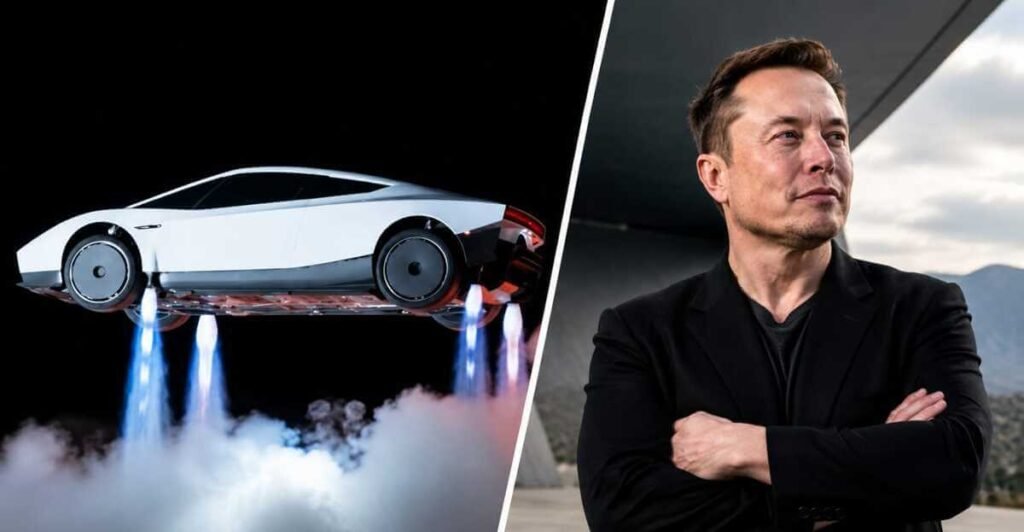
Tesla Roadster presents insurers with an unusual challenge as Elon Musk’s ambitious vehicle pushes the boundaries of conventional car insurance.
Tesla Roadster: The Roadster’s rocket-powered stunts won the headlines. Underwriters are stuck on duller questions: there is no price, no production date and 600 litres of high-pressure air.
Tesla has begun taking reservations of up to $250,000 for a sports car with no announced price. Production isn’t due until 2028, and the version that flies isn’t approved for public roads. Insurers see the problem at once: there is nothing yet to rate.
At a SpaceX test site in Texas on 15 October, the new Roadster drove up a ramp, flipped in a controlled manoeuvre and jumped over Tesla’s vehicle line-up, including the Semi truck. The demonstration car had no one inside. It was controlled autonomously, and the audience was kept well back. Elon Musk himself conceded the car is “not necessarily a safety-optimized car.”
Tesla Roadster: Three cars, three different insurance problems
Tesla is selling three versions. The Performance is the road-ready car, and Tesla says it reaches 60mph in under 1.6 seconds. The Thrust is a limited-release, race-ready car with rear cold-gas thrusters, which Tesla claims cuts that to under 0.9 seconds. The Rocket is the one that flies. It is single-seat, invite-only and not approved for public roads.
Each sits in a different corner of the market. The Performance looks like a hypercar risk, however extreme. The Thrust’s pitch as a track car collides with the exclusions specialist insurers typically apply. The Rocket may not be a motor risk at all.
Also Read: IRDAI Reforms Are an Opportunity, Not a Burden, Says ICICI Lombard’s Sanjeev Mantri
Tesla Roadster: A pressure vessel on wheels
The thruster system is what separates this car from every precedent. Tesla says every usable void is packed with carbon-fibre pressure vessels, holding up to 600 litres of compressed air on the Rocket. Tesla vehicle engineering chief Lars Moravy has said that refilling the Thrust’s 200-litre system currently takes two to six hours from an external high-pressure nitrogen source, and the Rocket’s full system takes roughly six to seven hours. Musk has said the car will eventually refill itself, but Tesla hasn’t said how long that takes.
That leaves underwriters pricing compressed-gas storage, an industrial exposure, inside a vehicle. Commentators have already flagged it: one auto-industry executive said it was “unlikely anyone will insure it,” and a financial-services executive asked what happens to liability once a driver tries to fly over another car rather than hit it.
Hari Radhakrishnan, an insurance commentator with nearly four decades in the industry, says the blend of risks is the point. A flying car, he argues, becomes “a mix of aviation and automobile insurances,” which brings “a significant liability exposure” that has to be specifically structured. That is why, in his view, the car will go to specialists rather than mainstream carriers. “These types of cars are underwritten by specialty insurers like MGAs or Lloyd’s syndicates,” he said. “If you go to a normal insurer, they will most likely decline.”
Tesla Roadster: The valuation gap
Even the ground-bound versions face a more basic obstacle. Tesla has not set a purchase price, and its reservation agreement says options and hardware are still being finalised. What buyers are putting down is a deposit. The listed figures are $50,000 for the Performance and $250,000 for the Thrust, against a $200,000 base price Tesla quoted back in 2017.
Without a price there is no value to insure. Nochiketa Dixit, managing director of EDME Insurance Broker, calls valuation the hardest question, because “with so few cars built, there is no market price to anchor on.” The industry’s answer is the agreed-value policy, in which insurer and owner fix the payout in advance. Brokers describe it as essential for hypercars because limited production makes them hard to value. Dixit’s advice is to fix that figure in writing before signing, and to expect the cover to depend on the owner as much as the car. “The car sets the range of the premium,” he said, “but the driver decides the terms, and whether you get cover at all.”
Tesla Roadster: The hypercar playbook, and where it runs out
There is a template. Specialist Lloyd’s-market underwriters already list supercars and hypercars, including Rimac and Bugatti, within their appetite on an agreed-value basis. UK comparison sites put annual premiums on a Bugatti Chiron at roughly 1% to 1.5% of the car’s value. Dixit points to the Veyron and Chiron as the nearest precedent: “tiny volumes, one repair network, very large claims.”
The Roadster fits that pattern on the ground and breaks it in the air. Radhakrishnan expects early cover to be “heavily bespoke,” because the car will behave like “a technology demonstrator” until it matures.
Tesla Roadster: Insuring something with no history
The industry has solved a version of this before. Waymo has no decades of claims data on driverless fleets, yet it has assembled cover through partners. Underwriters at Starr were given direct demonstrations of the technology. Allianz Partners is now setting up insurance and claims infrastructure for Waymo’s European expansion.
The Roadster is, if anything, the inverse of the autonomy story. Lemonade now sells Tesla owners roughly 50% off per-mile rates when Full Self-Driving is engaged, pricing the software over the person. Tesla’s executives have framed the Roadster as an ode to manual driving. Here the human at the controls matters again, and the demo car had none.
Tesla Roadster: What comes next
Nothing about the Roadster will be insurable in practice until it exists. That is at least two years away. Musk has said such a car will be “an actual car that’s on the roads,” though not necessarily legal everywhere. Until Tesla sets a price, publishes refill and safety data and clears the Rocket for any lawful use, underwriters can only price a prototype.