Train Ticket Insurance for All: Supreme Court Sets October 27 Deadline for Railways
Train Ticket: The Supreme Court has directed the Railways to meet the October 27 deadline in a case concerning insurance coverage for train passengers.
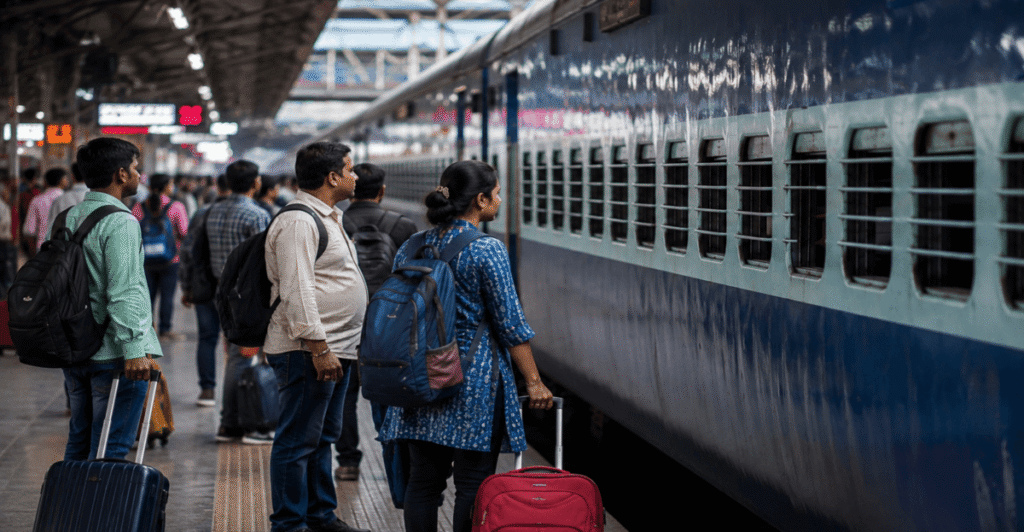
Train Ticket insurance is under the Supreme Court’s scrutiny as it sets an October 27 deadline for the Railways to address the issue.
NEW DELHI: The Supreme Court has directed Indian Railways to extend insurance coverage to all train tickets sold at railway station counters from October 27, 2026, bringing offline tickets on par with those booked online.
A bench of Justices Ahsanuddin Amanullah and R Mahadevan passed the order on October 6, giving the Railways two weeks to put the arrangement in place. The court said the direction must be implemented mandatorily and that the Railway Board would be directly accountable for any failure.
At present, accident insurance is available only to passengers who book tickets online and opt in for a premium of 45 paise. Those who buy tickets at counters are not covered. The court noted that the Centre had said on May 11 that a decision had been taken to extend the cover but found that no progress had been made since.
The order came in a case that began after the June 2023 Odisha train accident, which the court has widened to cover Kavach, track fencing and foot overbridges. The matter will next be heard on November 16.
Train Ticket: Why the Court Lost Patience
The insurance order was one thread in a wider rebuke. The Centre had told the court that arrangements were being worked out, but the bench found nothing had moved. The judges described their “utter disappointment and displeasure” at the Railway Ministry’s conduct in a matter of public safety, and observed that the Railways’ repeated assurances appeared to have stayed on paper.
The court also questioned how safety money was being used, noting that budgetary provisions for safety measures had not been fully utilised. It stressed that counter tickets are mainly bought by people from the lowest strata of society, who need travel security the most.
That point is the heart of the case. Online booking is for people with smartphones, bank accounts and digital habits. The counter serves many who have none of these.
Train Ticket: The 45-Paise Safety Net Counter Passengers Never Got
The cover the court wants extended already exists, but only on one side of the ticketing divide. Under the Optional Travel Insurance Scheme (OTIS), passengers booking on IRCTC can add up to ₹10 lakh of cover for 45 paise per passenger per journey, inclusive of taxes. That premium breaks down into a base amount of 38 paise and 7 paise of IGST.
The benefits are tiered. A death or permanent total disability pays ₹10 lakh, permanent partial disability pays up to ₹7.5 lakh, hospitalisation for injuries is covered up to ₹2 lakh, and ₹10,000 is available for transporting mortal remains. The policy covers accidents such as collisions and derailments that fall under Sections 123, 124 and 124A of the Railways Act, 1989. It is offered only for confirmed, RAC and part-confirmed tickets, and it excludes children under five. Policies have been issued through insurers such as United India Insurance, Liberty General Insurance and Royal Sundaram General Insurance.
How often is it used? Rarely, by railway standards. Railway Minister Ashwini Vaishnaw told the Lok Sabha that insurers settled 333 claims over five years, paying ₹27.22 crore in total. Extending the scheme to counters could widen the insured pool considerably.
Train Ticket: The Questions the Order Leaves Open
The court has set the date, but it has not set out the mechanism. The first question is who pays the premium. Online, the passenger opts in, and whether counter cover will be automatic, bundled into the fare or still optional has not been spelt out.
The second is how insurers will be linked to thousands of counters. Online cover is tied to a digital record, so offline tickets will need a way to issue a policy and notify the insured. Claims raise a third question. Under the current scheme they are handled by the insurer rather than IRCTC, and a paper ticket bought with cash makes proof and nominee details harder to establish.
Finally, there is the clock. With the deadline fixed at October 27, insurers will be watching closely for any official clarification from the Railway Board.
Train Ticket: Kavach, Fencing and the Long Road to Safer Tracks
The insurance direction sits inside a case that began with tragedy. In June 2023, the Coromandel Express, a Bengaluru-Howrah Superfast Express and a goods train collided near Bahanaga Bazar station in Balasore, Odisha. At least 288 people died and more than 1,100 were injured. A petition filed by advocate Vishal Tiwari sought an expert inquiry and guidelines for implementing the Kavach automatic train protection system.
The proceedings have since widened to cover track fencing, foot overbridges and passenger insurance. The court has asked what special measures were taken, what extra money was committed and how much work has actually happened on the ground.
On Kavach, the numbers show both progress and distance. As of March 2026 the system was installed on 3,103 route kilometres, with work under way on another 24,427. That is only about 4.4 per cent of a network spanning nearly 70,000 route kilometres. The Railways reported Kavach 4.0 commissioned on 2,633 route kilometres of the Delhi-Mumbai and Delhi-Howrah routes as of July 31, 2026, and fitted in 6,290 locomotives. Official figures differ by how they count, so “work taken up” should not be read as “protection in service.”
Train Ticket: What Happens Next
The court first directed the Railway Board chairman and members to appear in person. Additional Solicitor General Vikramjeet Banerjee, appearing for the Centre, asked for a final chance to file a detailed affidavit explaining the past year’s work and the missed targets, particularly on track fencing. The court agreed and held its summons in abeyance. The matter returns on November 16, when the bench is expected to review the progress reported by the Railways and its compliance with the directions.
For insurers, regulators and the millions who still buy their tickets at a window, the date to watch is October 27.