Tokio Marine Launches Japan’s First AI Robot Policy
Tokio Marine’s latest initiative highlights how insurers are adapting coverage to emerging risks associated with AI-powered robots and evolving technology.
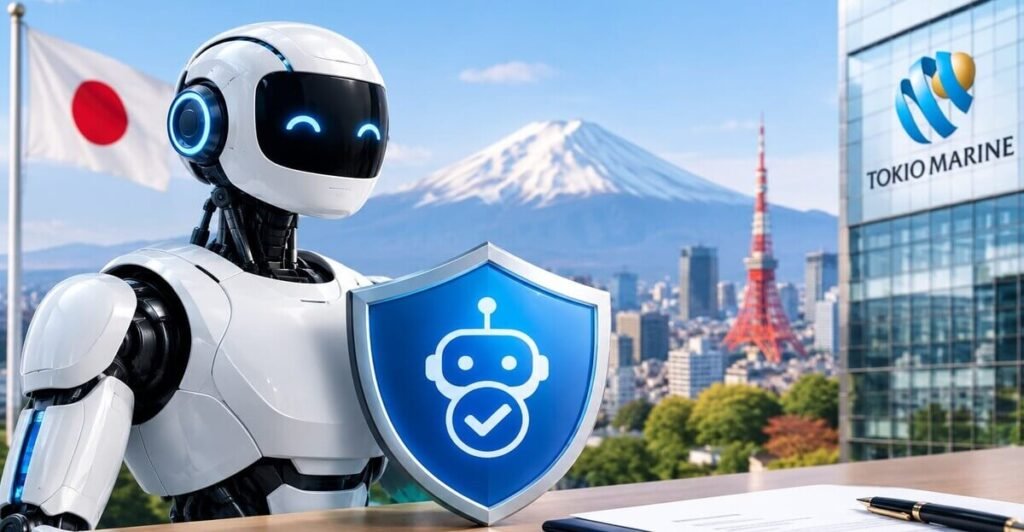
Tokio Marine has launched Japan’s first AI robot policy, marking a new step in the use of artificial intelligence in insurance.
Tokio Marine Holdings will begin selling insurance for robots driven by artificial intelligence next month, becoming the first nonlife insurer in Japan to offer a policy built for the technology. The product will be sold through its subsidiary Tokio Marine & Nichido Fire Insurance and is aimed at machines that use physical AI, where cameras and sensors feed an onboard system that judges a situation and acts on it without human direction. The launch comes as forecasts suggest the global market for such machines could pass $80 billion within a decade.
Tokio Marine: What the new physical AI robot policy covers
The policy is designed for robots and machines that think and move on their own, and it pays for repair or replacement when a unit is damaged by a disaster or an accident, or fails because of a malfunction. It also covers the other side of the ledger: compensation owed when a faulty robot injures someone or damages their property, and the cost of bringing in a substitute machine or temporary staff while the robot is out of action. For businesses that have started to rely on automation to keep operations running, that last element may matter as much as the repair bill, because a stalled robot in a care home or a store can mean a stalled service.
Pricing reflects the extra risk the insurer is taking on. For a robot worth 5 million yen, roughly $31,875, the annual premium is expected to run to several hundred thousand yen, about 20 percent above what is charged for conventional robot cover. Tokio Marine’s reasoning is that physical AI machines move through a much wider range of motion and make their own decisions, so the potential for something to go wrong is larger than with a fixed industrial arm on a factory line. The company is targeting about 1,000 insured robots by the fiscal year 2027.
Tokio Marine: Why Japan is betting on robots, and why insurers are following
The timing lines up with Japan’s national agenda. The government revised its AI robotics strategy at the end of June, setting a target of around 10 million AI-equipped robots working across 18 fields by 2040, with restaurants, food manufacturing and medical care added to the original list. Officials have also backed a homegrown foundation model for robots, known as Noetra, with reported support of up to 1 trillion yen over five years depending on results. The motivation is demographic: an ageing and shrinking population is leaving gaps in nursing homes, retail and manufacturing that robots are expected to help fill.
Market researchers see the same direction. Acumen Research and Consulting values the global physical AI market at about $5 billion in 2025 and projects roughly $82.8 billion by 2035, with Japan’s own segment growing from around $307 million to nearly $6.8 billion over the same period. Other research houses publish far larger figures, so the estimates should be read as a wide range, but all of them point steeply upward.
Tokio Marine: A global race to underwrite machines that act on their own
Tokio Marine is not the first insurer anywhere to write robot cover. In China, CPIC introduced a dedicated humanoid robot policy in late 2025 that follows a machine from production through deployment, and Ping An and PICC have since brought out their own products, including an arrangement that folds the premium into a leasing payment to lower the upfront cost for buyers.
In Hong Kong, Zurich partnered with a robotics distributor in June to embed micro-insurance directly into robot sales. Lloyd’s has argued that advanced robots should be assessed on their own technical characteristics rather than squeezed under general liability wording, and that pricing may eventually rely on live operating data.
The reason for the attention is that physical AI turns software errors into physical losses. Brokers and risk advisers note that the lines between product liability, property, cyber and motor cover are blurring, and that insurers have almost no claims history to price against.
Waymo’s recall of 3,871 robotaxis in June, after some vehicles entered closed freeway construction zones, showed how quickly an autonomy failure can become a safety question, and Europe’s product liability rules and AI Act are already tightening accountability for makers and operators. For insurers elsewhere, including in fast-growing markets such as India, Tokio Marine’s launch is an early test of whether a premium loaded 20 percent above standard robot cover is enough to absorb a risk that nobody has yet measured at scale.