Amazon for Insurance? Why Bima Sugam Is IRDAI’s Brahmastra Against 30% Commissions
Bima Sugam, IRDAI’s digital insurance marketplace, is targeting an end-September 2026 launch for motor, health and term products.
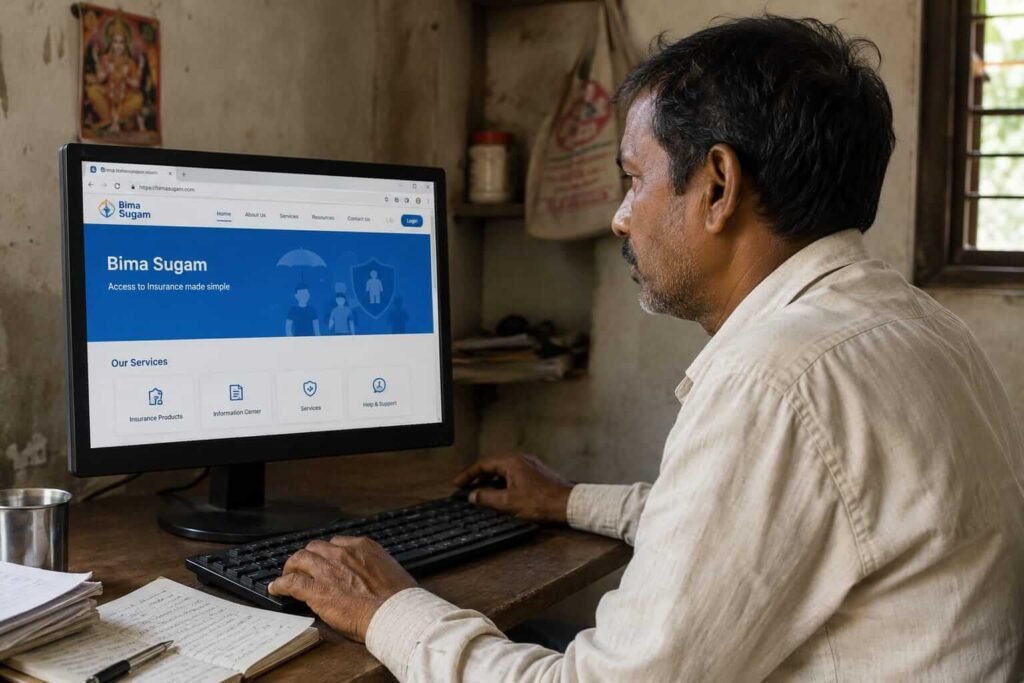
Bima Sugam: Say goodbye to hefty 30% agent commissions—IRDAI’s Bima Sugam is reshaping the market as the Amazon of Insurance.
Bima Sugam: In Indian mythology, the Brahmastra is the weapon of last resort — used only when every conventional fix has failed and the problem needs to be ended at the root, not managed at the edges. That’s the scale of the fix the Insurance Regulatory and Development Authority of India (IRDAI) is attempting with Bima Sugam. For decades, the unwritten rule of buying insurance in India has been simple: someone in the chain, an agent, a broker, or an aggregator, takes a cut of up to 30% of your premium before your cover even begins.
You never see that line item, but you pay for it every time. Rather than nudging that number down gradually, IRDAI is going straight for the root cause with a government-backed, Amazon-style marketplace where every insurer’s motor, health, and term products sit side by side, running on a platform fee of roughly 5–7% instead of a hefty commission. It’s a deliberate strike at how insurance has always been sold in India.
Motor insurance goes live first, health follows next, and term life insurance is targeted for end of the year.
Here’s everything confirmed so far, what it changes for your wallet, and what to actually do about it.
What Is Bima Sugam, In Plain English?
Think of it as a regulator-run “Amazon for insurance.”
Instead of visiting five insurer websites or trusting a single agent’s recommendation, Bima Sugam puts every insurer’s motor, health, and term products side by side, lets you compare premiums and features, and lets you buy, renew, port, or file a claim from one dashboard — using a single digital identity called Bima Pehchaan.
As we know by now, it isn’t a private startup. It’s built and run by the Bima Sugam India Federation (BSIF), a not-for-profit company approved and supervised by IRDAI, with an authorised capital of ₹500 crore and roughly ₹310 crore paid up, funded collectively by life, health, and general insurers.
Prasun Sikdar, previously MD & CEO of ManipalCigna Health Insurance, was named the platform’s first CEO to lead its rollout.
IRDAI’s own former chairman described the ambition bluntly: this is meant to be insurance’s version of the UPI moment — a single rail that every player plugs into, the way UPI standardised digital payments.
Bima Sugam: Why You Should Actually Care: The Math Behind the “Cheaper Insurance” Promise
Here’s the number that matters most to your pocket:
Web aggregators and brokers today can earn commissions of up to 30% of your premium — a cost that’s built into what you pay. Bima Sugam instead plans to charge insurers a nominal platform fee of roughly 5–7%.
IRDAI’s current chairman Ajay Seth has put it directly: the platform can deliver a good quality product at meaningfully lower cost, because it doesn’t need to sustain the industry’s high-commission structure — though some fee will still apply.
Separately, officials have confirmed the model is explicitly designed to move away from commission-driven selling toward a flatter, fee-based structure for the first time in India’s insurance distribution history.
Also Read: Govt’s Bima Bharosa portal received over 800 insurance complaints every day in FY26
Why this matters at scale: India’s life and general insurance market already writes over $130 billion in annual gross premiums, growing roughly 11% a year between FY20 and FY23, and analysts expect average annual premium growth of about 6.9% through 2030. Even shaving a few percentage points off distribution cost across a market this size translates into real rupees back in policyholders’ pockets — but but it’s not that simple, we will come to that later.
There’s a second number that explains why IRDAI is pushing so hard: India’s insurance penetration sits at just 3.7% of GDP, well below the global average of about 7%. Roughly two-thirds of Indians remain underinsured or uninsured. Bima Sugam is IRDAI’s central bet for closing that gap on the way to its stated “Insurance for All by 2047” goal.
Bima Sugam: The Rollout Timeline: What Goes Live When
Unlike earlier vague promises, IRDAI has now attached a concrete, phased calendar:
Each phase adds a full new insurance category rather than a partial pilot, and by September 2026, motor and health renewals both begin routing through the platform, with term life renewals following later.
It’s worth being honest about the backstory: this project has slipped repeatedly. It was originally proposed for a January 2023 launch, then pushed to April 2025, then mid-2025, then a scaled-down December 2025 start, and now to September-end 2026. IRDAI even had to ask shareholder insurers to inject an additional Rs 300 crore in early 2025 just to keep the project moving. Even Chairman Seth acknowledged in June 2026 that the rollout remains “behind schedule.” So treat these dates as the most credible ones yet — not guaranteed.
Bima Sugam: How It’ll Actually Work for You, Step by Step
- Create your Bima Pehchaan ID — a one-time digital KYC identity that becomes your permanentinsurance profile, similar to how a UPI ID works across banks.
- Open your e-Bima account — a single dashboard that shows every policy’s expiry date, premium,coverage, claim history, and nominee details, with documents synced to DigiLocker.
- Compare and buy — see standardised quotes from every participating insurer for the same productcategory side by side, instead of visiting each insurer’s app separately.
- Renew, port, or claim from the same screen — buy, renew, port, or raise claim requests entirely online, without repeating paperwork insurer by insurer.
- Get renewal nudges automatically — the platform sends renewal reminders by SMS and email before your policy lapses.
- Use it whether you go direct or through an agent — existing agents and brokers can register as intermediaries on Bima Sugam too, so you’re not forced to go it alone if you still want advice, reports suggest.
7 Concrete Ways This Should Benefit You as a Customer
- Lower effective cost of buying insurance — a 5–7% platform fee model replacing commissions that can run as high as 30% of premium.
- Real apples-to-apples comparison — standardised product data across insurers, instead of piecing together PDFs and sales calls.
- One identity, every policy — Bima Pehchaan means you’re not re-doing KYC for every insurer or every renewal.
- Faster, paperless claims — a streamlined settlement process for both health and death claims that runs off your policy number rather than physical documents.
- Built-in renewal protection — automated reminders cut the risk of an accidental lapse in cover,especially on motor and health policies with tight renewal windows.
- Wider reach into underserved areas — Bima Sugam sits alongside Bima Vistaar (a simple rural-focused composite policy covering life, health, and property) and Bima Vahaak (a women-led agent network selling Bima Vistaar through the Sugam platform), aimed specifically at Indians who’ve never had affordable access to formal insurance before.
- A regulator-run marketplace, not a private aggregator — because BSIF is jointly owned by insurers under IRDAI supervision, no single company can dominate the shelf space the way a commercial platform might.
Also Read: Best Pet Insurance Companies in India: 5 Things to Compare Before You Buy
Bima Sugam: What’s Still Missing — Be Realistic About Limitations
Phase 1 doesn’t help used-car buyers. Bima Sugam’s motor phase is built for discovering and buying fresh cover on new vehicles — it cannot tell you whether a specific used vehicle’s existing policy is currently valid or lapsed. That verification gap still needs to be closed through other channels, as per the reports.
Price isn’t everything. Industry voices have cautioned that buyers should evaluate policy features carefully rather than shopping on premium alone, especially once health and term products — where fine print matters far more than for motor — come onto the platform in phases 2 and 3.
Agent commissions aren’t disappearing overnight. A formal IRDAI consultation paper on broader distribution reform is expected by September 2026, and how it treats existing agents — many of whom rely on commissions for their livelihood in semi-urban and rural India — is still an open question.
Full national scale will take time. Insurers are still completing the technology integration needed to plug their systems into the platform, which is the main reason the timeline has already moved multiple times.
Bima Sugam: What Should You Actually Do Right Now?
If your motor or health policy renews between September and October 2026, expect your insurer or broker to start nudging you toward Bima Sugam-based renewal — you don’t need to do anything extra yet, but it’s worth asking your agent whether your renewal will route through the new platform.
Don’t cancel or delay a needed purchase just to “wait for Bima Sugam.” Phased rollouts of large government platforms routinely slip; buy the cover you need today and switch or compare later if it makes financial sense.
When it does go live for your product category, compare — don’t just default. Use the platform to check prices across insurers, but still read the policy wording for exclusions and waiting periods, particularly for health insurance.
Quick Bima Sugam FAQ
Is Bima Sugam live right now?
Partially. The website has been live since September 2025 as an information hub; transactional buying is rolling out category by category starting with motor insurance from mid-2026, with health and term life to follow.
Will Bima Sugam make my insurance cheaper?
It’s designed to, by replacing high commission structures (up to 30% of premium) with a smaller platform fee (roughly 5–7%). Actual pricing will depend on how insurers set premiums once live.
Do I have to stop using my insurance agent?
No. Agents and brokers can register as intermediaries on the platform and continue servicing you through it.
What is the “Bima Trinity”?
IRDAI’s three-part push for insurance access: Bima Sugam (the digital marketplace), Bima Vistaar (a simple rural composite policy), and Bima Vahaak (a women-led rural agent network selling Vistaar through Sugam).
Bima Sugam: The End or a New Beginning
What we need to understand is that Bima Sugam is less an apocalyptic threat to insurance intermediaries and more a necessary evolution for how insurance is bought, sold, and serviced in India. For traditional agents accustomed to high-commission policy pushing, the platform certainly signals the end of an opaque, friction-heavy era. However, for the broader ecosystem, it marks a monumental new beginning—democratizing coverage across Tier-2 and Tier-3 markets, driving down premiums by stripping out distribution markups, and transforming policyholders’ experience into a single, unified digital account. Ultimately, it doesn’t eliminate the human element; instead, it forces agents to pivot from transactional salespeople into high-value financial advisors while returning the resulting cost savings back to everyday policyholders.
Follow us on Twitter for latest updates
Claim Settlement Ratio of Life Insurance Companies in India: Complete IRDAI Data, Insurer-Wise Rankings and What It Actually Means