EPFO Opens the Vault: Members Can Now Withdraw Up to 75% of PF Balance for Emergencies
EPFO has expanded access to PF savings, allowing members to withdraw up to 75% of their balance for emergencies. Here’s what the new PF withdrawal rules
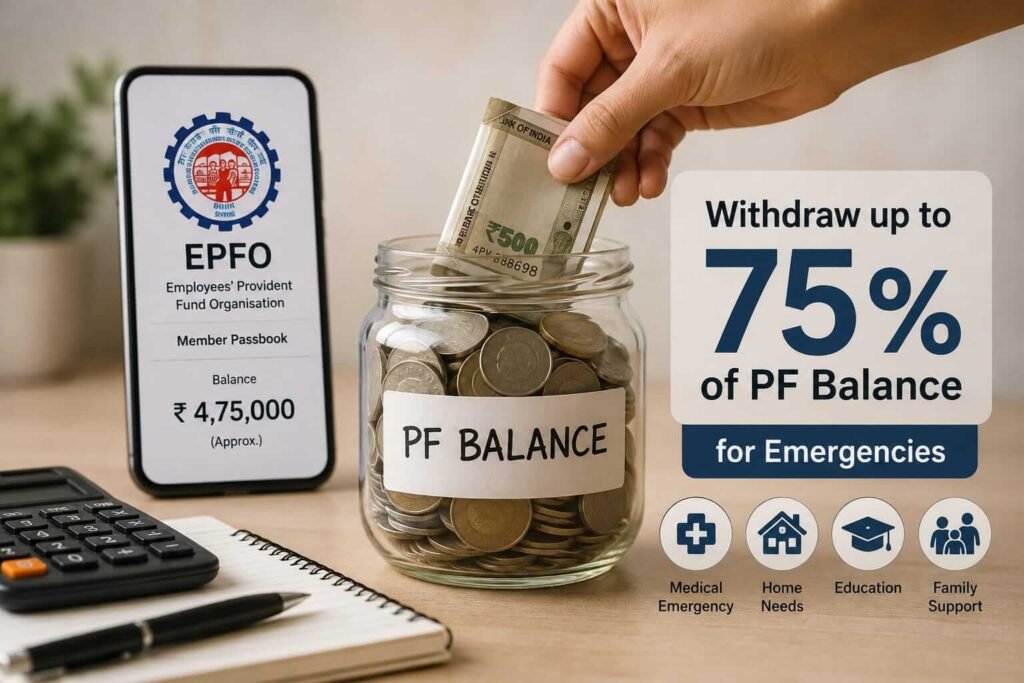
EPFO members can now access up to 75% of their PF balance for eligible emergency needs. The revised withdrawal rules aim to provide greater financial flexibility to subscribers.
EPFO: EPF subscribers can now access up to 75 per cent of their provident fund balance for a wider range of needs — including medical emergencies, unemployment, education and housing — under a simplified withdrawal framework confirmed by the government in the Lok Sabha on August 10, 2026.
Responding to a question from Trinamool Congress MP Kirti Azad on the revised withdrawal provisions under the EPF Scheme, 2026, Minister of State for Labour and Employment Shobha Karandlaje told Parliament that the Employees’ Provident Fund Organisation (EPFO) has simplified and liberalised the rules governing partial withdrawals and advances, while also introducing new waiting periods for final settlement of accounts.
Also Read: IRDAI Winds Down Sahara Life Chapter: Administrator Tenure Ends After SBI Life Portfolio Transfer
EPFO: Three Categories Replace Multiple Withdrawal Provisions
The government has grouped partial withdrawals into three broad categories under the revised framework:
- Essential needs: Covers medical treatment, education and marriage
- Housing needs: Covers buying, constructing, repairing or improving a house, as well as certain housing loan-related requirements
- Special circumstances: Allows members to withdraw up to 75 per cent of their balance without specifying a particular reason, subject to prescribed conditions
The three-category structure is intended to replace a larger number of separate withdrawal provisions that previously governed EPF advances.
EPFO: How Much Can Be Withdrawn During Unemployment
Under the revised framework, an unemployed member can access up to 75 per cent of their PF balance, providing liquidity during a period when regular income has stopped. The remaining 25 per cent is retained in the account, which the government said helps preserve part of the retirement corpus. The framework does not allow the entire EPF balance to be withdrawn immediately on job loss.
EPFO: Medical Withdrawals Carry No Fixed Frequency Limit
Medical treatment falls under the essential-needs category. Unlike some other withdrawal categories, illness-related withdrawals do not carry a fixed limit on the number of times a member can seek an advance, subject to applicable rules. The minimum EPF membership requirement for several advance-withdrawal provisions has also been reduced to 12 months, extending eligibility to relatively younger employees.
EPFO: Limits on Education and Marriage Withdrawals
For education-related expenses, members can make withdrawals up to 10 times during their EPF membership. Marriage-related withdrawals can be made up to five times. In both cases, the eligible withdrawal amount is linked to the member’s PF balance and the conditions prescribed under the scheme.
Under the earlier withdrawal framework, education and marriage expenses shared a combined limit of three withdrawals across a member’s EPF membership. The EPF Scheme, 2026 removes this combined cap and assigns each purpose its own separate limit — up to 10 withdrawals for education and up to five for marriage — giving members more room to draw on their PF corpus across multiple milestones, such as the education or marriage of more than one child, without exhausting a shared quota.
Also Read: PMFBY: A Rejected Tender and an Unpaid Bill — Why Gujarat and Telangana Never Came Back
EPFO: New Waiting Periods for Final Settlement
While partial withdrawals have been eased, the government has tightened rules around full and final settlement of accounts. A 12-month waiting period now applies to premature final settlement of EPF balances. For withdrawal benefits under the Employees’ Pension Scheme (EPS), the waiting period has been extended to 36 months. The government stated the objective is to discourage workers from prematurely withdrawing their retirement savings when they move between jobs. This waiting period applies specifically to final settlement and EPS withdrawal benefits, and is separate from the rules governing partial EPF advances.
EPFO: Background: Why the Rules Changed
Karandlaje told the Lok Sabha that the amendments were discussed by the Central Board of Trustees (CBT), EPF — which includes representatives of employees, employers and the government — before being recommended to the Centre. The government has said the changes are aimed at balancing two objectives: giving workers access to their savings during genuine financial need, while ensuring EPF continues to serve its core retirement-savings function.