Social Security’s 2032 Shortfall Could Cost Newly Retired Couples $17,000 a Year, New Report Warns
Social Security: Social Security’s trust fund is projected to run dry by late 2032, and a new CRFB analysis shows newly retired couples could lose nearly $17,000 a year in benefits if Congress fails to act before then.
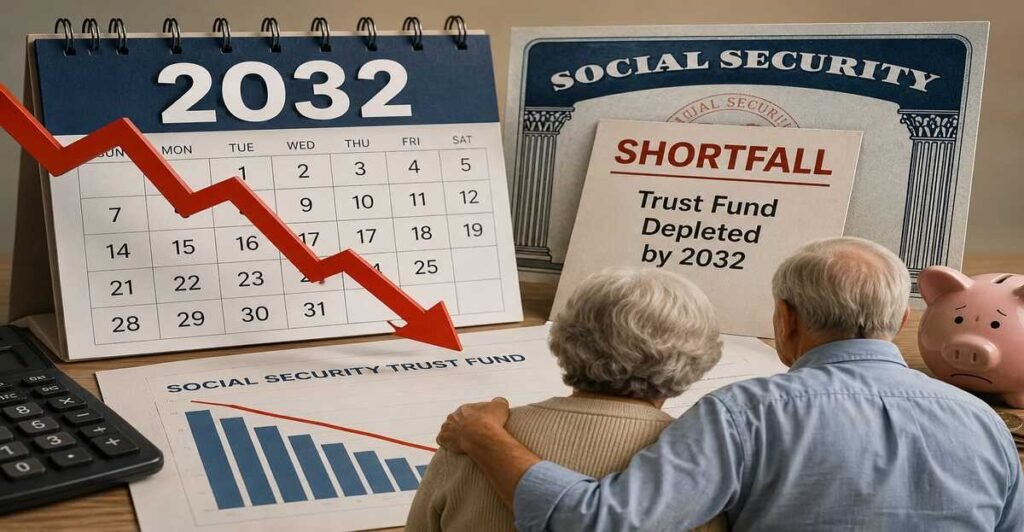
Social Security faces a critical funding milestone in 2032, raising concerns about the future of retirement benefits.
Social Security: Social Security is heading toward a funding cliff that could hit retirees’ wallets hard within the next seven years. A new analysis from the nonpartisan Committee for a Responsible Federal Budget (CRFB) has reportedly found that a typical, newly retired dual-income couple could lose close to $17,000 annually in benefits starting in 2033, if lawmakers in Washington continue to sit on the problem.
The trigger is the projected insolvency of Social Security’s Old-Age and Survivors Insurance (OASI) trust fund, which the program’s trustees expect to run out of reserves by the fourth quarter of 2032. Once that happens, federal law requires an automatic across-the-board cut to benefits, since payouts cannot legally exceed incoming payroll tax revenue.
Social Security: Why the Trust Fund Is Running Out
Social Security has been paying out more than it collects for several years now, a gap driven largely by an aging population, rising life expectancy, and a shrinking ratio of workers to retirees. To cover that gap, the program has been drawing down the reserves built up in its trust fund. Once those reserves are exhausted, incoming revenue alone would only be enough to cover a portion of scheduled benefits.
Also Read: As Monsoon Floods Hit Indian Cities, Home Insurance Remains an Afterthought
According to the trustees’ latest annual report, the combined trust funds covering old-age and disability benefits would be able to pay only around 83% of scheduled benefits once depleted. For the OASI fund specifically, which handles retirement and survivor benefits, that figure is even lower, with only about 78% of benefits payable once the fund runs dry.
Social Security: How Big Would the Cuts Be?
The CRFB’s report estimates that benefits would need to be cut by roughly 22% across the board when the OASI fund is exhausted. But the real-dollar impact varies sharply depending on a household’s income level and work history.
For a dual-earning couple with medium income who is newly retiring in 2033, the cut works out to about $16,900 a year, close to the $17,000 figure making headlines. Lower-income dual-earning couples would see a smaller absolute cut of around $10,200 a year, while high-income dual-earning couples could lose as much as $22,300 annually.
The CRFB report notes that even though the dollar amount is smaller for lower-income households, the cut represents a much larger share of their total income, making it more financially disruptive for that group despite the smaller headline number.
The Cuts Are Expected to Grow Over Time
The longer Congress delays action, the worse the eventual cuts are projected to become. The CRFB report states that the size of these cuts is expected to widen as the gap between Social Security’s costs and its dedicated revenue keeps growing, with projected annual cuts reaching as high as 35% by the end of the century if nothing changes.
The report also stresses that this is not a distant, hypothetical problem for future policymakers to inherit. Senators elected in the current cycle will still be in office when the OASI fund actually runs out, meaning the window to act is closing well within the current political generation.
Also Read: As Monsoon Floods Hit Indian Cities, Home Insurance Remains an Afterthought
What Is Congress Doing About It?
A handful of legislative efforts are underway, though none has gained enough momentum to become law. A bipartisan group of senators recently introduced the Protecting Retirement Opportunities and Maintaining Income Security for Everyone (PROMISE) Act, which would create a formal mechanism forcing Congress to vote on a plan to restore the program’s long-term finances, rather than continuing to defer the decision indefinitely.
Separately, the reintroduced Social Security 2100 Act proposes switching the cost-of-living-adjustment formula to the Consumer Price Index for the Elderly (CPI-E), which weighs healthcare and housing costs more heavily, alongside a 2% benefit increase and a higher minimum benefit tied to the federal poverty line. Advocacy group The Senior Citizens League has reportedly called it the “gold standard” of reform proposals, even while acknowledging it is unlikely to pass in the current Congress.
An Early Signal for India’s Insurance and Pension Sector
While Social Security is a US federal program, the shortfall carries a broader lesson for retirement planning conversations globally, including in India, where private pension and annuity penetration remains low relative to the workforce.
As government-backed retirement systems in developed economies show signs of strain under demographic pressure, it reinforces the case insurers and pension fund managers in India have been making for years:
relying solely on state-run retirement schemes such as EPFO or NPS may not be sufficient, and supplementing them with private annuities, ULIPs, or dedicated retirement plans is worth serious consideration for individuals planning decades ahead. Indian insurers watching this debate may also find it instructive as a preview of the political and fiscal challenges that come with delayed pension reform.