France vs Spain World Cup: Inside the Billion-Dollar Insurance Web Protecting Mbappe, Yamal
France vs Spain World Cup: Mbappé and Yamal’s World Cup semi-final carries a hidden insurance story worth hundreds of millions.
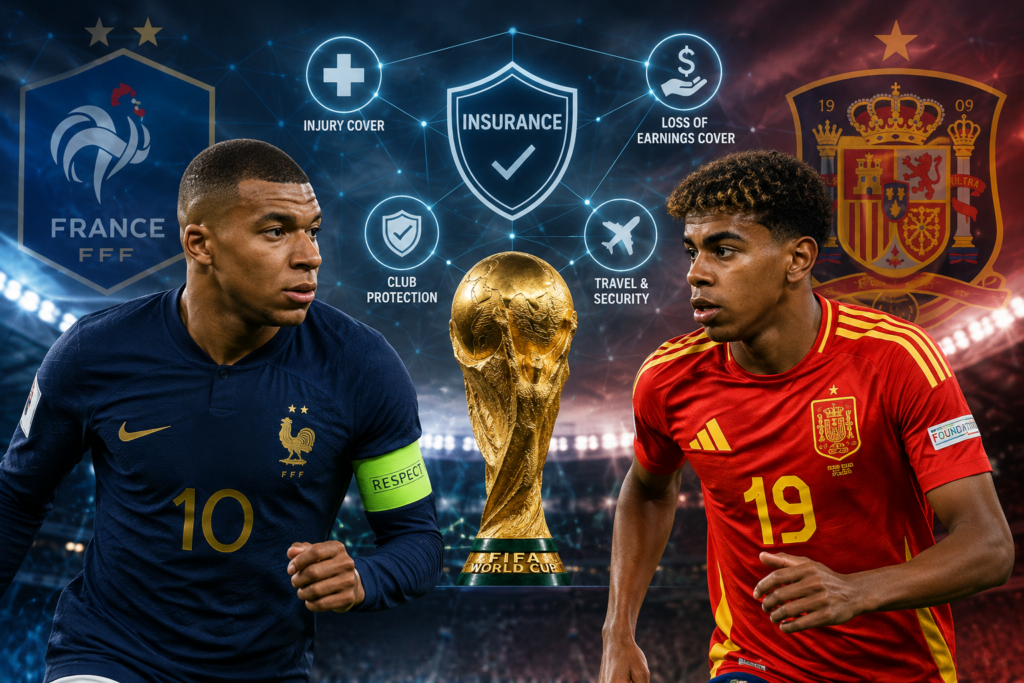
France vs Spain: France's Kylian Mbappe and Spain's Lamine Yamal headline a high-stakes football showdown, where beyond tactics and talent, multi-million-dollar insurance policies protect players, clubs and tournament stakeholders against injury, disability and financial loss.
France vs Spain World Cup: Tonight, France meets Spain at Dallas Stadium for a place in the World Cup final, with Kylian Mbappé and Lamine Yamal carrying the weight of two nations’ hopes. But behind every step both stars take on that pitch sits a quieter, less visible industry: the specialist insurers who’ve priced their legs, feet, and entire playing careers into eye-watering sums of money.
France vs Spain World Cup: Why Footballers Insure Their Own Bodies
A professional footballer’s career lasts barely eight to twelve years at the top level. For a global superstar earning well over €100 million a year in wages and endorsements, one bad tackle or an awkward landing can wipe out that entire earning window overnight. That’s why clubs, and sometimes players themselves, take out bespoke disability and “loss of value” policies, most famously underwritten through Lloyd’s of London, the same market that has insured musicians’ hands and models’ faces.
These aren’t ordinary health policies. They’re triggered specifically by an injury severe enough to end a player’s ability to perform at the elite level for good, with some policies also covering partial disability if a player’s ability drops sharply, say from Champions League standard to a lower tier, without ending the career outright.
France vs Spain World Cup: The Numbers Are Almost Unbelievable
Lionel Messi’s left foot has reportedly been insured for figures as high as $900 million, taken out by FC Barcelona during his time there. Cristiano Ronaldo’s legs were insured for roughly $144 million when he joined Real Madrid in 2009.
Also Read: World Cup 2026: The Hidden $7.5 Million Insurance Policy Protecting Top Stars
David Beckham’s entire body, legs and face included, carried a policy worth close to $195 million at his peak, reflecting his brand value as much as his football. Precise figures for current stars like Mbappé and Yamal are kept confidential, standard practice in this market, but industry reporting suggests top World Cup-level talents now carry comparable protection.
What FIFA Itself Actually Covers
FIFA runs its own safety net for exactly this weekend’s scenario: the Club Protection Programme. If a player is accidentally injured while on national duty, including this World Cup, it compensates his club for lost wages, but only after the player has been out for 28 days, and only up to roughly $27,000 a day for a maximum of 365 days. Crucially, it covers salary only, not bonuses, sponsorship losses, or permanent disability, and the entire programme is capped at €80 million a year across every club in world football combined.
Also Read: What Vinod Khosla’s $9.6 Bn Seahawks Purchase Reveals About Sports Franchise Insurance
That gap is exactly why lawyers and insurers who work with major clubs describe FIFA’s programme as a floor, not a ceiling. Real Madrid and PSG, the clubs of tonight’s two headline stars, are understood to layer additional private disability and loss-of-value cover on top, specifically because a serious World Cup injury can devalue a player commercially long before FIFA’s 28-day threshold even kicks in.
So What Happens If Someone Goes Down Tonight?
If either Mbappé or Yamal suffers a serious injury tonight, three separate financial mechanisms could activate: FIFA’s Club Protection Programme reimbursing part of their club’s wage bill, any private club-arranged disability insurance covering losses FIFA doesn’t, and, in the worst case, a career-ending clause that could trigger a payout running into hundreds of millions, depending on how the specific policy was structured.
It’s a reminder that behind the biggest stage in football sits a financial architecture most fans never see, one where a single collision can move as much money as it does emotion.