ICICI Lombard Cuts Call Centre Costs Using AI, Moves Health Underwriting to AI Bot
ICICI Lombard is using AI to automate health underwriting, detect insurance fraud and handle customer queries, while targeting lower operating costs and faster service.
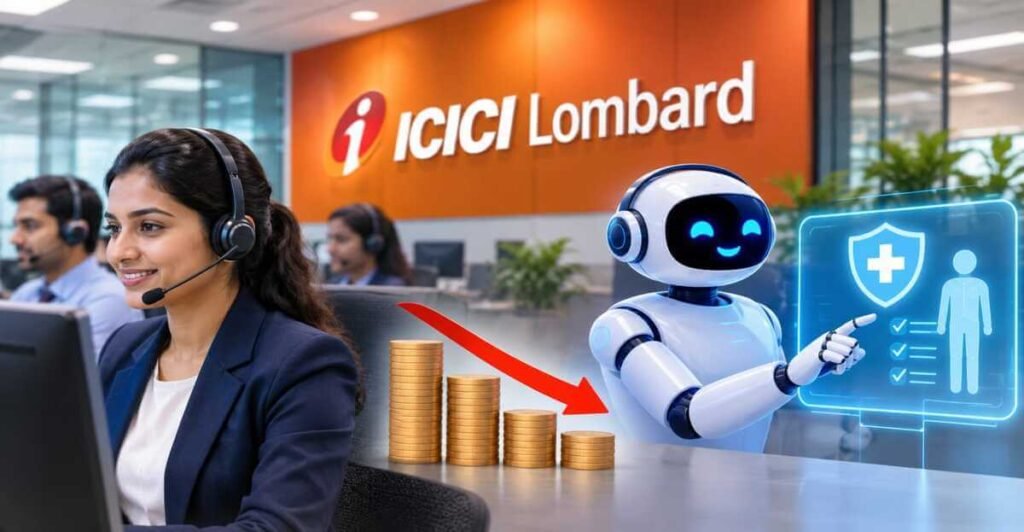
ICICI Lombard is expanding its use of artificial intelligence across health insurance underwriting and customer service to improve efficiency and reduce servicing costs.
NEW DELHI – ICICI Lombard General Insurance has shifted most of its health underwriting to an artificial intelligence engine. Doctors review the machine’s output, and the agency channel now runs entirely on the AI bot. Girish Sehgal, the company’s Chief of Health Underwriting and Claims, Customer Service and Operations, says the change has lowered servicing costs, kept customer scores high and helped the insurer’s loss rates look better than its competitors’.
ICICI Lombard: How AI-Led Health Underwriting Works
When a proposal comes in, any case that does not qualify for straight-through processing is sent a link. Once the customer opens it, the AI engine runs the questioning. It adapts each follow-up to the previous answer, so the process is an assisted conversation rather than a fixed form. The exchange typically lasts seven to ten minutes and is automated from start to finish.
A transcript of the conversation is emailed to the applicant. Sehgal says this is meant to head off mis-selling disputes and later arguments over what was or was not disclosed, since claims tend to surface long after the policy is sold and both sides can refer back to the record.
The engine also scores each applicant as high, medium or low risk. Low and medium-risk proposals move forward with a panel doctor reviewing the AI’s output. High-risk cases go to manual handling, where underwriters can ask for extra tests, fresh reports and more documents.
Also Read: PM Fasal Bima Yojana Comes to Bihar: 18 Crops Covered at Just 1.5% Premium
ICICI Lombard: Satellite Data, Fraud Detection and Better Loss Rates
On catastrophe risk, ICICI Lombard has combined its AI engine with satellite feeds to build an Automated Weather Alert System (AWAS). The system warns businesses in advance about cyclones, floods and other severe weather. Sehgal links this to underwriting performance, saying it is one reason the insurer’s loss rates look much better than the competition’s.
The company is also using AI for fraud detection. Sehgal says it has moved from a machine learning model to an AI model, and that its ability to catch fraudulent claims has increased multiple times. The emphasis here is on detection quality rather than cost savings.
ICICI Lombard: Digital Servicing Saves an Estimated ₹17 Crore
The call centre handles six to seven lakh customer queries a month across calls, emails and chats, or roughly 84 to 90 lakh a year. When the company began digitising its journeys, the split was about 20% digital and 80% manual. It has now flipped, with digital engagements at around 71–75% and manual handling at 25–30%. That works out to more than 40 lakh digital engagements over the year.
Sehgal estimates a manual call costs about ₹50, based on a relationship manager earning ₹6 lakh a year and handling roughly 1,000 calls a month. At that rate, 40 lakh digital engagements would have cost about ₹20 crore if handled manually. Digital servicing is not free, since it involves telephone line charges and payments to Meta for WhatsApp, but he puts the total at no more than ₹3 crore a year.
Based on these estimates, the potential annual saving from digitisation works out to approximately ₹17 crore. This is an estimated cost avoidance rather than a separately disclosed realised saving. Sehgal says Net Promoter Scores remain high, at 70 to 75.
Staff freed from the call centre have been moved into claims, sales and operations teams. The same plan applies to manual tele-underwriters once the bots are fully scaled up.
ICICI Lombard: Faster Claims and the Road Ahead
On the claims side, the app now accepts document uploads, which removes courier movement, and AI is shortening turnaround times. Sehgal says customers no longer measure the company against the regulator’s three-hour limit for discharge approvals and expect a decision in 15 minutes to an hour. He admits the company has not fully met that expectation yet, but says it has a head start on rivals.
The company’s core systems run on the cloud. Sehgal was cautious about how the spending will show up in the efficiency ratios analysts track each quarter, saying many initiatives are still in progress. He expects the effort of the past three to four years to deliver strong results over the next six to twelve months, both in returns and in efficiency.