France vs Spain: Biggest Match Of The Summer Has A Fraud Problem
As fans scramble for last-minute seats to tonight’s France-Spain World Cup semi-final, secondary-market ticket fraud is spiking across the US. Here’s how purchase-protection insurance, resale guarantees, and FIFA’s own marketplace actually compare before you pay.
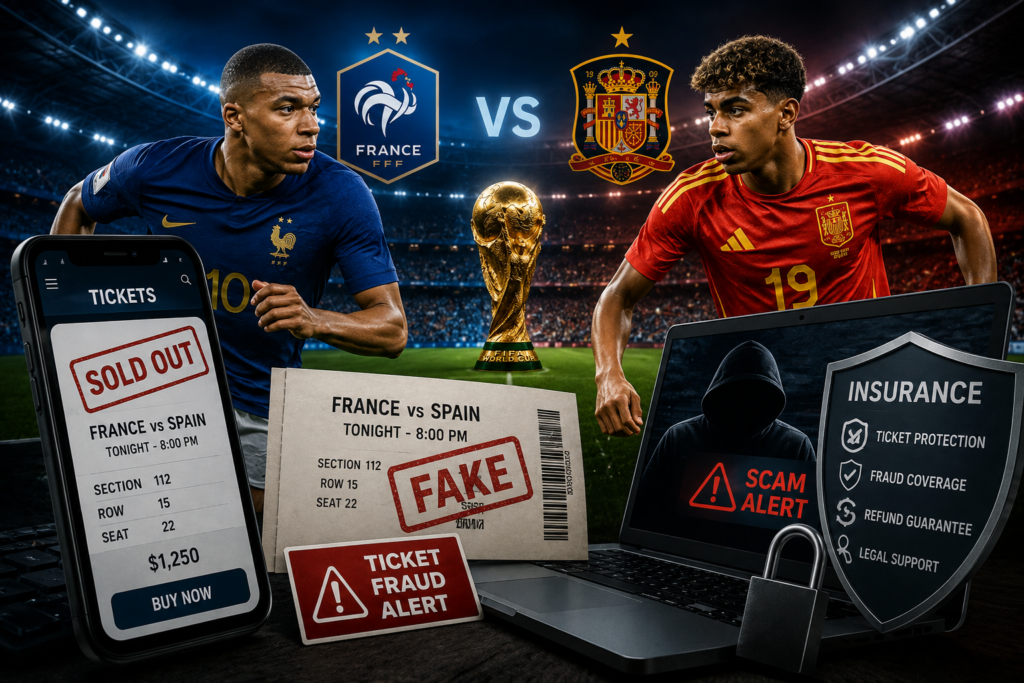
As thousands of fans gear up for France vs Spain, counterfeit tickets, online scams and last-minute cancellations are emerging as major risks—highlighting the growing role of ticket protection and event insurance in safeguarding football supporters.
Tonight’s France vs Spain semi-final at Dallas Stadium is one of the most in-demand fixtures of the entire 2026 FIFA World Cup, and wherever ticket demand spikes this hard, ticket fraud follows close behind. The FBI’s Internet Crime Complaint Center issued a public warning back in May flagging that cybercriminals were cloning official FIFA websites, harvesting fans’ personal and payment data, and selling fake tickets and hospitality packages to buyers desperate for a seat to matches exactly like this one. The Federal Trade Commission issued a nearly identical warning around the same time, describing scammers exploiting World Cup excitement through cloned websites, paid social media ads, and fabricated ticket listings.
France vs Spain: How World Cup Ticket Scams Actually Work
The FBI has publicly named specific lookalike domains built to mimic FIFA’s real site almost exactly, using an extra letter, a strange suffix, or generic-sounding words tacked onto the URL to fool a rushed buyer scrolling on their phone. The pattern investigators keep seeing is remarkably consistent: a “seller” creates false urgency, claims another buyer is closing in on the same seats, and steers the transaction toward Zelle, Venmo, Cash App, a wire transfer, or cryptocurrency, payment rails that are notoriously difficult, sometimes impossible, to reverse once money has moved.
A genuine World Cup ticket transfers only through FIFA’s own digital app-based system; a ticket sent as a screenshot, PDF, or emailed QR code is itself a warning sign, since authentic tickets simply don’t work that way anymore.
France vs Spain: FIFA’s Own Resale Marketplace — And Its Fine Print
For the first time in tournament history, FIFA has launched its own official ticket resale and exchange marketplace for 2026, built specifically to give fans a safer, sanctioned alternative to unregulated resale sites and social media sellers. It isn’t free. FIFA charges a 15 percent service fee to the buyer and another 15 percent to the seller on every resale transaction, meaning a ticket bought through the official secondary marketplace can carry a combined markup of up to 30 percent over face value. Fans who buy outside FIFA.com/tickets, by contrast, get no institutional backstop at all; FIFA’s own support documentation states plainly that tickets from unofficial sources may be invalid, duplicated, or voided without warning, and carry no guarantee of entry at the gate.
Also Read: World Cup 2026: The Hidden $7.5 Million Insurance Policy Protecting Top Stars
Where Purchase-Protection Insurance Actually Enters The Picture
This is where the more interesting, and far less covered, insurance angle emerges. Established secondary ticketing marketplaces like StubHub and Vivid Seats each run their own buyer-protection programs — StubHub’s FanProtect Guarantee and Vivid Seats’ 100% Buyer Guarantee — built to cover exactly the failure modes fraud investigators keep warning about: invalid tickets, non-delivery, duplicate seats, and cancelled events.
These guarantees function less like a regulated insurance policy and more like a marketplace-backed promise, but the effect for a buyer is similar: a financial safety net that unofficial, off-platform sellers simply don’t offer.
The fine print, however, matters more than the marketing copy suggests. FanProtect promises “comparable or better” replacement seats if a seller backs out, but “comparable” has already triggered real consumer disputes, including buyers who received demonstrably worse seating than what they originally paid for, with the platform citing system-generated limits on what replacement inventory was available.
If an event is officially cancelled and not rescheduled, StubHub offers buyers a choice between a straight cash refund or a 120 percent account credit. Crucially, though, if a match is merely postponed or moved to a different date, a real possibility given how World Cup knockout scheduling can shift, the original ticket simply remains valid for the new date, and no refund is triggered at all. These guarantees are built to catch fraud and outright cancellation; they are not built to protect a buyer who simply can’t attend or changes their mind.
Also Read: What Vinod Khosla’s $9.6 Bn Seahawks Purchase Reveals About Sports Franchise Insurance
France vs Spain Match: A Genuine Insurance Product Is Starting To Emerge
Beyond marketplace guarantees, a smaller but fast-growing category of true purchase-protection insurance, sold as an optional add-on at checkout on select ticketing platforms, is beginning to function more like conventional travel or event insurance. Rather than covering only fraud and cancellation, these policies can reimburse a buyer who is unable to attend due to documented illness, a travel disruption, or another qualifying personal emergency, coverage categories that standard marketplace guarantees do not touch at all. For an event carrying this much global attention, and this much last-minute resale volume in the hours before kickoff, understanding the gap between a “guarantee” and an actual underwritten insurance policy is exactly the kind of distinction most fans never learn until they need it.
France vs Spain: How To Actually Protect Yourself Before Tonight’s Kickoff
If you’re still hunting for a seat to France vs Spain this evening, the safest path remains FIFA’s own official ticketing channels or a licensed resale platform with a clearly disclosed guarantee, paid for by credit card rather than a peer-to-peer payment app, and with the entire transaction kept inside the platform rather than moved to a private message or off-site payment link. A seat priced dramatically below the going market rate should be treated as bait, not a lucky break; scammers are counting on exactly that instinct in a fan who’s run out of time. The small premium you pay for genuine protection, whether that’s a marketplace fee or a dedicated insurance add-on, is negligible compared to what’s lost the moment a “too good to be true” World Cup ticket turns out to be exactly that.