The Odyssey: How Insurance Companies Braved Christopher Nolan’s Storms, Monsters and Whirlpools
Christopher Nolan shot “The Odyssey” across six countries using real seas, real storms and real islands instead of green screens.
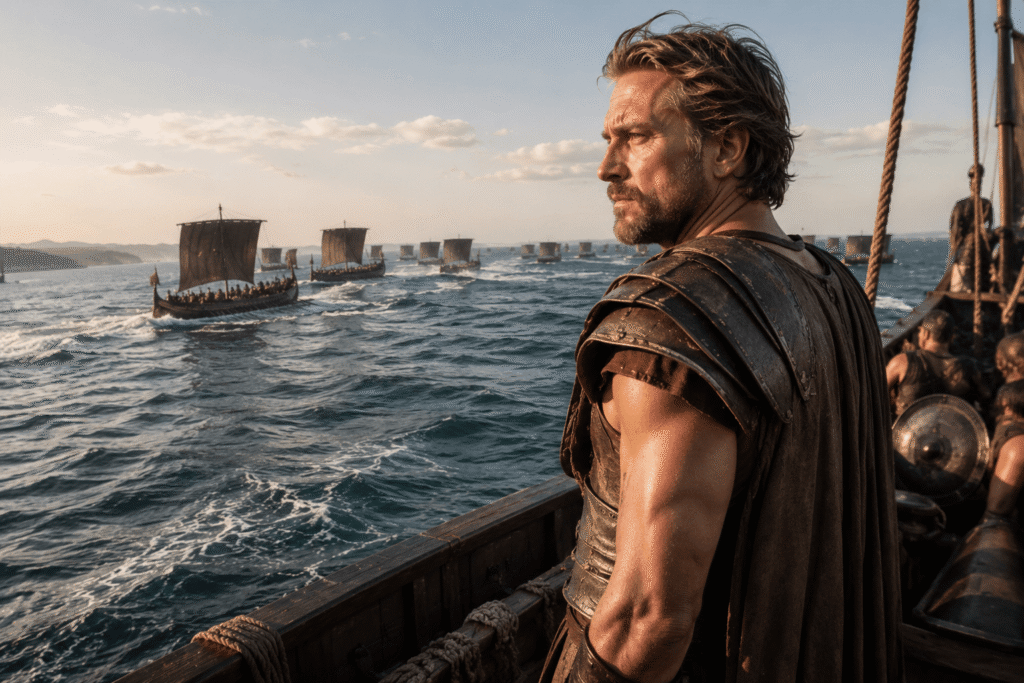
Christopher Nolan shot "The Odyssey" across six countries using real seas, real storms and real islands instead of green screens.
The Odyssey: Christopher Nolan built his reputation on refusing to fake things. Real jets crashed for “Tenet,” a real Boeing 707 was blown up for that film, and now, for “The Odyssey,” he has taken his cast and crew across six countries to shoot Homer’s storm-tossed epic on real seas, real coastlines and real islands rather than in front of a green screen. Behind every one of those decisions sat a quieter production department: the insurance and completion-bond desk that had to price the risk of putting Matt Damon, Tom Holland and Anne Hathaway in the middle of the Mediterranean and calling it a Tuesday.
Also Read: RBI’s New FD Rules From October 1: What Mean for Insurance Buyers Comparing Guaranteed Returns
The Odyssey: A $250-million bet, shot the hard way
The Odyssey is Christopher Nolan’s fantasy action epic, written and directed by him, produced by Emma Thomas and Nolan under Universal Pictures and Syncopy, with an estimated budget of $250 million — a figure that puts it among only two other Nolan films to cross the $200-million mark, “Tenet” and “The Dark Knight Rises.
” Once the roughly $125 million marketing spend is added, the total outlay on the R-rated epic is reported to have crossed $375 million.Rather than leaning on digital backdrops, the crew travelled to shoot in Greece, Morocco, Iceland, Scotland, the United States and Italy, including Sicily, and a significant portion of the shoot took place in the Aeolian Islands and Favignana, chosen because they closely mirror the settings of Odysseus’s voyage across open seas and isolated islands.
The film is also believed to be the first shot entirely on IMAX’s 70mm film cameras, and raw physical film stock alone is reported to have cost roughly $1.50 per foot, adding up to about $3 million for the roughly two million feet of footage shot. The bet paid off commercially: the film opened to $264 million worldwide in its first weekend, clearing its production budget within three days and becoming Nolan’s biggest global debut.
The Odyssey Completion bonds: the industry’s safety net for “on time, on budget”
Practical, location-heavy filmmaking on this scale isn’t underwritten through one policy. At the centre of the financing structure sits the completion bond — distinct from conventional insurance but built on the same actuarial logic.
A completion bond is an agreement between a production, its investors and a specialist bond company, under which the bond company guarantees the film will be finished on time and on budget; if the production runs over budget, the bond company funds the shortfall, and in the rare worst case where a bonded film collapses entirely, it repays investors in full. Technically, a completion bond isn’t insurance at all — it’s a guarantee that the film will be delivered as promised, or the company steps in financially.
Bond companies rarely carry that exposure alone. The principal completion-bond firms in Hollywood typically secure reinsurance from AAA-rated, multi-billion-dollar insurance corporations standing behind them, which is why banks and institutional financiers accept the guarantee in the first place — they’re trusting the balance sheet of a major insurer, not just a boutique guarantor.
Before bonding a project, the company reviews the script, budget, schedule, key cast and crew, and requires separate policies covering accidents, cast, personnel, equipment, fire, theft, weather, flooding and earthquake. Risk on a production tends to concentrate during the actual shoot — typically 25 to 40 days — and again in post-production while effects are finished and the film prepared for delivery. Premiums for this kind of all-risk cover typically run between 0.6% and 1% of a film’s budget, meaning a $200-million picture can carry an insurance bill of roughly $2 million before a single frame is shot.
Also Read: Gujarat Rains May Cost Insurers Nearly ₹5,000 Crore in Claims, Industry Estimates Show
The Odyssey: Pricing the storms, monsters and whirlpools
For a film built around a ten-year sea voyage — storms, shipwrecks, mythical creatures, hostile coastlines — the underlying insurance package goes well beyond standard general liability:
- Cast and “essential elements” coverage — covers the extra expense a production incurs if a covered cast member cannot perform because of illness, injury or death, often mandated by financiers and completion-bond providers.
- Workers’ compensation — statutory coverage for cast and crew injuries, required under SAG-AFTRA agreements, state law and most location contracts.
- Stunts, weapons and marine action — underwritten separately based on the stunt coordinator’s credentials, weapons handler licensing, scene complexity and pyrotechnician certification — a heavier line item on a film with storm-and-monster set pieces.
- Aerial coverage — drone hull and liability under FAA Part 107, helicopter aerial work and fixed-wing camera platforms, written per shoot or annually.
- Property and weather — production and auto accidents, print malfunctions, fire, theft, weather, flooding and earthquake — relevant for a shoot moving between Icelandic, Scottish, Moroccan and Mediterranean locations across different seasons.
The Odyssey: Three claim events that reshaped the market
The Odyssey was underwritten against the backdrop of an entertainment-insurance market still absorbing the cost of three major claim events from the past six years.
The Covid-19 shutdown, 2020–21. A unit of Allianz — which describes itself as the largest insurer of Hollywood studios — set aside about 488 million euros (roughly $575 million) in 2020 alone for coronavirus-related claims, much of it from the entertainment sector, and had already taken a 1.2-billion-euro hit to earnings in the first half of that year from virus-related claims.
A Variety estimate at the time put the sector’s total exposure at between $300 million and $1 billion in claims, while HUB International alone said it was handling $700 million in Covid-19 claims from film and TV production, and Lloyd’s of London said it expected to pay out up to $4.3 billion to global customers over the pandemic, against an estimated industrywide loss of around $203 billion.
One of the more visible individual disputes involved a Nolan-adjacent franchise: Paramount sued its insurer, Federal, after the carrier paid out only $5 million against a policy the studio said should have covered far more of the production delays on “Mission: Impossible,” following cast members contracting Covid-19 and civil-authority orders halting filming. The episode pushed insurers to act: Allianz’s chief claims officer confirmed that new film-production contracts sold by the company would no longer cover Covid-19-related losses, to avoid taking on new pandemic risk.
The “Rust” shooting, 2021. TMZ reported that Rust Movie Productions’ liability insurance limits totalled $6 million, against a fatal on-set shooting that led to a wrongful-death settlement with cinematographer Halyna Hutchins’s family, finalised in 2023, covering completion of the film and payments to her estate that included insurance funds.
A separate civil suit brought by three crew members over emotional distress was settled in 2025, and the case is credited with rewriting the national firearms standard for film sets — carriers now require certified armourers, written firearms protocols at every weapons call, rubber replicas of every practical firearm, and zero live ammunition on production property, with mid-policy audits to enforce it. For a production like “The Odyssey,” built around large-scale battle and combat sequences, that tightened weapons-underwriting regime is directly relevant.
The Los Angeles wildfires, January 2025. The fires that destroyed neighbourhoods in the Palisades, Altadena and Malibu paused production across Los Angeles for weeks, and in their wake completion-bond underwriters began explicitly pricing wildfire seasonality into LA County policies, several carriers non-renewed wildfire-exposed accounts, and civil-authority and ingress-egress terms tightened market-wide.
The Odyssey: What it adds up to
None of this appears to have deterred Nolan’s backers, and the box-office outcome suggests the insurance and bonding structure did its job — the production was completed, delivered and released on schedule, storms, monsters and all. But the arithmetic behind that outcome has changed in a few short years: post-Covid, insurers no longer underwrite pandemic-related shutdowns; post-Rust, weapons and stunt work carry audited protocols that didn’t exist before 2021; and post-wildfire, even where a film is shot has become a distinct pricing variable. For an industry that sells the illusion of effortless spectacle, the paperwork behind a $250-million practical epic has rarely been this exposed — or this expensive.