GST Council Allows Input Tax Credit on Employee Health, Life Insurance: What it Means for Employers
GST Council decision at its 57th meeting could ease the tax burden on employers providing health and life insurance benefits to employees.
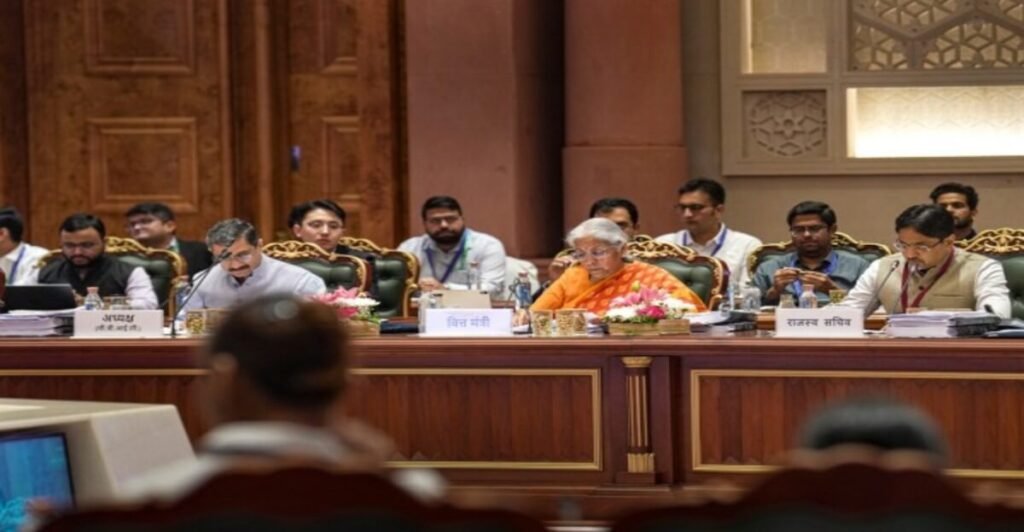
GST Council allows input tax credit on employee health and life insurance, offering potential tax relief for employers and implications for insurers.
NEW DELHI, GST Council: The GST Council at its 57th meeting decided that businesses will be able to claim input tax credit (ITC) on health and life insurance bought for their employees. The decision is part of a broader package of process reforms covering registration, returns, refunds, litigation and enforcement. It comes a year after the two-rate GST structure took effect.
GST Council: ITC on Employee Health and Life Insurance
Under the decision, credit will now be available on health and life insurance taken for employees. The Council’s note lists it among several categories of “ordinary business spending” on which credit is being opened up. The others are telecommunication towers, pipelines laid outside a factory, free samples, and stock written off on expiry of shelf life where a law requires the goods to be destroyed.
For employers, group health and life covers are a recurring cost. The note does not state an effective date for the insurance credit.
Also Read: IRDAI’s proposed commission caps could squeeze NBFC profits: Nuvama
The change follows last year’s GST restructuring, which the Council described as a “two-rate structure”. The note says that, in the year since, taxable supply has risen 25.8 percent, from Rs 40.19 lakh crore a month to Rs 50.58 lakh crore. Gross tax liability rose 13.6 percent, and the effective rate of tax on domestic supply fell from 14.55 percent to 13.13 percent. GST revenue has grown 11 percent in FY 2026-27 over the previous year, and 14.7 percent for June to August 2026 over the same months last year.
GST Council: Easier Refunds, Fewer Notices and Lighter Penalties
Several process changes in the package bear on insurers and insurance intermediaries, as taxpayers in their own right.
Refunds. The time limit for acknowledging a refund claim falls from 15 days to 10. If neither an acknowledgement nor a deficiency memo is issued within 10 days, the claim will be treated as acknowledged. The system, not an officer, will sanction 90 percent of a claim on a risk assessment, with the order issued within three working days of acknowledgement instead of the present seven. Refund of an excess balance in the cash ledger becomes fully automatic.
Returns and credit. The Council said about 95,000 system-generated notices are issued each year on differences between returns, with recovery of about 0.08 percent of the amount involved. It described them as “almost entirely a data entry problem”. Sellers will be able to reduce a previously reported amount through their sales statement, so the change reaches the buyer who claimed credit on it. Credit will be settled through the Invoice Management System, so that what a buyer accepts is what enters the buyer’s return. Corrections will be allowed for earlier periods, and a wrongly keyed buyer registration number can be fixed.
Litigation and penalties. One common standard will govern how notices are issued and served, when fraud may be alleged, how hearings are conducted and how orders are written. No notice will be issued below Rs 10,000. The general penalty, which applies where no specific penalty is provided, comes down from Rs 25,000 to Rs 10,000. The power of arrest is being removed from GST, and the threshold for prosecution rises from Rs 1 crore to Rs 5 crore. The minimum punishment is removed, leaving punishment to judicial discretion in every case. A taxpayer who files late, makes a mistake or falls behind on payment will face recovery, interest and a proportionate penalty, “and nothing beyond that”, the note says.
GST Council: Wider Changes: Credit Rules, Exports and E-Commerce
The note also covers changes in other areas that affect businesses across sectors, including insurance buyers and distributors.
Honest buyer protection. A Committee of Officers will examine how to protect a genuine buyer who holds a proper invoice, has received the goods and has paid the supplier in full. It has three months to complete its study, and an agenda will go to the next Council meeting.
No double taxation on resold services. A service bought and sold again in the same line of business will carry tax once rather than twice. Hotel accommodation up to Rs 7,500 a night booked through an agent, restaurant and catering services, and passenger transport are cited as common cases. Credit had been denied on these because the rate is 5 percent without credit.
Refunds on services and machinery. Where unused credit arises because inputs are taxed higher than outputs (an inverted rate structure), refund was confined to goods. Tax paid on input services will now be brought in, for credit availed on or after 1 November 2026. The exclusion of plant and machinery from refund is removed. Refund on plant and machinery will be calculated at one-sixtieth of the credit for each month, for credit availed on or after 1 April 2027.
Export of services. An Indian firm serving a foreign client through its own branch abroad will get export benefit. Work done in India on a foreign client’s goods, such as testing, repair, certification, research or processing, will count as an export of service even if the goods do not leave the country. The timing of export payment will follow Reserve Bank rules.
E-commerce and small sellers. A small seller will be able to declare an e-commerce operator’s warehouse in another State as a principal place of business there, with the operator’s consent, which the system will grant automatically. The registration is limited to supplies made through platforms. The Council also said platforms with different commercial models have been reading the same provision differently, and that tax on a booking will turn on the service actually delivered.
Registration and closure. About 61 percent of registrations already come through the automated route, and the system grants registration within three working days for low-risk applicants. Changes of trade name, director or partner, or address of an additional place of business will be accepted automatically. They made up 10.95 lakh of the 16.73 lakh amendment applications filed between November 2025 and September 2026. Business closure will be automated in stages, beginning with smaller taxpayers.
Annual return option. An optional scheme was approved in principle for taxpayers with turnover up to Rs 5 crore who supply only to consumers. They would file a return once a year and pay tax quarterly. The Council said 16.85 lakh of 1.05 crore active taxpayers report only such supplies, and about 99 percent of them fall below Rs 5 crore. Together they account for less than 1 percent of reported tax liability. The framework will go to the Council’s next meeting.
Goods in transit. A vehicle may be stopped only on specific intelligence, authorised in advance by an officer not below the rank of Joint Commissioner. Only the origin and destination States may inspect goods in a conveyance.
Rates. No rates were changed at the 57th meeting. The Council said rate matters will be taken up once a year, at one meeting set aside for the purpose.