How to Become Insurance Agent: Step-by-Step IRDAI Licensing Guide 2026
Becoming an insurance agent in India starts with a five-step IRDAI process — tying up with an insurer, pre-licensing training, clearing the IC-38 exam, documentation, and background verification.

Insurance Agent: Five steps stand between you and a licence to sell insurance in India — and none of them require a finance degree. Here's the exact IRDAI process, step by step.
Insurance Agent: India’s insurance sector has been steadily widening its distribution network, with insurers pushing further into tier-2 and tier-3 towns and, in the process, opening the door to a growing pool of individual agents. For many first-time applicants, the appeal is straightforward: becoming a licensed insurance agent reportedly requires no prior finance background, no mandatory graduation degree, and a process that can be completed within a few weeks. What it does require, without exception, is clearing IRDAI’s qualifying exam and securing a valid licence.
Also Read: 34 Crore EPFO Accounts Credited With 8.25% Interest for FY2025-26 — Here’s How to Check Your Balance
Insurance Agent: Here is the step-by-step path, as it currently stands.
Step 1: Tie up with an insurer
The process does not begin with an individual application to the regulator. Agents do not register alone — a candidate signs up through an IRDAI-recognised insurance company whose products they intend to sell. This insurer becomes the sponsoring entity for the rest of the licensing journey.
Step 2: Complete mandatory pre-licensing training
Before appearing for the qualifying exam, candidates must undergo IRDAI-approved training. This training is a prerequisite for taking the exam, and eligibility itself only requires the candidate to be an Indian citizen or legally permitted to work in India. No graduation degree or finance background is needed — a school-leaving certificate, valid ID, and willingness to learn are reportedly enough to begin.
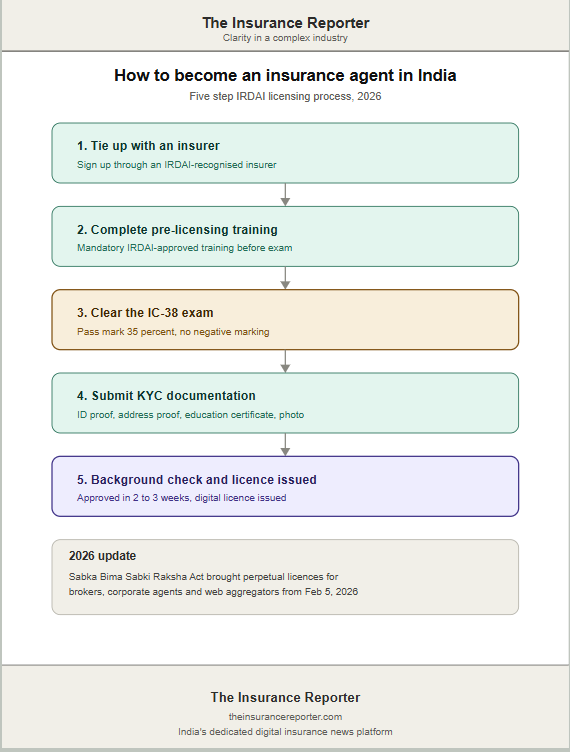
Step 3: Clear the IC-38 exam
This is the non-negotiable gateway. The IC-38 exam is conducted by the Insurance Institute of India on behalf of IRDAI and checks whether a candidate understands insurance products, regulations, and ethical selling practices well enough to advise real families. The bar to clear it is reportedly not steep — candidates need just 35% to pass, with no negative marking, though the syllabus still demands genuine familiarity with policy structures and compliance basics.
Step 4: Submit documentation for verification
Once the exam is cleared, candidates move to documentation. Standard KYC requirements apply — identity proof, address proof, an education certificate, and a photograph — nothing beyond routine paperwork.
Step 5: Background check and licence issuance
The sponsoring insurer submits the candidate’s application to IRDAI, which then runs a background verification. If everything is in order, the licence is typically approved within two to three weeks and issued in digital format. At that point, the individual is legally authorised to solicit and sell insurance products on behalf of the sponsoring insurer.
Also Read: Why Is RBI Worried About Policyholders Surrendering Their Life Insurance Policies?
Insurance Agent: What’s changed under the Sabka Bima Sabki Raksha Act
Agents entering the profession in 2026 should be aware of a recent regulatory shift. The perpetual licence scheme, introduced under the Sabka Bima Sabki Raksha (Amendment of Insurance Laws) Act, 2025, came into force on February 5, 2026. Previously, every category of intermediary — individual agents, brokers, corporate agents and web aggregators — had to renew their licence every three years. Under the new framework, brokers, corporate agents, insurance marketing firms and web aggregators reportedly no longer need to apply for renewal every three years, with continuity instead tied to the entity remaining active and compliant, alongside prescribed annual fees.
Whether this perpetual-validity treatment applies identically to individual agents — as distinct from corporate agents and brokers — is a detail some industry material still frames differently, with references to the standard three-year cycle persisting for individual agents even after the February 2026 change. New agents would do well to confirm this directly with their sponsoring insurer or IRDAI’s regional office.
Insurance Agent: Obligations that follow the licence
Once licensed, agents operate under a defined code of conduct. This includes assisting policyholders or nominees in understanding the claims process and completing documentation for a smooth settlement. On the restrictions side, selling a policy without formal appointment by a licensed insurer is illegal and can trigger immediate cancellation of the agency along with financial penalties, and agents are barred from encouraging or pressuring customers to misrepresent or conceal information on proposal forms.
Insurance Agent: The opportunity behind the process
The regulatory rigour reflects the scale of what’s at stake. India’s insurance premium income crossed ₹11.2 lakh crore in FY 2024-25, making it reportedly the fastest-growing insurance market globally, even as penetration remains at around 4% of GDP against a global average of 7%. That gap between penetration and potential is what continues to draw new entrants into agent and broker roles across the country.