Will Insurance Get Cheaper with Bima Sugam? How It Will Benefit Customers
Bima Sugam, IRDAI’s zero-commission insurance marketplace, is set to go live in phases through September 2026 — but whether it actually lowers premiums for customers depends on how insurers respond to the platform’s cost structure.

Bima Sugam aims to simplify insurance buying by bringing insurers, intermediaries, and customers onto a single digital platform.
Bima Sugam: After nearly four years of missed deadlines, Bima Sugam — the Insurance Regulatory and Development Authority of India’s unified digital insurance marketplace — finally has a concrete timeline. IRDAI Chairman Ajay Seth confirmed in late June that initial products covering motor, health, and term insurance should be available on the platform by the end of September 2026, with a phased rollout starting with motor policies, followed by renewals and health cover in August, and term life in September.
The bigger question for ordinary policyholders isn’t when Bima Sugam launches, but what it changes for their wallets. The platform is being built around a structural shift in how insurance is sold in India, and that shift is where any potential savings would come from.
Also Read: Blackstone, Ex-HDFC ERGO CEO Anuj Tyagi Join Hands for New General Insurer — First 90% FDI Play
Bima Sugam: The Zero-Commission Model, Explained
Traditionally, insurers pay commissions to agents and brokers, a cost that gets built into the premium a customer eventually pays. Bima Sugam is designed to work differently: rather than commissions, insurers reportedly pay the platform a fee of around 5-7% for policies sold through it, replacing the layered distribution costs that typically accompany agent-driven sales.
In theory, a lower distribution cost should translate to a lower premium, or at least a more transparent one, since customers would be able to compare pricing and coverage across insurers on a single screen instead of relying on an agent’s recommendation. IRDAI has pitched the platform as India’s answer to a fragmented insurance-buying experience, often described informally as an “Amazon for insurance.”
Also Read: Vikram-1 Launch: Who Insures Skyroot’s Rocket When It Flies — and When It Doesn’t?
Bima Sugam: What’s Actually Live Right Now
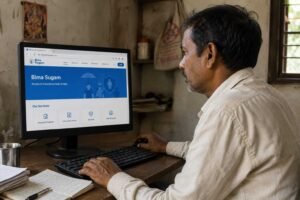
It’s worth being clear about where things stand today. The Bima Sugam website, run by the not-for-profit Bima Sugam India Federation (BSIF), has functioned mainly as an information hub since its launch in September 2025. Full transactional capability — where a customer can actually compare and buy a policy on the platform — is still being rolled out in phases, and insurers are in the process of completing their technology integration with the system.
BSIF itself is structured to stay neutral, with paid-up capital of roughly ₹310 crore contributed collectively by life, health, and general insurers, so no single insurer holds a controlling stake. The platform also rides on Bima Pehchaan, a permanent digital insurance ID linked to Aadhaar, PAN, and mobile number, which is meant to simplify KYC and let policies move with the customer rather than the insurer.
Bima Sugam: Why Cheaper Isn’t Guaranteed
Industry analysts have flagged a caveat worth taking seriously: a lower distribution cost doesn’t automatically mean a lower premium reaches the customer. Insurers could absorb some of the savings rather than pass all of it on, particularly in the early phases while the platform is still building transaction volume. Experts have also cautioned that buyers evaluating options on Bima Sugam should weigh policy features and claim-settlement track records rather than choosing purely on price, especially for more complex products like health and life insurance, where fine print matters more than the premium sticker.
There’s also the matter of Bima Sugam’s own credibility gap. The project has missed nearly every deadline set for it since it was first proposed for a January 2023 launch, having since slipped through April 2025, mid-2025, and a scaled-back December 2025 target before arriving at the current September-end 2026 window. That history is a reason some financial advisors are telling customers not to delay their insurance decisions while waiting for the platform to fully mature.
Bima Sugam benefit: How it will impact you
Take a comprehensive private car policy priced at, say, ₹18,000/year, split roughly into an Own Damage (OD) premium of ₹12,000 and a Third-Party (TP) premium of ₹6,000 (TP rates are fixed by IRDAI regardless of channel). Today, private car comprehensive policies typically carry commissions of up to 15% of the OD premium for agents, and dealer/MISP channels can push this close to 19.5% — once you stack on volume incentives and bundled add-on commissions, effective payouts of 25–30% on OD (as you mentioned) aren’t unusual in the dealer-financed channel. At 28% of a ₹12,000 OD premium, that’s roughly ₹3,360 going into distribution costs alone. On Bima Sugam, insurers are expected to pay a nominal platform fee of just 5–7% instead of agent commissions, so that same OD slice might cost the insurer closer to ₹720–₹840. If insurers pass even half of that saved margin through as a lower premium (a big “if,” since nothing obligates them to pass on 100%), you’re plausibly looking at 8–12% off the OD component — maybe ₹1,000–₹1,400 off an ₹18,000 policy. Not life-changing, but real money on a recurring annual expense.
The catch worth flagging for readers: that saving is only on the purchase side. Aggregators today mostly monetize lead generation and sales, while Bima Sugam’s real differentiator is meant to be a single-window claims interface across insurers rather than routing through each insurer’s own site — but in practice, aggregators like PolicyBazaar have already pivoted hard toward paid claims-assistance and concierge services precisely because their commission-based lead model is under pressure. So the honest framing is: Bima Sugam may shave money off your premium at purchase, but if you still want hand-holding during a claim (which is where people actually feel insurance pain — surveyors, garage approvals, cashless delays), you may end up paying for that separately, either as a platform add-on or through a private aggregator’s claims-assistance plan running alongside it. The net saving for a typical customer is therefore smaller than the headline commission-cut number suggests.
Bima Sugam: The broader objective
Bima Sugam is one piece of IRDAI’s broader “Bima Trinity” initiative, which also includes Bima Vistaar, a rural-focused composite insurance product, and Bima Vahaak, a women-centric agent network built to sell Bima Vistaar policies through the Sugam platform. A separate consultation paper on distribution reform is expected by the end of July 2026, which should give a clearer picture of how commission structures across the industry may change once Bima Sugam is fully operational.