Why India’s Insurance Distribution Space Is Ripe for Disruption
India’s insurance industry is expanding rapidly, but its distribution model remains rooted in the past. As digital infrastructure, AI, and changing consumer expectations converge, the biggest opportunity is no longer creating better insurance products—it’s reinventing how insurance reaches every Indian.
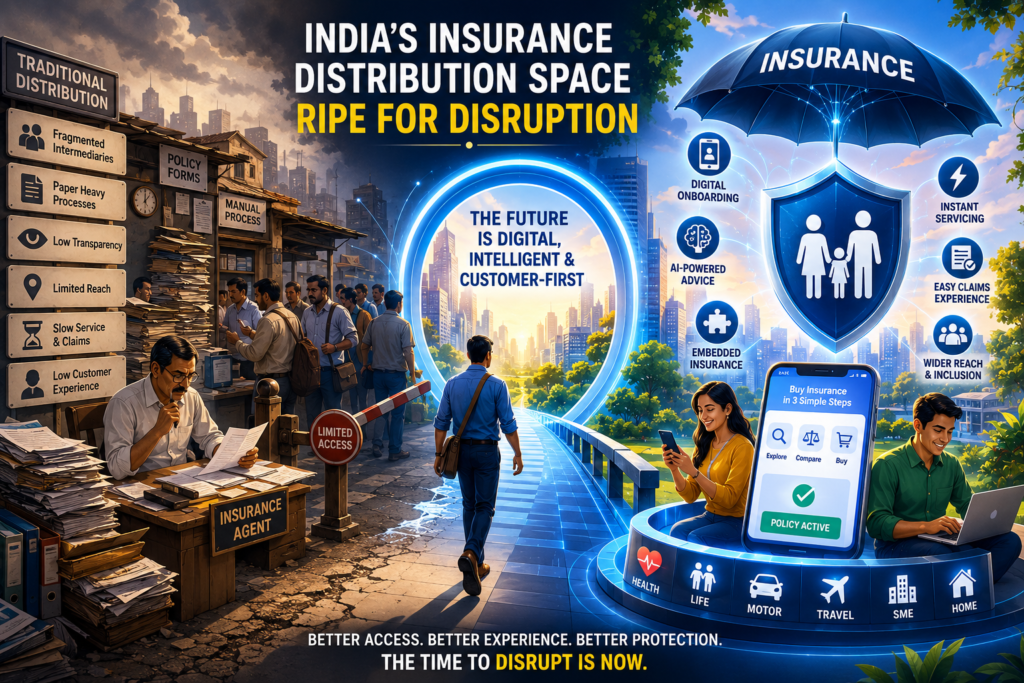
The insurance distribution sector in India is undergoing a tectonic Shift.
Insurance in India: India has become one of the world’s fastest-growing insurance markets, yet the way insurance reaches customers remains largely unchanged. Despite rapid digital adoption, rising disposable incomes, and increasing financial awareness, insurance distribution continues to be fragmented, inefficient, and heavily dependent on traditional channels. This gap between market potential and distribution capability presents one of the biggest opportunities for innovation in Indian financial services.
How is Indian insurance sector faring
The insurance sector itself has witnessed remarkable growth over the past decade. Life, health, motor, and commercial insurance have all expanded steadily, supported by favourable regulation, greater awareness after the COVID-19 pandemic, and government-led financial inclusion initiatives. However, distribution—the bridge connecting insurers with customers—has struggled to evolve at the same pace.
India remains significantly underinsured. Insurance penetration, measured as the percentage of premiums to GDP, continues to trail many developed economies. Millions of individuals and businesses remain either uninsured or inadequately insured, not because products do not exist, but because access, education, and advice remain inconsistent.
A large share of insurance distribution is still dominated by individual agents. While agents continue to play an important role, the model often faces limitations in scalability, productivity, and customer reach. Many agents focus primarily on urban markets, leaving vast segments of rural and semi-urban India underserved. Furthermore, customers increasingly expect faster, digital-first experiences that traditional distribution models often struggle to provide.
Consumer insurance behaviour
Consumer behaviour itself has undergone a dramatic transformation. Indians today compare products online, expect instant service, and demand transparency in pricing and claims. Yet purchasing insurance frequently remains a manual process involving paperwork, multiple intermediaries, and lengthy decision cycles. The contrast between customer expectations and the existing buying experience creates significant friction.
Health insurance highlights this challenge particularly well. Rising healthcare costs have made health coverage a necessity rather than an optional financial product. However, selecting the right policy remains confusing due to complex policy wordings, exclusions, waiting periods, and varying coverage structures. Many customers either delay purchasing insurance or end up buying products that do not adequately meet their needs.
Small businesses face similar hurdles. India’s millions of MSMEs require protection against operational, cyber, liability, property, and employee-related risks. Yet commercial insurance penetration remains relatively low. Many business owners lack awareness of available products, while distribution networks often prioritise larger corporate clients over smaller enterprises.
The opportunity becomes even larger when viewed through India’s broader digital transformation. The country has built one of the world’s most sophisticated digital public infrastructures through Aadhaar, UPI, eKYC, DigiLocker, and Account Aggregator frameworks. These systems have dramatically simplified identity verification, payments, and financial data sharing. Insurance distribution can increasingly leverage these digital rails to reduce onboarding friction, improve underwriting, and deliver faster customer experiences.
How AI is changing the sector
Artificial intelligence is expected to further reshape the industry. AI-powered advisory systems can simplify policy comparisons, personalise recommendations, automate documentation, and improve customer servicing throughout the policy lifecycle. Machine learning models can help identify customer needs, predict lapses, and optimise cross-selling opportunities with far greater efficiency than traditional methods.
Embedded insurance represents another powerful growth avenue. Instead of selling insurance as a standalone product, coverage can be integrated seamlessly into everyday customer journeys. Travel bookings, vehicle purchases, e-commerce transactions, consumer lending, and healthcare platforms increasingly provide opportunities to offer relevant insurance precisely when customers need it. This reduces customer acquisition costs while improving policy adoption rates.
Digital aggregators have already demonstrated how technology can simplify product discovery and comparison. However, the next phase of disruption extends beyond comparison websites. Future insurance platforms are likely to combine advisory, underwriting, servicing, claims assistance, renewal management, and financial planning into unified ecosystems that strengthen long-term customer relationships.
The regulatory environment has also become increasingly supportive of innovation. The Insurance Regulatory and Development Authority of India (IRDAI) has introduced reforms aimed at increasing insurance accessibility, encouraging digital innovation, and expanding distribution channels. Initiatives such as regulatory sandboxes have enabled companies to experiment with new business models while maintaining consumer protection standards.
One of the most significant structural opportunities lies in improving trust. Insurance remains a product that customers purchase today for uncertain future events. Many consumers continue to perceive policies as complex, claims as difficult, and documentation as overwhelming. Companies that simplify communication, improve transparency, and provide proactive customer support can build lasting competitive advantages.
Data-driven distribution further enhances this opportunity. Rather than relying solely on broad demographic targeting, insurers and distributors can increasingly utilise behavioural insights, financial data, transaction history, and contextual signals to offer more relevant products. Better targeting improves conversion rates while reducing customer acquisition costs.
India’s young demographic profile further strengthens the long-term outlook. Millions of first-time earners are entering the workforce every year, creating substantial demand for life insurance, health coverage, retirement planning, and wealth protection. At the same time, rising financial literacy is encouraging households to view insurance as an essential component of long-term financial planning rather than merely a tax-saving instrument.
Technology alone, however, will not define the winners. Successful distributors will combine digital efficiency with trusted human advice. Insurance often involves emotionally significant decisions involving family protection, healthcare, business continuity, and financial security. Hybrid models that blend technology with expert guidance are likely to achieve stronger customer engagement than purely digital or purely offline approaches.
Ultimately, India’s insurance distribution landscape stands at an inflection point. Strong macroeconomic growth, expanding digital infrastructure, supportive regulation, rising consumer awareness, and advances in artificial intelligence are converging to reshape how insurance reaches customers. While insurers continue to innovate on products, the larger opportunity increasingly lies in transforming distribution itself.
The companies that simplify complexity, build customer trust, leverage data intelligently, and integrate insurance seamlessly into everyday financial journeys will be best positioned to capture the next wave of growth. As India’s economy continues to formalise and financial inclusion deepens, insurance distribution may well emerge as one of the country’s most compelling fintech and insurtech opportunities over the coming decade.