Intestinal Parasite Infection: US Cases Top 4,000, Food Industry’s Insurance Gaps Come Into Focus
An intestinal parasite infection outbreak has sickened more than 4,000 people across 31 US states, with no confirmed single source yet identified.
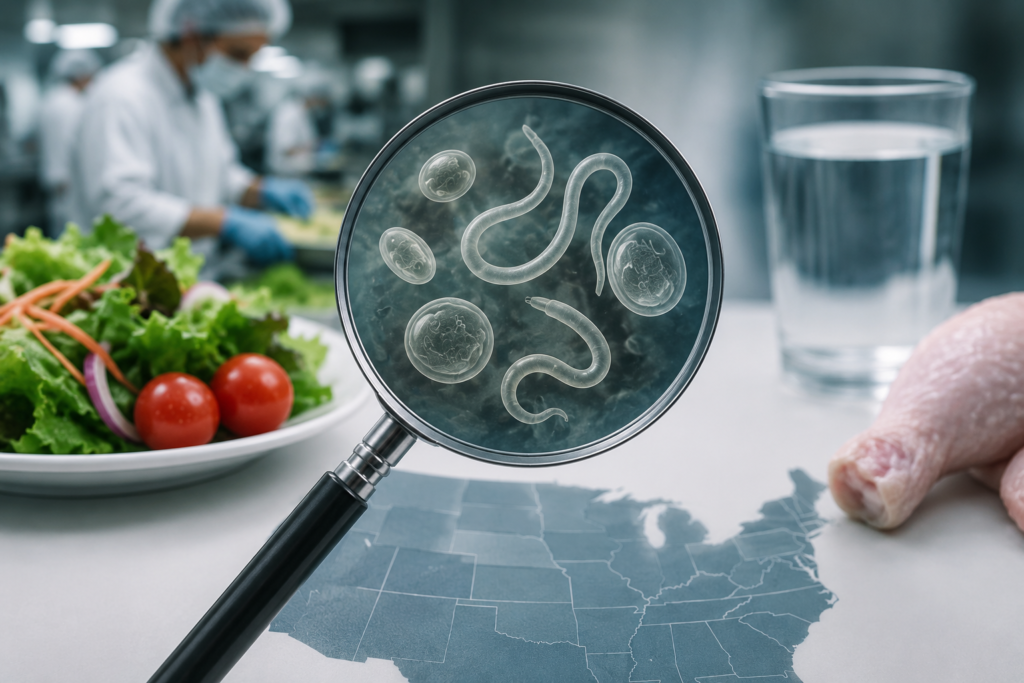
AI Image. Intestinal Parasite Infection seen under a microscope in a stained stool sample
Intestinal Parasite Infection: A cyclosporiasis outbreak has spread across more than half of US states this summer, with health officials tracking case numbers well above last year’s total and still no confirmed single source behind the surge. Michigan alone has logged over 1,560 confirmed cases since late June, including 44 hospitalizations, while Ohio has reported over 430 cases.
The Centers for Disease Control and Prevention had confirmed 843 domestically acquired cases as of July 9, though independent tallies by NBC News put the broader national count above 4,000, a gap that reflects the lag between when illnesses occur and when they get formally verified. The agency has said it sees no evidence linking these cases to one multistate outbreak, and is instead investigating multiple clusters that may trace back to different contaminated food sources.
That ambiguity is the story’s real insurance angle. Cyclospora is not spread person to person; it requires one to two weeks outside the human body to become infectious, meaning contamination almost always occurs upstream, often through irrigation water or produce handling, well before food reaches a store shelf or restaurant kitchen.
Also Read: What Vinod Khosla’s $9.6 Bn Seahawks Purchase Reveals About Sports Franchise Insurance
Intestinal Parasite Infection: History of past outbreaks
Past outbreaks have been traced to basil, cilantro, raspberries, snow peas, and pre-packaged salad kits, including a 2022 cluster linked to a Caesar salad kit containing bagged romaine. When the eventual source is identified, often weeks or months after the first illnesses appear, liability tends to cascade across the entire supply chain: growers, processors, distributors, and retailers can all be named in litigation regardless of where the contamination actually occurred.
This is where product liability and contamination insurance function very differently from standard general liability coverage, and where many food businesses discover gaps only after a claim arrives. A commercial general liability policy typically covers bodily injury claims from a contaminated product, but recall costs, brand rehabilitation expenses, and lost income during a shutdown usually require separate, specialized coverage: product recall insurance, contamination insurance, and business interruption riders.
Also Read: World Cup 2026: The Hidden $7.5 Million Insurance Policy Protecting Top Stars
Industry analysts have pointed to a persistent underinsurance problem in the sector; the 2009 Peanut Corporation of America recall cost producers an estimated one billion dollars in lost production and sales, the 2018 romaine lettuce E. coli outbreak caused an estimated 280 to 350 million dollars in total economic losses tied to a single farm’s operations, and the 2019 Blue Bell listeria outbreak resulted in a 19.35 million dollar criminal settlement on top of a nationwide recall. Company executives and directors can also face personal exposure: Blue Bell’s directors separately reached a 15 million dollar settlement tied to their oversight of the listeria outbreak, illustrating how contamination events increasingly pull in directors and officers liability coverage alongside product liability.
Cyclospora: Another layer of risk about Intestinal Parasite Infection
Coverage disputes add another layer of risk. In one widely cited case, Netherlands Insurance Company v. Main Street Ingredients, a recall of non-fat dried milk used in consumer cereal led to prolonged litigation. While the court ultimately surprised the industry by ruling that a standard general liability policy did cover the losses because the ingredients were inextricably mixed, the years of litigation underscore how heavily businesses must rely on clear, specialized product recall policies to avoid catastrophic gaps when the source of contamination is disputed or shared across multiple entities, which is precisely the situation the CDC now faces with cyclospora.
The current outbreak is unfolding at a moment when the public health infrastructure responsible for identifying these sources has also been under strain. Following a 2025 CDC policy shift that scaled back the Foodborne Diseases Active Surveillance Network (FoodNet) and made state-level tracking of Cyclospora optional, federal traceback efforts are facing significant headwinds.
For insurers underwriting food industry risk, a slower federal investigation means a longer window of uncertainty, and uncertainty is generally priced into higher premiums or tighter underwriting terms for produce growers and food manufacturers with export or fresh-produce exposure.
For now, the practical takeaway for food industry risk managers is unchanged from past outbreaks: contamination and recall coverage needs to be purchased deliberately and reviewed for gaps, rather than assumed to be bundled into general liability.
Whether this season’s cyclospora cases resolve into a single traceable source or, as the CDC currently suspects, several independent clusters, the insurance exposure for growers, processors, and retailers along the supply chain will only become clear once the investigation does.