NPCI Sets Flat ₹5 UPI Fee on Insurance Premiums as New MDR Regime Kicks In
NPCI will charge a flat ₹5 MDR on UPI insurance premium payments above ₹2,000 from October 15, 2026 — policyholders continue to pay nothing.
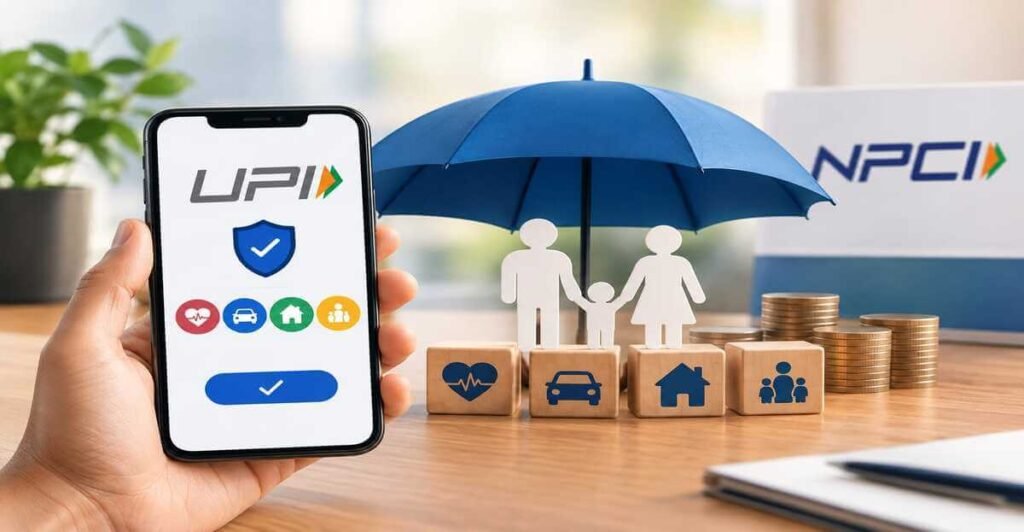
NPCI's new UPI MDR regime kicks in October 15 — insurance premiums above ₹2,000 will draw a flat ₹5 fee, not the standard 0.4%.
NPCI: The National Payments Corporation of India (NPCI) has confirmed that insurance premium payments made through UPI will attract a flat Merchant Discount Rate (MDR) of ₹5 per transaction, applicable to premiums exceeding ₹2,000, once the country’s new UPI charging framework takes effect on October 15, 2026, according to a document released by NPCI on September 15. Premiums of ₹2,000 or below will continue to attract zero MDR.
The clarification places insurance among a small set of sectors — alongside railways, telecom services and fuel retail — that will be charged a fixed fee rather than the standard percentage-based MDR being introduced for Person-to-Merchant (P2M) UPI transactions.
NPCI: What the New MDR Framework Says About Insurance
Under the broader policy, NPCI is introducing a 0.4% MDR on P2M UPI transactions above ₹2,000, with the fee capped at ₹300 for transactions of ₹75,000 and above, the FAQ document stated. However, for insurance premium payments specifically, this percentage-based structure has been replaced with a flat ₹5 charge per transaction on premiums exceeding ₹2,000, rather than a proportional fee.
NPCI said the concessional flat-rate treatment is intended to spare policyholders making high-value annual or semi-annual insurance payments from heavy backend fee friction. The document added that insurers would benefit from low-cost digital collections, which NPCI said would help expand insurance coverage across India.
Also Read: Bamboo Insurance Launches IPO Roadshow, Targets $18-$20 Per Share on NYSE
For context, a 0.4% MDR on a ₹50,000 premium payment would work out to ₹200, whereas under the flat-rate concession applicable to insurance, the same transaction would attract only ₹5 — a structure NPCI has similarly outlined for other named categories such as railways, telecom and fuel, which will also be billed a flat ₹5 per transaction above ₹2,000 instead of the 0.4% variable rate, per the FAQ document.
NPCI: No Change for Policyholders Paying Premiums via UPI
NPCI reiterated in the FAQ document that consumers — including policyholders — will not be charged for UPI transactions under the new framework, and that UPI app providers are barred from levying any platform fee on payments made through UPI. Merchants, including insurers, are similarly barred from passing on the MDR to customers, the document stated, ensuring that consumers continue to pay only the posted price.
Premium payments up to ₹2,000 will remain entirely free of MDR for insurers, the document confirmed, in line with the broader exemption applicable to all UPI P2M transactions below that threshold.
Broader Context: Why NPCI Is Introducing MDR on UPI
The insurance-specific concession sits within a wider commercial restructuring of UPI that NPCI said is necessary to fund infrastructure resilience, cybersecurity and customer service across the ecosystem, given that UPI processes billions of transactions every month and the MDR revenue is distributed only within the UPI ecosystem, according to the FAQ document.
NPCI cited scale as a driver of the change, noting that UPI processed 2,451 crore transactions valued at ₹29.9 lakh crore in August 2026 alone. The FAQ document said industry estimates put the annual cost of maintaining UPI payment operations, server bandwidth, fraud prevention systems and bank technical support at around ₹20,000 crore, and that government subsidies were designed as short-term bridge funding rather than a permanent revenue source.
The operational parameters and category-wise caps, including the flat-rate treatment for insurance, are decided by the UPI and Services Steering Committee, which is headed by NPCI, the document said.
A separate dedicated fund is also being proposed to subsidise digital payment infrastructure for small merchants in Tier 3–6 centres, with the detailed framework to be finalised in consultation with the Reserve Bank of India (RBI) within three months, according to the FAQ.
NPCI has advised the public to rely only on official communications from the Ministry of Finance, RBI or NPCI itself for verified updates on UPI charges, cautioning against unverified messages circulating on social media.