World Cup Final: Trump’s Coming to Watch Messi vs Yamal — What If Argentina vs Spain Gets Called Off?
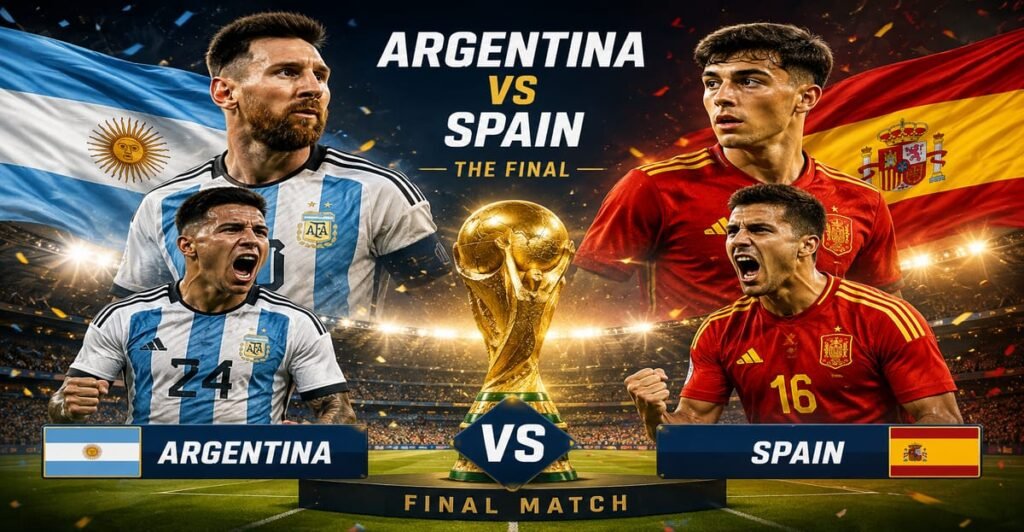
World Cup Final: Only one team will lift the trophy. Who are you backing to become World Champions?
World Cup Final: Today, as Spain and Argentina walk out for the FIFA World Cup 2026 Final, there’s a number far bigger than any transfer fee or prize pool sitting quietly in the background: over $1 billion. That’s the estimated value of the event cancellation insurance protecting this single tournament — and almost nobody watching from the stands has any idea it exists.
Add one more variable into the mix this year: US President Donald Trump is confirmed to attend the match at MetLife Stadium, alongside FIFA president Gianni Infantino, and is expected to help present the trophy after the game. A sitting head of state in the building changes the entire risk calculus for organizers — and it’s exactly the kind of scenario event cancellation insurance is built to handle.
Event cancellation insurance is no longer a niche add-on for big events. It has become the financial backbone of every mega-event in the world, and the 2026 World Cup Final is the perfect case study for why.
Also Read: Heavenly Spices Garlic Powder Recall: Here’s How US Companies Protect Themselves
World Cup Final: What Is Event Cancellation Insurance?
Event cancellation insurance is a specialized policy that protects organizers, sponsors, and broadcasters from the financial fallout if an event is cancelled, postponed, interrupted, or cut short. Instead of just reimbursing lost profits, a well-structured event cancellation insurance policy puts stakeholders back in the exact commercial position they would have been in had the event gone ahead as planned.
For an event the scale of the World Cup Final, that means covering:
– Cancellation or abandonment of the match itself
– Postponement or rescheduling costs if the game has to be delayed
– Non-appearance risk — what happens if a star player or even an entire team can’t make it
– Extra operational costs to keep the event running under threat, like additional security during civil unrest or emergency cooling systems during extreme heat
Why This Year’s World Cup Event Cancellation Insurance Bill Crossed $1 Billion
For the 2022 World Cup in Qatar, FIFA reportedly secured close to $900 million in event cancellation coverage. For 2026, industry estimates put that figure above the $1 billion mark — and the reason is structural, not just inflation.
This year’s tournament spans three countries — the US, Canada, and Mexico — with 48 teams and over a hundred matches. That three-nation footprint has pushed insured values sharply higher and increased demand for terrorism cover, cyber protection, and broader contingency insurance layered on top of standard event cancellation insurance.
The Trump Factor: When a Head of State Raises the Stakes
Presidential attendance at a mega-event isn’t just a photo opportunity — it’s a major line item in the event cancellation insurance calculation. Whenever a sitting president attends an event of this size, security protocols multiply: airspace restrictions, expanded Secret Service perimeters, and heightened threat monitoring all become part of the operational picture.
None of that is new for Trump, who has attended the Super Bowl, the NBA Finals, and last year’s FIFA Club World Cup final at this same MetLife Stadium. But every one of those appearances adds a layer of complexity that event cancellation insurance underwriters have to price in — because a security-driven delay or interruption is just as real a risk as bad weather or a cyberattack.
World Cup Final: What If Argentina vs Spain Actually Gets Called Off Today?
It’s the question every organizer quietly prepares for and every insurer prices into the policy: what if kickoff doesn’t happen on schedule?
If today’s final were called off — whether due to an extreme weather event, a credible security threat, or a medical emergency in or around the stadium — event cancellation insurance is what stands between FIFA and a financial disaster. It would kick in to cover:
– Refunds or rescheduling costs for the 80,000+ ticket holders inside MetLife Stadium
– Broadcast and sponsorship penalties tied to missed air dates
– The added cost of extra security, medical staff, or crowd management if the disruption stretches on
– Non-appearance risk, in the rare case a key figure — player, official, or dignitary — can’t take part once the match resumes
No World Cup match has been outright cancelled since 1946, and individual games have only ever been rescheduled for weather. That track record isn’t luck — it’s the direct result of decades of increasingly sophisticated event cancellation insurance built specifically so a disruption never turns into an uninsured catastrophe.
World Cup Final: Beyond Cancellation: The Full Insurance Stack Behind the Final
Event cancellation insurance for a tournament this size never travels alone. It sits inside a much bigger insurance framework that typically includes:
Terrorism and Political Violence Cover
With matches in three countries and heightened global security concerns, insurers now treat political violence as a named peril rather than folding it into a generic “all risk” policy.
Cyber Insurance
Ticketing systems, broadcast feeds, and stadium infrastructure are all digital — and all exposed. A cyberattack on any of these could trigger the same financial chaos as a physical cancellation.
Pandemic and Health-Risk Exclusions
Standard business interruption policies often exclude pandemics entirely, which is a real gap given that fans are arriving from virtually every country on earth. This is one of the trickiest parts of structuring event cancellation insurance today.
Weather and Natural Catastrophe Cover
Extreme heat, storms, and other climate risks are now priced directly into event cancellation insurance premiums for outdoor, high-attendance events like this one.
Why Traditional Claims Processes Are Struggling to Keep Up
Here’s the part most fans never think about: even great event cancellation insurance is only as good as how fast it pays out. With insured values potentially running into the billions and stakeholders spread across multiple countries and legal jurisdictions, traditional loss-adjustment processes are proving too slow.
This is why parametric insurance — policies that pay out automatically once a pre-agreed trigger event occurs (a certain wind speed, a confirmed cancellation, a specific health alert) — is rapidly gaining ground as a companion to standard event cancellation insurance for events of this scale.
Also Read: Argentina vs Spain World Cup Final: Messi, Yamal and the Risk Behind Football’s Biggest Night
World Cup Final: What This Means for Everyday Insurance Buyers
You don’t need to be FIFA to learn from this. The same core principle behind billion-dollar event cancellation insurance applies to any wedding planner, concert organizer, or corporate event manager: the bigger the financial exposure, the more essential it is to insure against the things you can’t control.
No World Cup match has been outright cancelled since 1946 — but that track record isn’t an accident. It’s the result of decades of increasingly sophisticated event cancellation insurance, designed precisely so that a single bad afternoon of weather, security, or health news never turns into a billion-dollar catastrophe.
World Cup Final: The Bottom Line
While 80,000 fans in the stadium and millions more at home are focused on Messi’s final World Cup appearance, insurers are quietly managing one of the largest event cancellation insurance exposures in sporting history. It’s proof that behind every unforgettable sporting moment, there’s an equally massive financial safety net most people never see — until they need it.