IRDAI Is Treating the Symptom, Not the Disease
Hari Radhakrishnan writes on IRDAI’S reforms: Insurers already have the option to sell directly. They mostly don’t, because it costs them more. Why the regulator’s push to squeeze distributors may only move the bill from one column to another.

IRDAI: Commissions are a symptom, not the disease. India's regulator wants to squeeze distributors, but the real fix lies in claims and customer trust, writes Hari Radhakrishnan.
By: Hari Radhakrishnan
It took the market barely a day to deliver its verdict. On 23 September, the insurance regulator released a consultation paper proposing a sweeping overhaul of how insurance is distributed in India. By the next session, insurer and bank stocks were sliding sharply.
The reaction online was just as fast, and far less rational. Financial influencers and much of the public cheered. Agents and brokers objected loudly. Insurers, tellingly, have said very little, perhaps because none of them wants to be seen taking a side.
I should declare my bias: I am an insurance broker. Even so, I believe the paper has diagnosed three problems correctly. Commissions are excessive in some segments, notably life insurance first-year premiums and credit-linked policies sold through bancassurance, and that invites mis-selling. The distribution architecture is too complex and burdens regulated entities with compliance. And insurers’ expenses of management (EOM) are climbing, with many unable to stay within regulatory limits.
Nobody should argue for high intermediation costs or for insurers to spend policyholders’ money carelessly. My quarrel is with the diagnosis of why these problems exist, and therefore with the cure.
Why insurance costs so much to sell
The prevailing view among regulators, insurers and parts of the public is that commissions are simply too high. “High” is relative. Next to mutual fund distribution, insurance commissions look steep. But that comparison is unfair, because the products, the post-sale service and the public’s trust in them are entirely different.
The cost of selling a financial product tracks how hard it is to sell. Life insurance is hard, so distributors must be paid enough to choose it over easier products. Banks and finance companies add another layer: they sit on a captive customer base, and the price of access to it gets built into their commissions.
Nor will making buying easier bring these costs down much. Many expect platforms like Bima Sugam to do so, but the evidence says otherwise. Insurers have always been free to sell directly, online and offline, yet direct sales remain a small part of the retail market. The reason is simple: the unit cost of selling directly is higher than the cost of selling through intermediaries. If it were not, intermediaries would have disappeared by now.
Selling insurance involves a great deal of failure. Most proposals never convert. Intermediaries are paid only when a sale closes, and never for the prospects they worked on and lost. An insurer’s own sales staff draw fixed salaries whether or not the sale happens.
Simpler products and better experiences at purchase and at claims will certainly help. But many people with low perceived risk will still put off buying, and only distributors can nudge them.
First, fix the claims
The paper notes that in FY26, 63% of complaints closed on the Bima Bharosa portal went in the policyholder’s favour. Of those that reached the Ombudsman, 75% did. In consumer forums and courts, 54% did. The paper reads this as a sign of poor service quality.
It is more serious than that. Service can be poor without anyone complaining. Complaints arise from deficiency: claims not settled on time or for the right amount. Such numbers show that insurers’ internal grievance systems are failing, and that claims teams are not trained or equipped to read policy terms correctly. Too many wrong decisions are made at the first step, and they travel upward.
This is the link the paper misses. When customers do not trust that claims will be paid, insurance must be pushed, and pushing costs money. High-pressure selling is a symptom of low trust. Tackle the commission without tackling the trust, and the reform is destined to fail.
The wrong yardstick
The paper’s focus on commission percentages can mislead. A 25% commission on a two-wheeler third-party premium of Rs 500 is just Rs 125. In rural pockets where insurance penetration is low, higher commissions are what keep distributors interested. In the aggregator model, they are often what it takes to recruit point-of-sale agents. Cut them, and the sales opportunity disappears and the market stays untapped.
The better measure is the total cost of sales. That includes the external cost, meaning commissions paid to intermediaries, and the internal cost, meaning the insurer’s own sales and marketing staff. Today only the first is reported as acquisition cost, while the second hides inside operating expenses.
Compress distribution and costs do not vanish; they migrate from external to internal. Since an insurer’s unit cost of selling is typically higher than a distributor’s, EOM will swell. The savings that were supposed to reach customers will never materialise.
Expense ratios need context
The paper also treats EOM as a simple formula with a predictable output. It is not. It says EOM ratios of private insurers have “spiralled” since expense controls were progressively relaxed, ending in the entity-level framework of 2023. That is a sweeping generalisation.
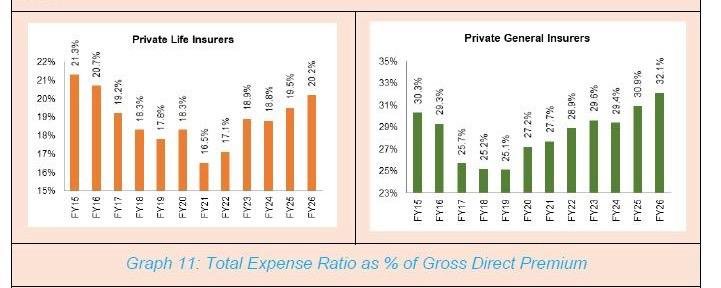
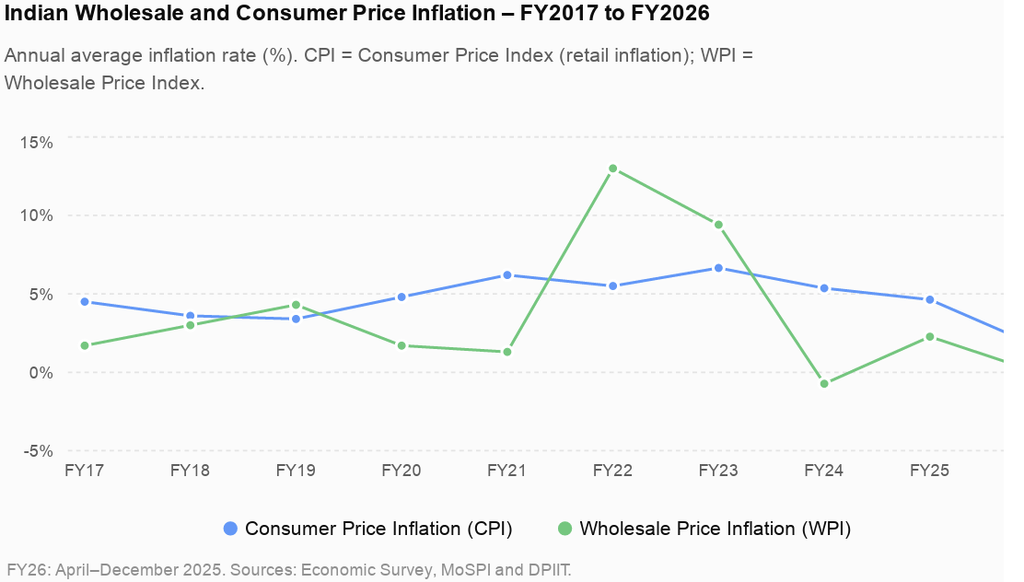
The EOM ratio is EOM divided by gross direct premium (GDP). The numerator is largely salaries and overheads, which rise with inflation. The denominator is only loosely tied to inflation. Motor premiums follow vehicle sales and regulated third-party rates. Health premiums track medical inflation. Fire premiums have been held back by discounts and falling rates. Crop premiums depend on the PMFBY design. Across all lines, the link to inflation is weak.
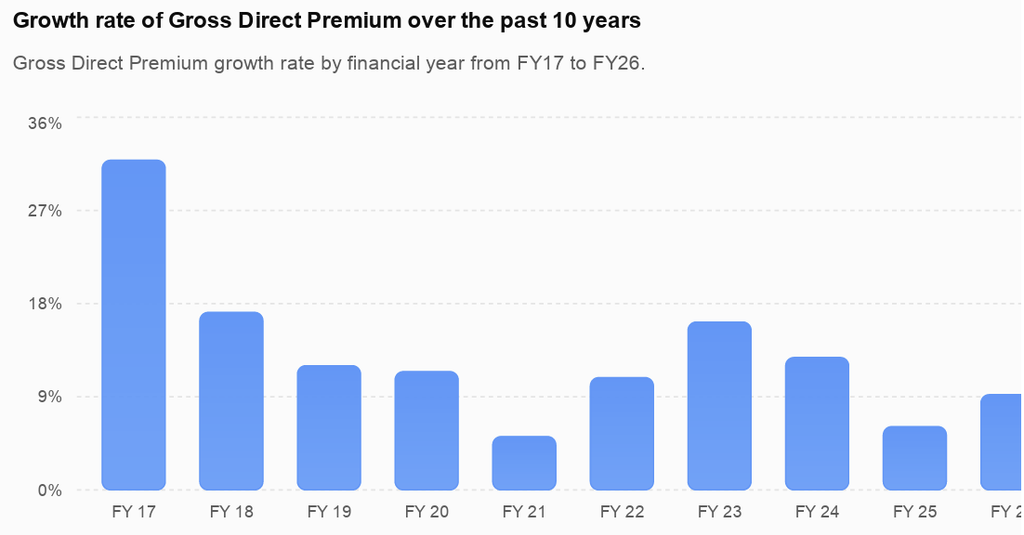
Premium growth has also been erratic: just 5% in FY21 because of Covid, 17% in 2018, and about 9% in FY26. The paper compares an EOM ratio of 25.2% in 2018 with 32.1% in 2026 without adjusting for any of this. Market structure matters too. Private non-life insurers grew from 25 in FY19 to 28 in FY26, with entrants such as Kshema, Galaxy and Narayana. More players mean more competition and more spending. If regulators want lower EOM ratios, they must accept fewer insurers. Competition has a cost, and the ratio should be adjusted for factors beyond an insurer’s control before any firm conclusion is drawn.
Linkage with loss experience
The report misses out on a crucial linkage which exists between cost of intermediation and loss experience. There is generally an inverse relationship between the two. If the product is profitable, which means low claims, more intermediation costs are paid. If the loss experience is high, intermediation is lower. Hence, for retail health, the commissions are higher than in group health for corporate customers.
The inverse relationship between claims and intermediation can create perverse incentives. The product may be purposely designed to result in a low claims experience so that high distribution costs can be paid. This benefits both parties, the insurer (low claims) and distributor (high commissions), at the expense of the customers.
This has been eloquently articulated by my friend, Atmaram Cheruvu, Co-founder and Director, Mad Over Insurance, in his LinkedIn post. In mortgage insurance, the claims ratio is usually in single digits or low double digits. Despite such low claims payouts, distribution commissions and distributor acquisition costs have gone up to 70% and beyond, bundled into long-term home loans.
In mature insurance markets, the relationship between customer value and product pricing is closely scrutinised by the regulator. In the UK, the Financial Conduct Authority (FCA) enforces a fair value standard. As per this, insurers and distributors must demonstrate that the price paid by the customer is reasonably proportional to the benefits and claims delivered. If an add-on or credit-linked product exhibits a very low loss ratio with high distributor payouts, the regulator deems it a poor value product and imposes direct regulatory sanctions or bans the distribution structure outright.
In the US healthcare and specialized property markets, regulators enforce a mathematical floor on customer return. For instance, 80% to 85% of premium dollars must go to paying claims. If an insurer’s combined administrative and distribution expense crowds out customer payouts, they are legally mandated to rebate the difference back to policyholders. The Risk-Based Capital norms in Singapore and the European Union, unviable acquisition expenses, and poor combined ratios directly inflate the insurer’s capital charge. Unsustainable expense structures are penalized through solvency requirements.
A calibrated response
The consultation paper has raised a genuine concern. But distribution is a web of linked parts and cannot be fixed in isolation. Retail and corporate insurance face different problems, and they need different answers, not a single rule for all.
Customers deserve affordable products, and distributors deserve fair pay for selling and servicing them. The two are not in conflict. Done carefully, this reform can be a win for both.
Hari Radhakrishnan is an insurance industry commentator with nearly four decades in the business.
Editorial Disclaimer:This is a contributed article. The views and opinions expressed are those of the author(s) and do not necessarily reflect the position of The Insurance Reporter, which does not endorse or take responsibility for the accuracy of claims made herein. Readers should conduct their own due diligence before making any financial or insurance-related decisions.