NSE IPO: From 32 Paise to Rs 1,800, What 5 PSU Insurers Stand to Gain
NSE IPO: Five state-owned general insurers stand to turn a combined ₹6.6 crore original investment into nearly ₹6,861 crore at an alleged ₹1,800 offer price.
NSE IPO: Five PSU insurers are unlocking up to 5,625x returns by selling 3.81 crore shares acquired for as low as 32 paise in the 1990s. LIC, holding 10.72%, is sitting out the offer for sale.
NSE IPO: Five state-owned general insurance companies are among the selling shareholders in what could become India’s largest-ever initial public offering: the listing of the National Stock Exchange of India Limited (NSE). Their combined holding on offer, 3,81,15,000 equity shares at prices ranging from 32 paise to ₹5.26 per share, according to the draft red herring prospectus (DRHP) NSE filed with the Securities and Exchange Board of India (SEBI).
SEBI issued its observation letter clearing the IPO on September 4, 2026, a day after the Supreme Court disposed of the regulator’s appeals in NSE’s long-running co-location and dark-fibre cases, which had stalled the listing for close to a decade. The exchange settled that matter for ₹1,491.21 crore. With that hurdle cleared, market reports point to the price band being announced around September 11, the offer opening around September 15, and a listing near September 21-25 — on the BSE, since exchange rules bar NSE from listing on its own platform.
NSE IPO: What’s Actually Being Sold, and When
The IPO comprises up to 14,89,05,525 equity shares of face value ₹1 each, or roughly 6% of NSE’s paid-up capital, entirely through an offer for sale (OFS). There is no fresh issue component, so NSE itself will not receive any proceeds — the money goes entirely to the 19 corporate and four individual selling shareholders named in the DRHP, in proportion to what each sells. The issue is estimated at around ₹30,000 crore based on reports, and at an alleged valuation of roughly ₹5 lakh crore (about $55 billion), it could surpass Hyundai Motor India’s ₹27,870 crore IPO of 2024 to become the largest public issue in Indian history.
Among the sellers are five public sector general insurers: General Insurance Corporation of India (GIC Re), The New India Assurance Company Ltd., National Insurance Company Limited, United India Insurance Company Limited and The Oriental Insurance Company Limited. Together they are offering 25.6% of the total shares up for sale in the IPO.
Also Read: Insurance Claim: Karnataka HC Backs Cancer Patient in ₹2.85 Lakh Dispute
NSE IPO: 32 Paise vs ₹1,800 – The Math
An alleged offer price of ₹1,800 per share has been circulating in market reports and grey-market activity this week, though it is not an officially confirmed figure — NSE has not yet announced its price band. Using that number purely as an illustrative reference point, and the weighted average acquisition costs in Annexure A of the DRHP, here is what each insurer’s offered shares would be worth:
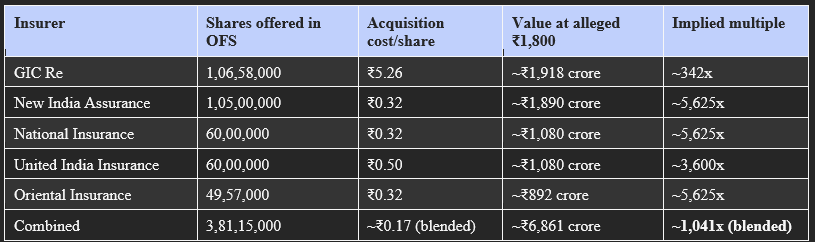
GIC Re’s acquisition cost, at ₹5.26 a share, is markedly higher than the other four insurers’ — all of whom acquired their shares for 32-50 paise. This is because GIC Re’s DRHP-disclosed weighted average reflects a different mix of allotment dates and prices across its holding history compared with the other insurers, whose disclosed costs cluster at the lowest end of NSE’s founding-era allotments.
Combined, the five insurers’ original outlay for the shares now on offer was under ₹6.6 crore. At the reported ₹1,800 figure, that same block of shares would be valued at close to ₹6,861 crore, a blended multiple of roughly 1,041 times the original acquisition cost. These are illustrative calculations only; actual proceeds will depend on the final Offer Price NSE sets in consultation with its book running lead managers, and on how much of each insurer’s authorised quota is ultimately allotted.
NSE IPO: The ₹47,750-Crore Stake That Isn’t for Sale
Life Insurance Corporation of India (LIC) is NSE’s single largest shareholder, holding 26,52,75,000 equity shares — 10.72% of the pre-offer equity share capital — as disclosed in the DRHP’s list of shareholders holding 1% or more of NSE’s capital.
At the same ₹1,800 figure, LIC’s retained stake would be worth approximately ₹47,750 crore. This is not sale proceeds, LIC is not participating in the OFS, but a reference point for the scale of its holding relative to the insurers that are selling. The DRHP shows LIC’s percentage holding has stayed unchanged at 10.72% across the one-year and two-year lookback periods disclosed in the document. LIC also has a nominee director, Shri Tablesh Pandey, on NSE’s governing board, according to the DRHP.
Insurance companies enjoy a higher ownership ceiling than most other domestic investors under NSE’s shareholding rules. As per the SECC Regulations read with the SECC Master Circular disclosed in the DRHP, no resident Indian entity may hold more than 5% of NSE’s paid-up equity share capital, unless it is a public financial institution, insurance company, depository, banking company, or stock exchange — categories permitted to hold up to 15%. LIC’s 10.72% holding and the other insurers’ smaller stakes fall within this higher ceiling; none of the insurers is at or near the 15% cap.
NSE IPO: How the Paise-Level Pricing Happened
The DRHP’s capital structure section traces the low acquisition costs to NSE’s founding share allotments in the early 1990s. GIC Re and LIC were among the seven initial subscribers to NSE’s Memorandum of Association in November 1992, each allotted a single share at ₹10 face value. In a preferential allotment in August 1993, LIC received 14,00,000 shares, while GIC Re, National Insurance, New India Assurance, Oriental Insurance and United India Insurance were each allotted 1,60,000 shares — alongside other founding institutions such as State Bank of India, Industrial Development Bank of India and Industrial Finance Corporation of India, each of which also received 14,00,000 shares in the same round.
A further preferential allotment in April 1994 added 23,99,999 shares to GIC Re and 2,40,000 shares each to National Insurance, New India Assurance, Oriental Insurance and United India Insurance, per the equity share capital history table in the DRHP.
NSE’s face value was subsequently split from ₹10 to ₹1 per equity share with effect from December 14, 2016 — a 1:10 split that is reflected in the per-share acquisition costs disclosed in the current DRHP.
“As public sector insurance companies were early investors in NSE at a preliminary stage, they are now reaping bountiful returns for their long-term patience after a long wait. This shows how early institutional investors—including State Bank of India and other key institutions alongside the insurance firms—can generate exceptional returns from ground-floor investments,” said Kranthi Bathini, Equity Strategist at WealthMills Securities.
NSE IPO: What Each Insurer Keeps After the Sale
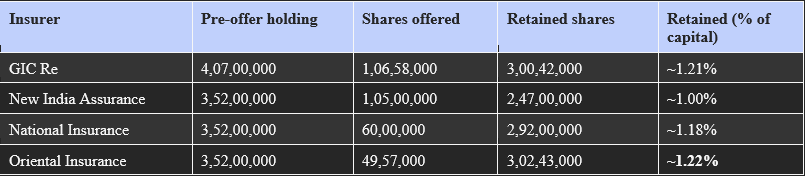
The DRHP’s list of shareholders holding 1% or more of NSE’s pre-offer capital shows GIC Re held 4,07,00,000 shares (1.64%) as of the date of the DRHP, while New India Assurance, National Insurance and Oriental Insurance each held 3,52,00,000 shares (1.42%). United India Insurance’s total holding is not separately disclosed in that table, as its stake falls below the 1% threshold used for that disclosure.
Based on the offer quantities in DRHP, each of the four disclosed insurers would retain a majority of its existing stake after the OFS:
NSE IPO: What the Unlisted Market Is Already Pricing In
As per the DRHP records, several secondary transfers of NSE shares among other selling shareholders between January 2025 and May 2026, at prices ranging from approximately ₹1,485 to ₹2,260 per equity share. Separately, market reports this week have cited unlisted NSE shares changing hands in the ₹1,940-₹2,035 range, with grey market premiums quoted around ₹273-₹285 over the yet-to-be-announced issue price, though still reportedly 13-14% below their June 2025 peak of around ₹2,360. None of these figures constitute the official Floor Price, Cap Price or Offer Price, which NSE has said will be determined in consultation with its book running lead managers and disclosed in coming days.
NSE already has a sizeable shareholder base even ahead of listing: the DRHP states the Company had 2,12,562 Shareholders, based on the beneficiary position statement available as on June 15, 2026.
NSE IPO: The Exchange Behind the Numbers
NSE reported a net profit of ₹3,120 crore for the quarter ended June 2026 (Q1FY27), up from ₹2,923 crore in the same quarter a year earlier. Revenue from operations for the quarter rose to ₹4,560 crore from ₹4,032 crore year-on-year, though it declined 8% sequentially. NSE Clearing Ltd., the exchange’s clearing corporation, maintained a Core Settlement Guarantee Fund of ₹13,079.15 crore as of March 31, 2026, per the DRHP.
For comparison, BSE — India’s other major exchange and NSE’s listing venue for this IPO — has seen its shares rise roughly 28-fold since its own 2017 listing, according to market reports.
NSE IPO: Offer Structure and What Comes Next
The NSE IPO is a 100% book-built offer for sale, with Kotak Mahindra Capital Company Limited, JM Financial Limited and other book running lead managers named as arrangers in the DRHP. NSE has stated in the DRHP that it does not have an identifiable promoter.
Besides the five public sector general insurers, the DRHP’s list of selling shareholders includes State Bank of India, MS Strategic (Mauritius) Limited, Canada Pension Plan Investment Board, Aranda Investments (Mauritius) Pte Ltd, Bank of Baroda, Stock Holding Corporation of India Limited, Crown Capital Limited, 2726247 Ontario Inc., Mahagony Limited, Indian Bank, private insurer ICICI Lombard General Insurance Company Limited, TA Asia Pacific Acquisitions Limited, Soach Global Strategic Holdings Ltd. and Be-In Eight s.r.l., along with four individual selling shareholders.
ICICI Lombard is offering up to 23,50,000 shares at a weighted average acquisition cost of ₹169.49 per share — markedly higher than the public sector insurers’ costs, reflecting a later entry into NSE’s shareholder base.
An updated Red Herring Prospectus is expected to be filed following SEBI’s clearance, after which the price band, subscription dates and final Offer Price will be officially announced.