How India Buys Insurance? Google Explains In Latest Report
Insurance India is in focus as Google’s latest report explores changing consumer behaviour, digital search patterns and the factors influencing insurance buying decisions.
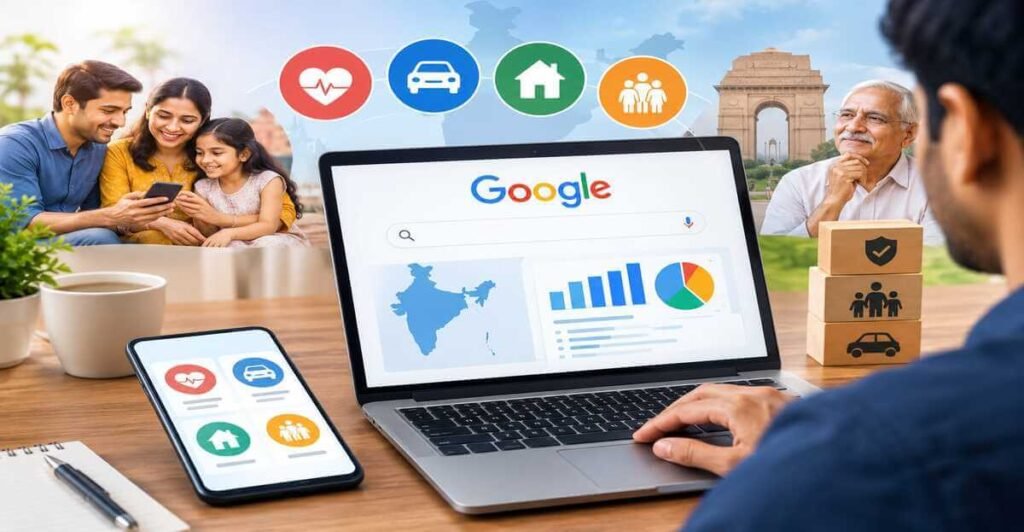
Insurance India is evolving as Google’s latest report sheds light on how consumers discover, evaluate and purchase insurance products.
NEW DELHI – Insurance India: Nearly 80 percent of India’s insurance buying journey now takes place online, and digital research influences more than 40 percent of health and life insurance sales, according to a new report by Google with McKinsey & Company as its knowledge partner. The report, titled “Decoding the DICA Consumer,” says digital channels influence more than 20 million insurance policies a year, against roughly 5 million bought directly online. It describes a growing group of buyers it calls DICA, short for Digitally Influenced, Closed with Assistance, who research and shortlist insurers online and then turn to a human advisor, branch or call centre to complete the purchase.
The report, published in September 2026, is based on a survey of 1,039 insurance consumers, a masked lead-to-conversion analysis covering life and health insurers, interviews with advisors and distribution platforms, Google first-party data and McKinsey’s industry experience. It estimates that about 50 million health and life policies are sold in India each year, and that digital influence touches more than 40 percent of them, around four times the volume sold through direct digital channels.
Insurance India: Shortlisting Happens Online, Validation Happens Offline
The survey found that 78 percent of consumers narrow their choice to two or three insurers online before speaking to an advisor, and that more than half stick to that original shortlist even after the conversation. The report concludes that advisors increasingly need to answer specific questions on coverage, exclusions and service support instead of introducing buyers to insurance brands from scratch.
Even so, fewer than 30 percent of buyers said they are comfortable with a fully or mostly digital process for selecting an insurer. The report says consumers still look to advisors to explain policy exclusions, confirm that a long-term financial commitment is safe and support the family during hospital claims. In the survey, 44 percent cited the 10-to-30-year nature of an insurance commitment, and 33 percent said their main worry about self-service buying is who will help the family when a claim arises. Another 28 percent said they did not clearly understand features or exclusions while researching online.
Also Read: Policyholder Murdered, LIC Claim Rejected: Punjab Commission Rules on Insurance Dispute
Siddharth Shekar, Director at Google India, said the DICA consumer shows that buying insurance in India is a complex journey in which no single touchpoint or advisor works in isolation. He said that when the digital ecosystem influences more than 40 percent of purchases, the online shortlist becomes a decisive factor, and that closing the gap between a consumer’s digital evaluation and the offline advisory experience is now the biggest lever for insurance penetration and value creation.
The report also describes who these buyers are. Consumers in the leading non-metro cities show roughly twice the digital nurture rate of the national average of about 10 to 12 percent, meaning a larger share of their purchases begin with a lead left online. Salaried professionals aged 25 to 35 are the largest group driving digital research. The report says online-influenced offline purchases generate premiums about 40 percent higher than traditional sales, and that digitally influenced offline buyers are 18 to 20 percent more likely to attach riders.
Insurance India: AI Search, Video and Apps Shape How Indians Research Cover
The report says search behaviour is becoming more detailed. Longer queries account for 18 percent of insurance searches on Google, reflecting questions on specific coverage needs and complex policy terms, such as comparing a critical illness rider with a standalone plan or finding cover for parents abroad. It also found that 41 percent of consumers used AI Overviews to compare options and settle their coverage criteria before approaching an insurer.
Video plays a similar role. About 60 percent of online insurance researchers use video at some point in their research, and insurance content on YouTube in India drew more than 2.5 billion views over the past year, with growth above 80 percent year on year, making it the fastest-growing finance category on the platform.
More than 15 percent of those views came from connected TV, which the report says suggests insurance research can involve discussion among household members. Insurance app engagement is also rising. Monthly active users have grown sixfold over four years, and the number of insurance apps with more than one million annual downloads has risen from three to twelve, with users turning to apps for tasks such as tracking policies and managing claims.
Insurance India: Where the Handoff Breaks and What the Report Recommends
The report says the move from online research to offline sales is often not seamless. More than 40 percent of buyers said they were frustrated at having to repeat their requirements after being contacted as new leads, and more than a third cited generic sales scripts that did not reflect their needs. It also found that 30 percent want faster answers from call centres, 22 percent see a mismatch between what the advisor said and what they found online, and 34 percent want more personalised recommendations from call centres. It groups these problems under the acronym FAIL: faded intent, anonymity, information mismatch and lack of personalisation.
To address them, the report sets out three imperatives for insurers. The first is to reorganise teams so that advisors, agency leaders and digital teams share ownership of the customer journey, including shared KPIs and a proper relationship handover from call centres to advisors. The second is to change how value is measured, through multi-channel revenue attribution, a common budget pool for DICA consumers and a return-on-ad-spend calculation that counts digitally influenced conversions.
The third is to build an intent-to-conversion capability stack, combining a unified customer data layer, AI-driven lead scoring and advisor matching, and an engagement layer that lets customers resume where they left off across channels. The report also includes a seven-question self-assessment that places insurers in one of four categories, from “I2C Bystander” to “I2C Pioneer.”
Industry leaders quoted in the report point to the same handoff challenge. Parthanil Ghosh, Managing Director and CEO of HDFC ERGO General Insurance, said the rise of the DICA consumer will improve awareness and accessibility of insurance, and that enabling the journey across advisors, websites and apps can build consumer confidence and raise penetration.
Sumit Madan, Managing Director and CEO of Axis Max Life Insurance, said the future of distribution will depend less on where customers buy than on how well digital discovery is connected with trusted advice, and that the next growth opportunity lies in turning informed intent into protection.
The report also cites FY25 direct-to-consumer premium of more than INR 500 crore at HDFC ERGO General Insurance, more than INR 440 crore at Star Health, and more than INR 200 crore each at Axis Max Life and ICICI Prudential Life, and notes that players in China, Japan and Southeast Asia that fixed lead handoff issues saw two to three times higher conversion within the same channel.