Indu Bhushan: Modi’s Ayushman Bharat Architect Gets Insurance’s Hottest Brief
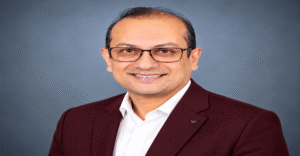
Indu Bhushan: The ex-IAS officer the PMO tapped to build Ayushman Bharat and the national digital health mission now chairs the panel that must help IRDAI cool the fight over agent and broker commissions.
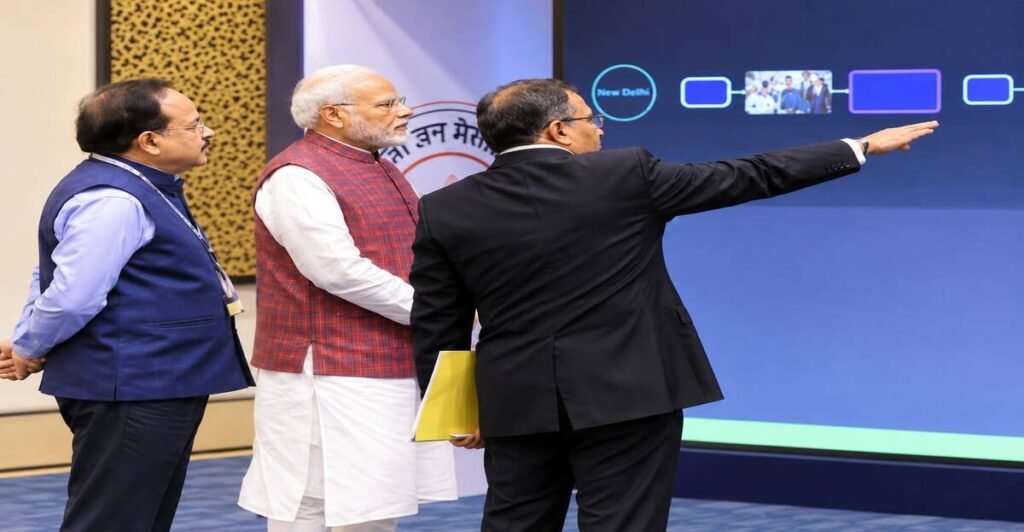
Image taken from Indu Bhushan's Twitter account. Enhanced using AI.
NEW DELHI: India’s insurance regulator has picked a fight with the people who sell its product, and it now needs a referee. On Monday, IRDAI named Indu Bhushan, the bureaucrat Prime Minister Narendra Modi’s office has turned to for two of its biggest health projects, to chair a six-member advisory panel on its distribution overhaul. The report is due on 31 December.
The fight is over money. By IRDAI’s own figures, distributor pay in a sample of life insurers’ corporate-agency business rose 125% in two years while premiums grew 28%, and it wants to cap commissions by product and channel. The reply: about 218,000 consultation answers from more than 13,000 respondents, a protest by agents planned for Delhi in early December, and brokers lobbying the Finance Minister.
Bhushan did not rise through the insurance trade, but he knows large-scale cover. He is the PMO’s go-to name on health: pulled out of the Asian Development Bank in 2018 to build Ayushman Bharat, a government-funded scheme meant to cover more than 500 million people, then asked to start the national digital health mission. Now the same trust is being put to work on a harder sell: who gets paid how much for selling insurance.
Enjoying this story?
Subscribe to our newsletter for fresh stories and expert insights delivered straight to your inbox.
Indu Bhushan: The reform that lit the fuse
For years, India’s insurance regulator has chased two goals at once: cheaper cover and wider cover. In 2023 it replaced per-product commission ceilings with a single cap on insurers’ overall expenses of management, a change the industry welcomed as freedom from micromanagement. By September 2026, IRDAI’s verdict was that the experiment had not delivered. Figures from its own exercise show that in a sample of life insurers’ corporate-agency business, new premium grew 28% between FY23 and FY25 while distributor pay on that business grew 125%.
Total expenses at private life insurers climbed to 20.2% of gross premium in FY26, up from 16.5% in FY21.
The consultation paper, Recalibrating Economics of Insurance Distribution, released on 23 September, proposed a reset. Expense-of-management limits would step down to 12.5% of premium for life insurers and 20% for general insurers over five years.
Also Read: Insurance Distribution Reforms: IRDAI Sets Up Expert Committee to Review Responses
Commission ceilings would vary by product and by channel. Eight licence types would collapse into a single distribution-entity licence. Corporate agents and brokers would have to name the salesperson on every policy from 1 January 2027. In the draft, the first-year cap on a long-term life policy is 20% for entities and 25% for individual agents; in health it is 15% and 20%; on third-party motor cover for a new vehicle it is nil for entities and 2.5% for agents.
What followed was less a consultation than a siege, and the expert panel is the regulator’s answer to it.
Indu Bhushan: The call from the PMO
Bhushan has told the story more than once. In his account, the Prime Minister’s Office reached out, wanting him to design and run Ayushman Bharat, the flagship health scheme announced in Budget 2018.
Within three days he had resigned from the Asian Development Bank and was back in the Government of India. In a Johns Hopkins alumni profile, he recalls the Prime Minister asking him to leave his job, skeptics calling the task insurmountable, and a hard deadline: “The Prime Minister gave me six months to establish and run the program.” By his telling, the scheme was delivering 20,000 treatments a day within that window, and about 40,000 a day by 2023.
The proximity to power was real. He told Business Standard in 2018 that it began with a call less than a year earlier, followed by a meeting at the PMO, and that he met Modi within a month of taking charge. Every day at 5 pm, a report reached the Prime Minister with the numbers: cases registered, e-cards issued, amounts claimed. Asked for the high point of the job, he answered without a pause: “Working directly with the PM.”
But “favourite” is an incomplete word for the arc. When his three-year term ended on 31 January 2021, many expected an extension. The Ken reported that he was told three days before it lapsed that he was being replaced; former Trai chairman RS Sharma took over. Trusted to build, not guaranteed to stay.
Indu Bhushan: The engineer who wanted to know how policy gets made
He trained as an electrical engineer at IIT (BHU), added a postgraduate diploma in control systems and instrumentation at IIT Delhi, and joined the IAS in 1983 in the Rajasthan cadre.
Public health found him by accident. Posted in tribal Udaipur, he was chosen to lead a UNICEF-backed drive against Guinea worm, a disease he says he had never heard of. Cases clustered around step wells, so the intervention was blunt: stay out of the wells and drink safe water. Cases fell 90% in a year, by his account. The project left behind a health-communication bureau in the state’s health department and introduced him to people at Johns Hopkins.
What was meant to be a nine-month course at Hopkins became a doctorate in health economics. He arrived with savings that covered his air ticket and roughly three months of living costs, then sold the car his father had given him to pay for a term, without telling his father, because in those days nobody sold the family car. A fellowship from the university’s communication programmes later covered his tuition.
He left the IAS in the early 1990s (published accounts give different years) and became a senior economist at the World Bank from 1994 to 1996. He joined the ADB in 1997 and stayed 21 years, rising to director general of the Strategy and Policy Department and then of the East Asia Department. In that last role he oversaw ADB’s engagement with China, Hong Kong, Korea, Mongolia and Taiwan, and a portfolio of 113 projects worth $12.6 billion.
Those years shaped the Indian scheme. Asked by Modi to limit the scope for fraud, Bhushan looked to Thailand; for IT plumbing, to China, where his last ADB posting had been.
The CV has odd corners. He is a CFA charterholder. He received a Population Award from Vietnam’s government, the E-Governance Gold Medal from the Government of India, Johns Hopkins’ Global Achievement Award in 2020 and IIT-BHU’s Distinguished Alumnus Award.
Off duty, his favourite cuisine is Korean. At his 2018 Business Standard lunch he reached for chopsticks without a thought, and said ADB’s streamlined days had left him time for bridge and films, a luxury the 12-hour days of Ayushman Bharat ended. His wife, Anjana, is a public-health professional, and both daughters are physicians trained at Harvard Medical School; one of them, Devika, served as acting California Surgeon General in 2022. When Stanford classmates learned that his elder daughter’s father ran Ayushman Bharat, she became an instant campus celebrity.
One footnote for the fact-checkers: a 2018 DNA India piece had to separate him from a 1989-batch Rajasthan-cadre IPS officer of the same name who was reported to have been removed from a central posting.
Indu Bhushan: Building a health scheme the size of a country
PM-JAY promised hospital cover to more than 500 million people. Bhushan had to knit it together with existing state schemes, a job he described as running dozens of different schemes at once, and he said he most wanted traction in “greenfield” states such as Bihar and Uttar Pradesh. He named rural hospital beds as the hardest problem: adding them without inflating the cost per bed. He also acknowledged that the government wanted private-sector participation.
He brought 32 states on board and steered the agency through Covid, calling 2020 a “zero year” for the scheme. At the Prime Minister’s request he then added the National Digital Health Mission, later renamed the Ayushman Bharat Digital Mission, pitching its privacy architecture by comparison with UPI.
Indu Bhushan: Life after the PMO
Since leaving the NHA he has advised non-profits and serves as an ambassador for Johns Hopkins’ Gupta-Klinsky India Institute. He is also a boardroom regular. His ITC Hotels profile lists independent directorships at ITC Hotels (since December 2024), United Spirits (since March 2024, where he chairs the CSR and ESG committee), Colgate-Palmolive (India), Balrampur Chini Mills, Godrej Properties, HDFC Securities IFSC, Apollo Healthco and Cult.fit, plus non-executive seats at the Vidhi Centre for Legal Policy, Swasth Digital Health Foundation and the NATHEALTH Foundation. No insurer appears on that published list.
Indu Bhushan: The row he inherits
The reaction to the September paper was immediate and broad. LIC alone has more than 15 lakh active agents who live on commission, and their unions say the draft would cut income that had already been trimmed once, when an October 2024 restructuring took first-year total commission from 35% to 28% on applicable business.
The LIC Agents’ Organisation of India objects to clawbacks when policies lapse for reasons beyond an agent’s control, and to a higher minimum qualification, Class 12 in place of Class 10, which it says could push out 30 to 40% of the agent force. Agent bodies petitioned the PMO, the Finance Ministry and IRDAI, lobbied MPs and are planning a protest in Delhi in the first week of December. Employee unions argued that the 25% cap on total commission introduced in 2022 never delivered the promised volumes.
Things to Check Before Buying Car Insurance in India: A Complete Buyer’s Guide (2026)
Brokers fought on a different front. The industry has more than 750 members, with the top ten holding an estimated 90 to 95% of the business. Multinational brokers took their case to the PMO and to Finance Minister Nirmala Sitharaman.
The PMO reportedly passed the matter to the Department of Financial Services, and the minister told them to take it up with IRDAI chairman Ajay Seth, while some large firms began planning for job cuts. Lawyers at Cyril Amarchand Mangaldas warned that the framework could effectively erase brokers as a distinct class of intermediary, leaving no one in the market specifically bound by a fiduciary duty to the customer. IRDAI’s first chairman, N Rangachary, urged a gradual transition tied to policyholder welfare.
Seth has defended the proposals as an orderly route to lower costs for policyholders, but his tone shifted. “Reforms of this nature must be built on consensus,” he said at an event in Mumbai. By the extended 31 October deadline, IRDAI had received about 218,000 responses to 32 questions from more than 13,000 respondents.
Indu Bhushan: What the panel can and cannot do
On Monday, 23 November, IRDAI constituted a six-member expert committee with Bhushan in the chair. The members are Suresh Goyal, director general of the National Council of Applied Economic Research; A V Girija Kumar, former CMD of Oriental Insurance; Praveen Vashishta, former CEO and chairman of Howden Insurance Brokers India; and Mahesh Kumar Sharma, former MD and CEO of SBI Life. IRDAI executive director Ayyaj Tamboli is the convener.
The brief is notably about people rather than percentages. The panel is to assess how the proposals could affect employment and the earnings of agents and other distribution personnel and recommend ways to soften the blow. It is to design transition options, including phased implementation and glide paths, for smaller insurers and distributors. It will review how commission limits should be set on small-premium policies, look at extending cover to smaller towns, rural areas and underserved segments, and judge whether large commercial risks should move gradually toward transparent, fee-based services. It may seek data from IRDAI and submit interim observations before its report, which is due by 31 December 2026.
It is not a veto. The panel advises and the regulator decides; the new norms had been expected to start in early 2027.
Why Bhushan?IRDAI has not spelled out its reasoning, but the fit is not hard to read: an outsider to the insurance trade, with no insurer on his published board list, who ran India’s largest publicly funded coverage programme, dealt with fraud and incentives in a claims system, and carries credibility in the PMO, the very door agents and brokers have been knocking on.
In 2018 he was given six months to make a health scheme work. This time the clock is about five weeks, and the agents’ protest in Delhi will arrive before his report does.
Follow us on Twitter for latest updates

Priyam Thakur is a Correspondent at The Insurance Reporter, where he covers insurance regulation and policy in India and globally. Trained as an engineer, he has a knack for dissecting dense numbers...