Cyclospora Alert: The ‘Explosive Diarrhea’ Parasite Making Headlines Worldwide
A surge of cyclosporiasis, the diarrheal illness caused by the parasite Cyclospora cayetanensis, has pushed case counts past 4,000 across 32 U.S. states since May, with lettuce and salad greens now under investigation as a possible source.
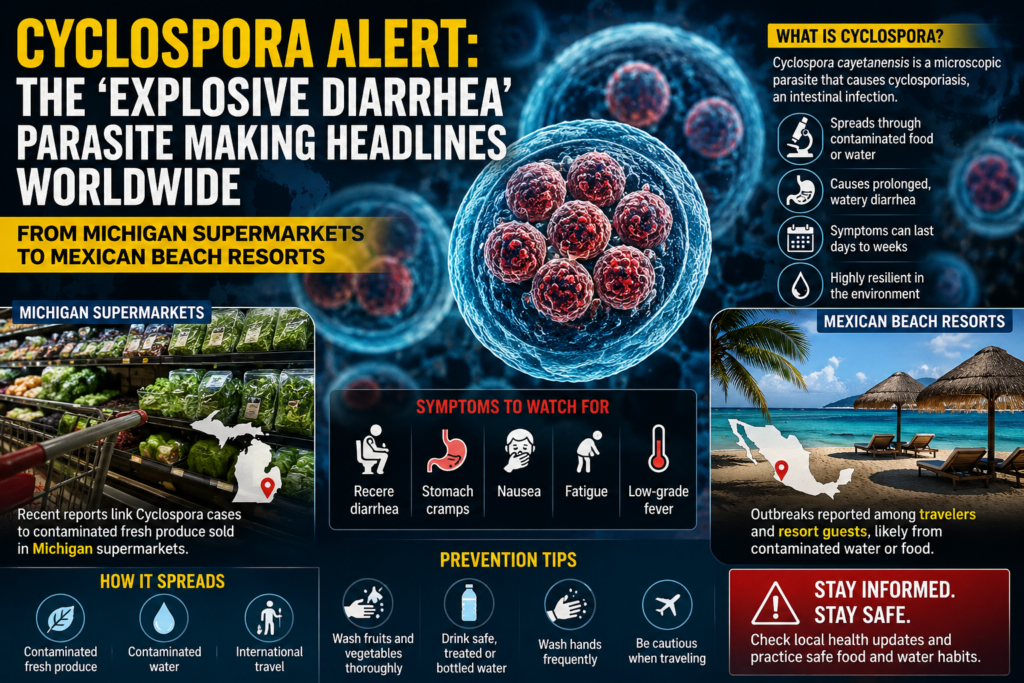
Cyclospora, a microscopic intestinal parasite spread through contaminated food or water, has triggered fresh public health concerns following reported cases linked to supermarket produce in the United States and popular tourist destinations in Mexico. Health experts advise proper food hygiene and safe drinking water to reduce the risk of infection.
Cyclospora Alert: Cyclospora cayetanensis has become one of the most talked-about pathogens of the summer, and for good reason. What began as a cluster of unusual stomach illness reports in Michigan has grown into a sprawling investigation spanning at least 32 U.S. states, with more than 4,000 suspected or confirmed cases reported by state health departments, according to NBC News tallies, even though the CDC’s own confirmed count sits lower at 843 cases as of July 9. That gap exists because the CDC only reports cases that states formally forward to it, while the true scale of infection is almost certainly higher still, since many people recover from cyclosporiasis without ever seeking medical care or getting tested.
The outbreak has made front pages well beyond America’s borders, and that international interest is not misplaced. Cyclospora is not a parasite confined to one country’s grocery aisles. It is endemic in tropical and subtropical regions including Central and South America and South and Southeast Asia, which means it has quietly shaped food safety and travel health policy on nearly every continent for decades. What is unfolding in the United States right now is simply the most visible chapter of a much older, genuinely global story.
Cyclospora Alert:Inside the US Outbreak Driving the Headlines
Michigan sits at the center of the current surge, with roughly 2,640 cases reported since late June, a figure state health officials say is about fifty times higher than the 40 to 50 cases Michigan typically sees in an entire year. At least 44 people there have needed hospital care. Ohio has logged 361 cases with 46 hospitalizations, and active clusters are also being tracked in New York, Illinois, North Carolina and California. No deaths have been reported.
Investigators, led in part by Michigan’s chief medical executive Dr. Natasha Bagdasarian, say lettuce and salad greens have repeatedly surfaced as a common thread in patient interviews, and that lead has since prompted scrutiny of Taco Bell’s supply chain as one possible link, alongside leafy greens more broadly. No specific grower, supplier or produce type has been confirmed as the source, and officials caution that other foods cannot yet be ruled out. The CDC, for its part, has stopped short of declaring this a single linked outbreak, saying instead it is tracking several possible clusters at once while the source investigation continues.
Cyclospora Alert:Why the Rest of the World Is Watching Closely
Health authorities outside the U.S. have been quick to respond to public concern, and their answers reveal how differently this parasite behaves from one region to the next. Canada’s Public Health Agency has stated plainly that it is not currently investigating any cyclospora outbreak on its own soil, and that the parasite is not commonly found in Canadian food or drinking water, according to comments to CBC News from food safety researcher Lawrence Goodridge. Cross-border produce shipments have still put Canadian officials on alert, since the country imports fresh vegetables from many of the same suppliers as the U.S.
In the United Kingdom, the picture is different again. The UK’s National Travel Health Network and Centre notes that Cyclospora infections there are almost always travel-related, tied overwhelmingly to trips to Mexico, rather than to food bought at home.
Peer-reviewed research tracking outbreaks across Europe has documented cyclosporiasis cases in Belgium, France, Germany, Greece, Ireland, Italy, the Netherlands, Spain, Sweden and the UK over the years, with the UK alone reporting notable spikes of 79 cases in 2015 and 440 cases in 2016, almost entirely among returning travelers rather than from local food contamination. That pattern is exactly why global health bodies, including in a recent Lancet Global Health analysis of foodborne disease burden, continue to classify Cyclospora as a pathogen of worldwide concern even in years when headlines are dominated by a single country.
Cyclospora Alert:A Parasite Built for a Globalized Food System
The reason cyclospora keeps resurfacing internationally comes down to how it spreads and how modern food systems work. The parasite is transmitted when people eat or drink food or water contaminated with human feces, most often through fresh produce eaten raw, such as lettuce, herbs like cilantro and basil, berries, and snow peas. Unlike bacteria such as salmonella or E. coli, Cyclospora cannot be grown in a laboratory and its genetic fingerprint does not stay stable enough for the kind of precise DNA matching scientists normally use to trace an outbreak back to a single farm or shipment. That makes it a notoriously difficult pathogen to pin down no matter which country is investigating it.
Fresh produce also increasingly crosses borders before it reaches a plate, which means a contamination event at a single farm or packing facility can, in theory, ripple into multiple countries’ food supplies at once. Past outbreaks have been traced to Guatemalan raspberries, and produce imported from various endemic regions has repeatedly been implicated in both U.S. and Canadian cases. That international supply chain is precisely why food safety officials worldwide are treating America’s current outbreak as a warning worth heeding, rather than a strictly domestic problem.
Cyclospora Alert:Symptoms, Treatment and How to Protect Yourself Anywhere
Also Read: What Vinod Khosla’s $9.6 Bn Seahawks Purchase Reveals About Sports Franchise Insurance
Cyclosporiasis typically causes watery diarrhea, often described as explosive, along with loss of appetite, bloating, nausea, cramping, fatigue and occasionally low-grade fever. Symptoms usually begin about a week after exposure, though they can take up to two weeks to appear, and the illness can drag on for weeks or even relapse if left untreated. It is not fatal and does not spread through person-to-person contact, but it is genuinely miserable, and doctors typically treat it with a course of antibiotics alongside rest and fluids to manage dehydration.
The prevention advice is largely the same whether someone lives in Detroit, London or Delhi. Buying whole heads of lettuce rather than pre-washed bagged salad mixes, discarding the outer leaves and thoroughly rinsing the rest under running water, separating and washing herbs like cilantro and basil leaf by leaf, and cooking leafy greens when possible all reduce risk, since heating food to 158 degrees Fahrenheit, or 70 degrees Celsius, reliably kills the parasite. Travelers heading to regions where Cyclospora is endemic are advised to drink only bottled or boiled water, avoid unpeeled fruit and salads of uncertain origin, and pack oral rehydration sachets as a precaution.
Cyclospora Alert:Why This Story Isn’t Going Away Soon
Complicating the U.S. investigation is a quieter, less-discussed factor: cuts to the very surveillance systems designed to catch outbreaks like this one early. In 2025, the CDC scaled back FoodNet, a partnership with the USDA, FDA and ten state health departments that had proactively tracked eight foodborne pathogens including Cyclospora by contacting labs directly. That network now monitors only salmonella and a dangerous E. coli strain, leaving Cyclospora more dependent on slower, sometimes voluntary state reporting.
With the traditional cyclosporiasis season running through the end of August, and with global food supply chains tying regional contamination events to dinner tables far beyond the country where they start, health officials expect this outbreak to keep generating headlines well beyond America’s grocery aisles before a definitive source, or sources, is confirmed.